What should you look for when buying?
First, check how much will fit alongside your other supplies at the same time. Then compare the specific model’s freezing capacity, annual energy consumption and installation requirements.
| Consideration |
What to check when buying |
Who should consider this? |
| Space and freezing capacity |
Estimate the portions and other supplies you need to store at the same time; compare usable capacity in litres and freezing capacity in kg/24 h separately. |
If I freeze larger batches, I need enough room for the new portions as well as the supplies I already have. Around 33% of consumers prioritise space for batches. |
| Annual energy consumption |
Compare the kWh/year on the energy label with the usable capacity and how you plan to use the appliance; the energy class alone doesn’t tell you its annual consumption. |
If the chest freezer runs between meal-prep days too, I don’t want to keep cooling space that I hardly use. Around 25% of consumers focus primarily on running costs. |
| Location and surroundings |
Check the external and transport dimensions, as well as clearance for the open lid. If you plan to keep it in an unheated room, check the permitted ambient temperature for the specific model. |
If space is limited or the chest freezer is going in a cold cellar, the appliance needs to be suitable for installation and operation there. Around 25% of consumers say this is their main installation consideration. |
| Access to portions |
Check which baskets or organisation features are actually included; label portions with their contents and date. |
If I regularly take out individual lunch portions, I want to find them quickly among other supplies and use the older ones first. Around 17% of consumers prioritise easy access to individual portions. |
Chest freezers at Joybuy
The models below are chest freezers that offer extra freezer space, for example for prepared portions of broccoli alongside other supplies.
 No image available
Exquisit 142-litre chest freezer, 4-star
This model is described as a chest freezer, offering extra space for portions alongside other supplies.
The product title lists a capacity of 142 l, a 4-star freezer, electronic temperature control with an LED display and a fast-freeze function.
Manual defrosting is required; the product information recommends it when a significant amount of ice has built up.
Joybuy
 No image available
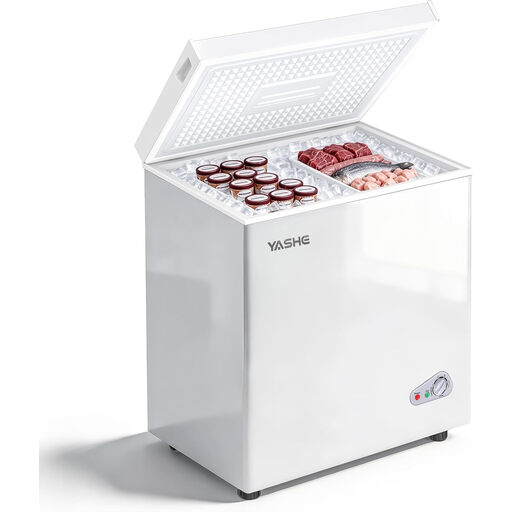
YASHE BC-150Q-EU, 150 l
If you want to store lunch portions separately from other supplies, the removable baskets are worth considering as an organisation feature.
The product title lists a capacity of 150 l, two removable baskets and six temperature settings.
Joybuy
 No image available
AUCMA convertible chest freezer, 141 l
This model is worth considering if you need extra freezer space for prepared portions.
The product title lists a capacity of 141 l, energy efficiency class E, a removable basket and a defrost drain. The appliance can switch between fridge and freezer modes.
Joybuy
 No image available
AUCMA convertible chest freezer, 197 l
If you need room for larger supplies as well as lunch portions, this model offers 197 l according to the product information.
The product title lists energy efficiency class E, digital temperature control with five settings, a removable basket and a defrost drain. The appliance can switch between fridge and freezer modes.
Joybuy
 No image available
Gorenje FH15E6W5, 141 l
This model is described as a freestanding chest freezer, suitable for freezing new batches of broccoli alongside other supplies.
The product title lists a capacity of 141 l, FastFreeze, flexible baskets and FreezeProtect for ambient temperatures down to −15 °C.
The product information recommends defrosting when ice has built up.
Joybuy
Frequently asked questions
How should I prepare portions of broccoli for the chest freezer?
Wash and trim the broccoli, blanch it briefly, then cool it in iced water. Divide it into portions and pack it into suitable freezer bags or containers, removing as much air as possible. Label each one with its contents and date.
What temperature should I set for frozen storage?
The Verbraucherzentrale recommends −18 °C for upright and chest freezers. This is a storage recommendation, not a blanket legal minimum requirement for every appliance on sale.
Can I take frozen broccoli with me in the morning without keeping it cool until lunch?
Freezing alone doesn’t make food safe to store without refrigeration. The Federal Institute for Risk Assessment stresses that temperatures during transport and storage matter; inadequate cooling can allow harmful germs to multiply. Also consider the cooling needs of any other perishable ingredients in your lunchbox.
What energy label should a freezer have in Germany?
The current EU energy label for freezers uses classes A to G and shows, among other things, the standardised annual energy consumption in kWh. Earlier ratings such as A++ are not equivalent to today’s classes. Labelling requirements apply to the sale of appliances; they don’t set a minimum energy efficiency class for buyers.
What should I do with an old chest freezer?
Electrical appliances must not be put in household waste; local collection points generally accept them free of charge. Under certain legal conditions, retailers must also take back an old appliance free of charge when you buy a new one that is essentially equivalent. Before placing your order, check that the delivery and the arrangements for taking back your old appliance work together.


