What should you look for when buying?
The consumer advice centre recommends choosing a capacity that suits your needs and comparing the annual energy consumption of specific appliances. The Federal Centre for Nutrition advises freezing vegetables in suitable portions and labelling them.
Existing freezer compartment
A good fit if: Your prepared portions fit inside and you only occasionally add larger quantities.
Consider: You won’t need another appliance, but you may run short of space if you freeze larger or more frequent batches.
Compact chest freezer
A good fit if: You regularly need extra freezer space but have limited room.
Consider: Its smaller capacity limits how much you can store, and a second appliance will still use electricity.
Medium or large chest freezer
A good fit if: You want to store larger batches of broccoli alongside other frozen food.
Consider: More capacity takes up more floor space, and an appliance that’s too large may use more electricity than you need.
Upright freezer with drawers
A good fit if: You want to find lots of small, separate portions quickly.
Consider: Compare specific appliances by their kWh/year and internal storage layout, rather than assuming the design tells you how much energy it uses.
| Buying priority |
What to check |
Who is this especially important to? |
| Finding portions quickly |
Check the number and layout of baskets, and whether there’s room for labelled containers. |
If I take out individual packs at different mealtimes, I want to reach them without having to search for long. Around 31% of consumers put easy access to portions first. |
| Freezing larger batches |
Compare usable capacity in litres and freezing capacity in kg/24 h separately against your actual needs. |
If I regularly freeze larger quantities of fresh food, I look at the stated daily freezing capacity as well as the space available. Around 25% of consumers say freezing capacity is their top priority. |
| Energy consumption |
Compare the kWh/year of specific models and choose a capacity that suits the amount you store. |
If the freezer runs all the time, I want to take its energy consumption into account when deciding what to buy. Around 25% of consumers put energy consumption first. |
| Space and surroundings |
Check the dimensions, route for moving it and lid clearance. If it’s going in a cool room, check the model’s permitted ambient temperature. |
If space is tight or the freezer will be kept in a cool room, it needs to fit and be suitable for those conditions. Around 19% of consumers prioritise where the appliance will go and the space available. |
Chest freezers at Joybuy
The following Joybuy products offer extra freezer space for portioned food or larger quantities. Compare their capacity, freezing capacity and space requirements with your needs.
 No image available
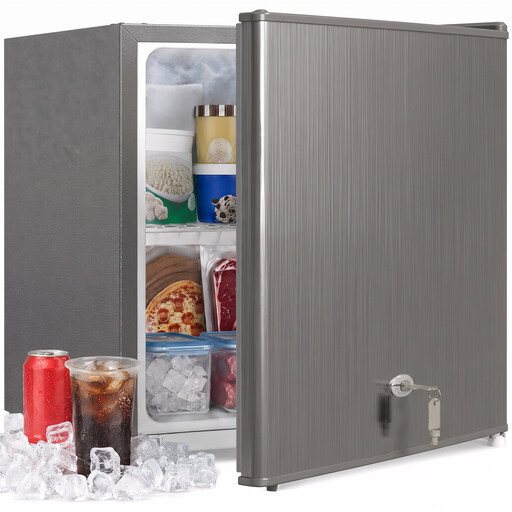
35 l mini chest freezer
Described as a compact way to add freezer space. Check whether the capacity is enough for your portions.
- Capacity: 35 l
- Five temperature settings; temperature range −14 °C to −24 °C
- Removable inner shelf, described as holding up to 4 kg
- Dimensions: 47 × 44,2 × 48,8 cm
- Assembly required
View at Joybuy
 No image available
AUCMA chest freezer with a capacity of 141 l
For extra freezer space. Compare the capacity with the amount you regularly need to store.
- Capacity: 141 l
- 4-star freezer rating, energy class E
- Switchable freezer or fridge mode
- Seven-stage thermostat, removable basket
- 179 kWh/year
- Dimensions: 632 × 554 × 848 mm
View at Joybuy
 No image available
AUCMA chest freezer with a capacity of 95 l
Its compact size may suit smaller stores. Check that the capacity matches the amount you plan to keep inside.
- Capacity: 95 l
- 4-star freezer rating, energy class E
- Switchable freezer or fridge mode
- Seven-stage thermostat, removable basket
- 165 kWh/year
- Dimensions: 550 × 475 × 848 mm
View at Joybuy
 No image available
AUCMA chest freezer with a capacity of 291 l
For larger stores alongside portions of broccoli. Make sure you have enough space and take the stated annual energy consumption into account.
- Capacity: 291 l
- 4-star freezer rating, energy class E
- Switchable freezer or fridge mode
- Five-stage digital temperature control, removable basket and LED lighting
- 226 kWh/year
- Dimensions: 1100 × 597 × 872 mm
- Allow at least 10 cm of ventilation space around the appliance
View at Joybuy
 No image available
CHiQ chest freezer with a capacity of 99 l
A compact option for extra portions. Check whether the stated freezing capacity suits the fresh batches you plan to freeze.
- Capacity: 99 l
- 4-star freezer rating, energy class E
- Freezing capacity: 4,5 kg/24 h
- Wire basket
- Dimensions: 54,5 × 47,6 × 83,5 cm
View at Joybuy
Frequently asked questions
Is the freezer compartment I already have enough for blanched broccoli?
If your prepared portions fit inside and you only occasionally add larger quantities, you may not need an extra chest freezer. The consumer advice centre recommends choosing a capacity that matches your actual needs.
How should I prepare broccoli for meals at different times?
The Federal Centre for Nutrition recommends washing and chopping vegetables, blanching them briefly in boiling water, then cooling them in iced water. Pack portions in suitable freezer containers with as little air as possible, and note the contents, quantity and date.
What’s the difference between usable capacity and freezing capacity?
Usable capacity in litres tells you how much storage space is available. Freezing capacity in kg/24 h tells you how much fresh food the appliance can freeze in 24 hours. If you freeze larger batches, compare both figures with your needs.
What temperature should a chest freezer be set to?
The consumer advice centre gives −18 °C as the optimum temperature for freezers. The Federal Centre for Nutrition notes that, for some dishes, vegetables can go straight from the freezer into a frying pan, soup or baking dish. Follow the recipe you’re using.
Can any chest freezer be kept in an unheated cellar?
No. Check the permitted ambient temperature for the specific model. For example, Liebherr specifies FrostProtect down to −15 °C for the CFd 2085 Plus; this doesn’t automatically apply to other chest freezers.


