Who might need a chest freezer in a shared kitchen?

Households freezing larger batches of vegetables

If you regularly blanch large quantities of carrots or freeze other supplies, you’ll need to consider both the storage space and the freezing capacity for new batches. The Verbraucherzentrale lists choosing the right appliance size as a buying criterion.

Kitchens where people take out individual portions

If several people need to find and take out their own portions of carrots, suitable containers, clear labels and a well-planned basket layout can help. The Bundeszentrum für Ernährung recommends noting the contents, quantity and date on packaging.

Households with limited space

If you’re considering an additional chest freezer, its external dimensions must fit the space available. Compare its annual energy consumption with your actual storage needs too: as the Verbraucherzentrale explains, an oversized freezer can use more electricity than necessary.

Which buying criteria matter for storing carrots?

What you need What to check before buying Who will find this important?
Freezer space required Compare the free space in your existing compartment, the quantity and dimensions of your portions, and the chest freezer’s usable capacity. If we regularly store carrots and other supplies in our kitchen, I need enough room without planning for unnecessary extra capacity. Around 26% of consumers put storage space first.
Freezing capacity for new batches Compare the size of your largest usual batch in kilograms with the model’s stated freezing capacity in kg/24 h. Usable capacity and freezing capacity measure different things. If we freeze a large batch of blanched carrots at once, I check that the stated batch capacity is suitable. Around 21% of consumers prioritise freezing capacity.
Organisation and access Check the basket layout and whether there’s room for your own freezer-safe containers; label portions with their contents, quantity and date. The Bundeszentrum für Ernährung recommends adding this information to make it easier to keep track. If several people take out individual portions, I want to be able to identify them without searching for ages. Easy access is the most important consideration for around 21% of consumers.
Placement and accessibility Check the external dimensions, the route for moving the appliance and the space needed to open the lid. If it will be placed somewhere cold, make sure the permitted ambient temperature is suitable for the specific model. If our kitchen has little spare space, an additional chest freezer needs to fit properly and remain accessible from above. Around 16% of consumers focus primarily on space and access.
Ongoing electricity consumption Compare annual consumption in kWh with usable capacity, and calculate the cost using your own electricity tariff. How you use the appliance and where you place it can affect its actual consumption. If we share the use of another appliance, we want to factor its stated annual consumption into our running costs. Around 16% of consumers put running costs first.

Buying pitfalls to avoid

  • Confusing usable capacity with freezing capacity

    Capacity in litres tells you how much storage space is available; kg/24 h is the manufacturer’s stated freezing capacity for new food. So a larger interior doesn’t, by itself, tell you how much new food you can freeze at once.

    Work out the size of your largest usual batch of carrots and your total storage needs separately, then check both against the model’s specifications.

  • Buying a large chest freezer for occasional portions

    An appliance that’s larger than you need can use more electricity than necessary and take up space permanently. If you don’t have much to freeze, your existing compartment may be enough, as long as it’s suitable for freezing fresh food.

    Before planning for extra freezer space, check what room you have and whether your existing compartment is suitable.

  • Stacking shared supplies without labels

    Without portioning and labelling, it can be harder to find and take out the right amount.

    Divide food into portions in freezer-safe containers and note the contents, quantity and date. Also plan how to arrange the baskets and containers in the chest freezer.

Chest freezer brands to consider

Exquisit

The GT100-E-040E weiss is an example of a compact chest freezer with a usable capacity of 98 l.

  • For this model, Exquisit lists a fast-freeze function, a freezer basket and annual consumption of 168 kWh.
  • These specifications apply to this model only. Check that its usable capacity and freezing capacity suit your batches.

Severin

The GT 8849 is an example of a chest freezer with a usable capacity of 200 l.

  • For this model, Severin lists a freezing capacity of 9 kg/24 h, annual consumption of 128 kWh and a basket.
  • These are the manufacturer’s specifications, not the result of an independent comparison test. A single basket won’t necessarily keep all the portions belonging to several people organised.

Haier

The freestanding HCE200C is an example of a model with a capacity of 196 l.

  • Haier lists energy class C and external dimensions of 915 × 555 × 845 mm (W × D × H).
  • The manufacturer’s claims about temperature distribution and the seal are not independently verified performance figures.

Liebherr

The CFe 1870 Pure is an example of a larger chest freezer with a total capacity of 281 l.

  • For this model, Liebherr lists SmartFrost and FrostProtect for ambient temperatures down to −15 °C.
  • Allow for its external dimensions of 82 × 104 × 71 cm (H × W × D) when choosing where to place it. The FrostProtect specification doesn’t apply to other models as a matter of course.

Beko

The HSA29540N is an example of a model with 284 l of freezer space.

  • For this model, Beko lists dimensions of 129 × 86 × 67,5 cm (W × H × D), energy class E and static cooling.
  • The MinFrost specification comes from the manufacturer; check the product’s specific details for its freezing capacity.

Chest freezers at Joybuy for shared supplies

This selection includes chest freezers for shared portions of carrots and other supplies. Whether a model is suitable for freezing new batches depends, among other things, on the freezing specifications listed for that particular appliance.

Exquisit chest freezer with a usable capacity of 142 l

Exquisit chest freezer, 142 l

An option for shared supplies if its usable capacity and freezing capacity suit your planned batches of carrots.

Specifications include a usable capacity of 142 l, a four-star freezer compartment and a freezing capacity of 7 kg in 24 hours. A quick-freeze function and removable basket are also listed. Manual defrosting is required.

View at Joybuy
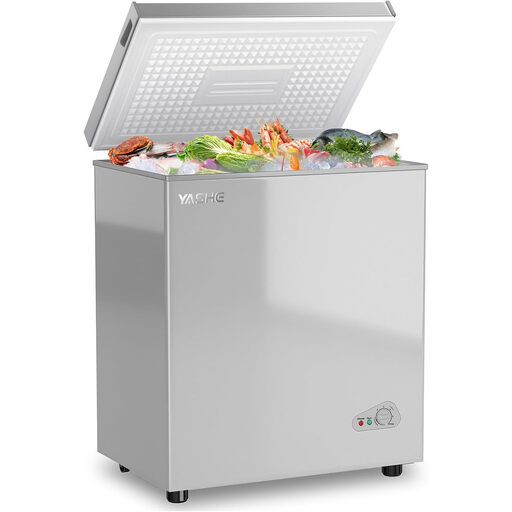
YASHE BC-150Q-EU chest freezer with a usable capacity of 150 l

YASHE BC-150Q-EU, 150 l

The stated usable capacity and removable baskets may be useful for organising shared supplies.

Specifications include a usable capacity of 150 l, two removable baskets and six temperature settings. Before freezing fresh carrots, check whether the product information confirms that the freezer compartment is suitable for this purpose.

View at Joybuy

AUCMA convertible chest freezer with a usable capacity of 141 l

AUCMA Convertible chest freezer, 141 l

A possible option for shared supplies if its storage space and stated freezing features suit your needs.

Specifications include a usable capacity of 141 l, a four-star freezer compartment and a removable basket. The product name also lists energy class E.

View at Joybuy

AUCMA convertible chest freezer with a usable capacity of 291 l

AUCMA Convertible chest freezer, 291 l

The larger stated usable capacity may suit you if you need to store other shared supplies as well as carrots and have enough floor space.

Specifications include a usable capacity of 291 l, a four-star freezer compartment, a removable basket and interior lighting. The product name lists energy class E.

View at Joybuy

AUCMA convertible chest freezer with a usable capacity of 197 l

AUCMA Convertible chest freezer, 197 l

For shared supplies, compare the stated usable capacity with the space available and the batches you plan to freeze.

Specifications include a usable capacity of 197 l, a four-star freezer compartment and a removable basket. The product name also lists digital temperature control and energy class E.

View at Joybuy

Frequently asked questions about freezing carrots

How should I prepare blanched carrots for a shared chest freezer?

The Bundeszentrum für Ernährung recommends cooling blanched vegetables in iced water, packing them in portions in freezer-safe packaging with as little air as possible, and noting the contents, quantity and date. If possible, don’t place new, unfrozen packs directly on top of food that’s already frozen.

How can I check an appliance’s electricity consumption before buying?

The EU energy label includes information such as the energy efficiency class, annual consumption in kWh, volume and noise level. The consumption figure is based on standardised conditions; how you use the appliance and where you place it can affect its actual consumption.

Is the capacity in litres enough to help me choose the right chest freezer?

No. Usable capacity tells you how much storage space there is, not how much food you can freeze from fresh at once. If you regularly add larger batches of carrots, also compare the freezing capacity in kg/24 h stated for the specific model.

What’s the difference between a guarantee and your statutory rights?

If a product is faulty, your statutory rights are against the seller; a guarantee is an additional voluntary offer with its own terms and conditions. The Verbraucherzentrale points out that they are two different types of entitlement.