Families freezing large batches of carrots
If you regularly blanch a lot of vegetables at once, compare the largest fresh batch you plan to freeze with the specific appliance’s freezing capacity.


If you only freeze a few portions of carrots now and then and your existing freezer has enough room, it will usually be sufficient; an additional chest freezer needs extra space and uses electricity. If you regularly freeze larger batches, choose a model based on its freezing capacity in kg/24 h for the amount of fresh food you want to freeze in a day, and its capacity in litres for your overall stock. The Berlin Consumer Advice Centre recommends choosing an appliance that suits your needs; the BZfE advises labelling frozen food with its contents, quantity and date.
If you regularly blanch a lot of vegetables at once, compare the largest fresh batch you plan to freeze with the specific appliance’s freezing capacity.
If you store other meals and shopping alongside your carrots, you’ll need the right amount of overall storage space and easy access to individual portions. The BZfE advises labelling packaging with its contents, quantity and date.
If you need extra freezer space but don’t have much room, check the dimensions, access route and lid clearance before buying. If you plan to put the freezer somewhere unheated, it’s also important to check that the specific model is suitable.
First weigh your largest fresh batch of carrots, then plan for your overall stock and check the energy consumption and available space. The Berlin Consumer Advice Centre recommends choosing an appliance that suits your needs; the BZfE advises labelling frozen food with its contents, quantity and date.
A good fit if: Your prepared portions and other frozen food will fit, and you only freeze larger batches occasionally.
The trade-off: You won’t need an additional appliance, but you’ll be limited by the space available and the freezing capacity of your existing appliance.
A good fit if: You regularly freeze and store larger quantities of carrots or other food for family meals.
The trade-off: More storage space also means taking up more room and using electricity continuously; you’ll still need to make sure the fresh batch is within the freezer’s capacity.
| What you need | What to look for | Who it matters most to |
|---|---|---|
| Freezing a fresh batch | Weigh the largest quantity of carrots you’ll freeze at one time and compare it with the specific model’s freezing capacity in kg/24 h. | If I’m freezing a large batch of carrots at once, the appliance’s performance needs to match the weight of the fresh produce. Around 33 % of consumers put freezing capacity for this batch first. |
| Space for family supplies | Estimate your overall stock and compare it with the model’s usable capacity in litres and its baskets. Label portions with their contents, quantity and date. | If I want to store several meals alongside other frozen food, I need enough space and want to be able to find individual portions again. Around 27 % of consumers prioritise space and easy access for organising family supplies. |
| Ongoing electricity consumption | Compare the stated annual consumption in kWh with the usable capacity and your needs. Energy label figures are based on standardised conditions and don’t predict your individual consumption exactly. | If I’m running an additional freezer all the time, I want to avoid unnecessary energy use from having more storage space than I need. Around 20 % of consumers pay particular attention to annual consumption. |
| Suitable location | Measure the route into your home, the floor space and the clearance needed to open the lid. If the room is cold, check the permitted ambient temperature for the specific model. | If space is limited or the location is unheated, the chest freezer needs to fit there and the lid must be able to open. Around 20 % of consumers prioritise the dimensions and suitability of the location. |
Usable capacity tells you how much food you can store, not how much fresh food the appliance can freeze in a day.
Weigh the largest batch of carrots you plan to freeze and compare it with the specific model’s freezing capacity in kg/24 h.
If the batch exceeds the appliance’s capacity, you may need to split it up. This takes extra time and may mean finding room for several freezing cycles.
An additional freezer takes up floor space and uses electricity continuously; if you only need a little extra capacity, your existing freezer compartment may be enough.
First check how much space is available in your existing appliance and how often you actually have larger quantities to freeze.
External dimensions alone won’t tell you whether the appliance will fit through the access route or whether you’ll be able to open it in the intended spot. Suitability for cold rooms varies by model.
Measure the access route, floor space and clearance above the lid. If the room is unheated, check the specific appliance’s approved temperature range.
The GT 8849 is an example of a 200-l chest freezer with a basket for storing portioned food.
At 219 l with two baskets, the GTE 822 is an example of a model suited to larger family stocks.
The HCE200C is a freestanding 196-l chest freezer, so you can consider its usable capacity alongside its external dimensions.
The CFc 1875 Plus is an example of a model for a location that can get genuinely cold.
At 284 l, the HSA29540N is an example of a model suited to larger stocks.
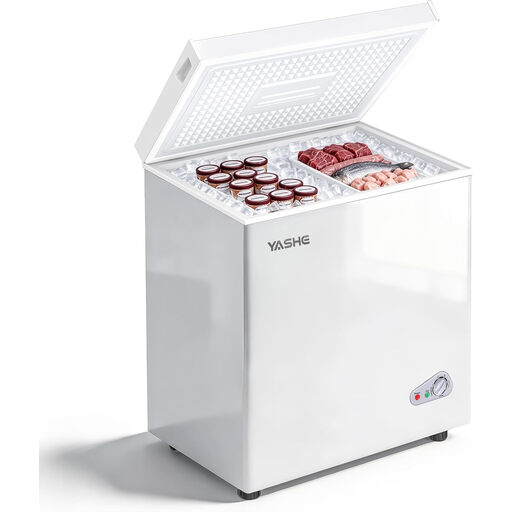
The Joybuy products below are chest freezers for storing portions of carrots and other supplies. Compare the stated usable capacity with your overall needs and check that the freezer will fit in the space you have in mind.
 No image available
The two removable baskets give you a way to separate family portions within the freezer.
150 l usable capacity; two removable baskets; six temperature settings.
 No image available
The removable basket can help you keep smaller portions of carrots separate from the rest of your frozen food.
141 l usable capacity; switchable fridge and freezer operation; seven-stage thermostat; dimensions: 632 × 554 × 848 mm.
 No image available
With a usable capacity of 95 l, this model is an option if you need less freezer space and have to keep an eye on the available dimensions.
Removable basket; switchable fridge and freezer operation; dimensions: 550 × 475 × 848 mm.
 No image available
The larger usable capacity could be a good choice if you want to keep other supplies in the freezer alongside your carrots.
291 l usable capacity; switchable fridge and freezer operation; removable basket; dimensions: 1100 × 597 × 872 mm. According to the product description, at least 10 cm of ventilation clearance is required; the appliance must not be tilted by more than 45° during transport.
 No image available
This model offers more storage space than the 95-l version if you want to keep portions of carrots and other supplies together.
197 l usable capacity; switchable fridge and freezer operation; removable basket; dimensions: 816 × 554 × 848 mm.
Plan your overall stock and check the largest fresh batch you’ll freeze in a day separately. Compare the usable capacity in litres and freezing capacity in kg/24 h; a large usable capacity alone doesn’t tell you whether the appliance can freeze your batch.
Once prepared, leave the blanched vegetables to cool and pack them into suitable portions, removing as much air as possible. The BZfE advises labelling packaging with its contents, quantity and date; the Berlin Consumer Advice Centre gives −18 °C as the optimum temperature for freezers.
No. You need to check that the specific model is suitable for low ambient temperatures. Liebherr says the CFc 1875 Plus can operate at ambient temperatures down to −15 °C; this manufacturer’s claim doesn’t apply to other chest freezers in general.
Compare the annual consumption in kWh shown on the EU energy label and check with the retailer what delivery options are available to your chosen location. Label figures are based on standardised conditions, so actual consumption at home may vary.
The German Environment Agency says that old electrical appliances must not be put in household waste. When a suitable new appliance is delivered, you may generally be able to return a large old appliance free of charge, even when buying online; check collection arrangements with the retailer in advance.