Who should consider these options?

People sharing food storage

If several people are storing portions of dough, separate, labelled packaging and a clear system make it easier to keep track. The Federal Centre for Nutrition recommends labelling frozen food with its contents, quantity and date.

Kitchens with limited space

The appliance dimensions, route in and space needed to open the lid must all suit the available spot. The consumer advice centre points out that a freezer that is too large for your needs can use unnecessary electricity.

People who often bake in large batches

If you regularly freeze several fresh batches of dough, check the appliance’s freezing function and freezing capacity as well as its storage volume. The Federal Centre for Nutrition distinguishes between freezing fresh food and storing food that is already frozen.

What should you look for when buying?

What matters when buying What to check Who will find this most important?
Keeping track of portions Check the interior layout and baskets; label containers and agree how everyone will access the food. If I want to find my portions of dough quickly and tell them apart from everyone else’s, a clear layout is essential. Around 33% of consumers prioritise keeping food organised and easy to identify.
Space and size Make sure the external dimensions, route in and space needed to open the lid are suitable for the storage capacity you need. If kitchen space is limited, the freezer needs to be practical to position and open once it has been moved in. Around 27% of consumers prioritise choosing an appliance of the right size.
Freezing fresh batches Check the specific model’s four-star freezing function and freezing capacity in kg/24 h. If I want to freeze several portions of fresh dough at once, freezing performance matters just as much as the available storage space. Around 20% of consumers put freezing fresh batches first.
Running costs If two models have a similar storage capacity, compare their annual energy consumption on the EU energy label. If running costs matter to me, I want to choose an appliance that’s the right size for the amount of food I actually store. Around 20% of consumers prioritise energy consumption during use.

Avoiding common buying mistakes

  • Confusing storage capacity with freezing capacity

    The capacity in litres tells you how much space is available, not how much fresh dough can be frozen within 24 hours.

    Check the specific model’s four-star freezing function and freezing capacity in kg/24 h.

    With large batches of fresh dough, you may need to take extra steps even if there’s enough room, if the freezing capacity isn’t suited to the quantity.

  • Choosing the biggest freezer without considering your needs

    A freezer that’s too large for your needs can use unnecessary electricity. The consumer advice centre therefore recommends matching the size to the amount of food you actually store.

    Work out how many containers and fresh batches need to fit at once, then compare the storage capacity, external dimensions and annual energy consumption.

  • Assuming less frost means no defrosting

    MinFrost and SmartFrost are manufacturers’ terms for reducing ice build-up or the effort involved in defrosting. They don’t mean the appliance will never need to be defrosted.

    Read the care instructions for the specific model and agree how cleaning and defrosting will be managed in your shared kitchen.

    Defrosting and cleaning can still take time, so remember to plan for them when sharing the appliance.

  • Assuming freezing makes raw dough safe to eat

    The Federal Institute for Risk Assessment warns against eating unbaked cookie dough because flour may contain harmful bacteria.

    Store the dough covered and separately, follow good kitchen hygiene and bake it before eating.

Useful brands to consider

Haier

The HCE200C chest freezer is an example of a mid-sized model with features specified by the manufacturer.

  • Haier lists the HCE200C as having a 196 l capacity, C energy efficiency rating, electronic display and LED lighting.
  • The model is listed with no drawers. An advertised antibacterial seal does not mean raw dough is safe without packaging or good kitchen hygiene.

Beko

The HSM22340 is a freestanding chest freezer that Beko lists with a 230 l capacity.

  • Beko lists this model with a D energy efficiency rating and MinFrost.
  • MinFrost doesn’t mean you won’t need to defrost the freezer. Check the baskets, lid and freezing capacity of the specific model you’re considering.

Amica

According to the manufacturer, the GT 311 105 W, GT 313 105 W and GT 315 100 W chest freezers have capacities of 99, 199 and 300 l respectively.

  • The GT 311 105 W is listed as measuring 54,5 × 83,5 × 47,6 cm and having an E energy efficiency rating.
  • Compact external dimensions alone don’t tell you whether the freezer can handle large batches or what its annual energy consumption will be.

Liebherr

The CFd 2505 Plus is an example of a larger chest freezer; Liebherr lists its capacity as 359 l and its width as 167 cm.

  • Liebherr lists this model with SmartFrost and FrostProtect for ambient temperatures as low as −15 °C.
  • The benefit of protection in cold locations may not matter in a heated shared kitchen, where the space the freezer takes up could be more important.

Chest freezers at Joybuy

This selection includes chest freezers for fresh portions of dough, shared food storage and different space requirements.

Exquisit chest freezer, 142 l, four-star freezer compartment

Exquisit chest freezer, 142 l, four-star freezer compartment

The four-star freezer compartment is important when freezing fresh portions of dough for the first time.

142 l; electronic temperature control with LED display; fast-freeze function.

View at Joybuy
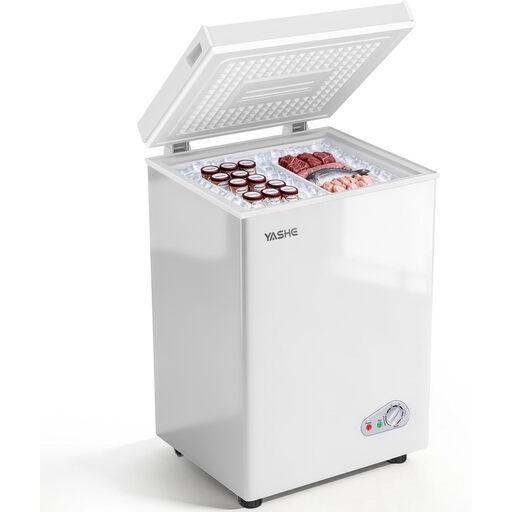
YASHE BC-100Q-EU chest freezer, 100 l, with two removable baskets

YASHE BC-100Q-EU chest freezer, 100 l

The two removable baskets offer a way to keep food stored separately in the freezer.

100 l; two removable baskets; six temperature settings.

View at Joybuy

AUCMA chest freezer, 197 l, convertible between fridge and freezer modes

AUCMA chest freezer, 197 l, convertible

The convertible fridge and freezer function is worth checking if you want flexibility in how you use the appliance.

197 l; E energy efficiency rating; digital temperature control with five settings; removable basket.

View at Joybuy

TCL CF182EWE0 chest freezer, 140 l, with storage basket

TCL CF182EWE0 chest freezer, 140 l

The included basket helps you keep frozen food organised.

140 l; storage basket; counterbalanced lid; E energy efficiency rating.

View at Joybuy

TCL CF126EWE0 chest freezer, 98 l, with storage basket

TCL CF126EWE0 chest freezer, 98 l

Its listed compact capacity may suit a tight space; check that it can still hold the amount of food you need to store.

98 l; storage basket; counterbalanced lid; E energy efficiency rating.

View at Joybuy

Frequently asked questions

What temperature and freezing function do I need for fresh cookie dough?

For storage, the consumer advice centre recommends −18 °C. For freezing fresh food for the first time, the Federal Centre for Nutrition specifies a four-star function. Three-star compartments are intended for long-term storage of food that is already frozen.

How can we keep track of portions of dough in a shared freezer?

Wrap the portions separately and label each package with its contents, quantity and date. The Federal Centre for Nutrition recommends this labelling for food you freeze at home; in a shared kitchen, adding a name can make it easier to identify whose food is whose.

Does freezing make raw cookie dough safe to snack on?

No. The Federal Institute for Risk Assessment warns against eating unbaked cookie dough because flour may contain harmful bacteria. Follow good kitchen hygiene and bake the dough before eating.

How do I compare the energy consumption of chest freezers?

For appliances with a similar storage capacity, compare their annual energy consumption in kWh on the EU energy label. The consumer advice centre points out that a freezer that’s too large for your needs can use unnecessary electricity; actual consumption also depends on how and where it’s used.

Does a shared kitchen need to be registered if it’s used for cookie dough?

Not simply because several people share a kitchen privately: according to the Federal Office of Consumer Protection and Food Safety, private domestic premises are exempt. If food is produced or stored there commercially as part of a food business, each relevant establishment generally needs to be registered with the responsible authority. What matters is how the kitchen is actually used.