What should you look for when buying?
Use your existing freezer
A good fit if: your portions fit and you are not planning to store extra food regularly.
The trade-off: you won’t need another appliance, but you’ll be sharing the available space with other food.
Compact chest freezer
A good fit if: you regularly need extra freezer space but have limited room. Beko lists the CF100EWN with a usable capacity of 98 l and a width of 54.5 cm.
The trade-off: taking up less floor space also means there’s less room for other food.
Medium or large chest freezer
A good fit if: you regularly store larger quantities of food as well as dough. Beko lists the CF200CWN at 198 l, and Haier lists the HCE321T at 319 l.
The trade-off: more capacity takes up more space. A freezer that’s larger than you need may also use electricity unnecessarily.
The Verbraucherzentrale advises against choosing a freezer that’s much larger than you need. Compare the space required for your dough and other food with the usable capacity, external dimensions and annual energy consumption of the specific model.
| Buying priority |
What to check before buying |
Who is this particularly important to? |
| Suitable capacity |
Assess your existing freezer space and the amount of food you regularly keep; compare usable capacity in litres. The Verbraucherzentrale gives 50–80 l per person as a general guide, not as a minimum size for cookie dough. |
If I regularly store other food as well as dough, I need enough room without buying a freezer that’s larger than necessary. Around 33 % of consumers say suitable capacity is their top buying priority. |
| Energy consumption |
When comparing models of a similar suitable size, check their annual energy consumption in kWh and their energy rating. The Verbraucherzentrale and the European Commission explain the labelling; your own electricity tariff also matters when estimating your costs. |
If the appliance will be running all the time, I look at annual energy consumption rather than just the energy rating. Around 25 % of consumers say electricity costs are their top buying priority. |
| Organising portions |
Check the number and arrangement of baskets; label freezer-safe containers with their contents and the date they were frozen. The Verbraucherzentrale recommends labelling containers this way. |
If I want to take out lots of individual portions of dough, I need to be able to keep them organised. Around 25 % of consumers say being able to find and remove portions easily is most important to them. |
| Space available |
Check the width, depth and height, as well as the clearance needed to open the lid. If the freezer will be in an unheated room, check the permitted ambient temperature for the exact model. |
If space is tight, I want to know before buying whether the freezer will fit with the lid open. If it’s going in a garage, I also need to check that the model is approved for that location. Around 17 % of consumers say available space is their top buying priority. |
Chest freezers at Joybuy
This selection includes compact to larger chest freezers, giving you extra space for portions of dough and other household food.
 No image available
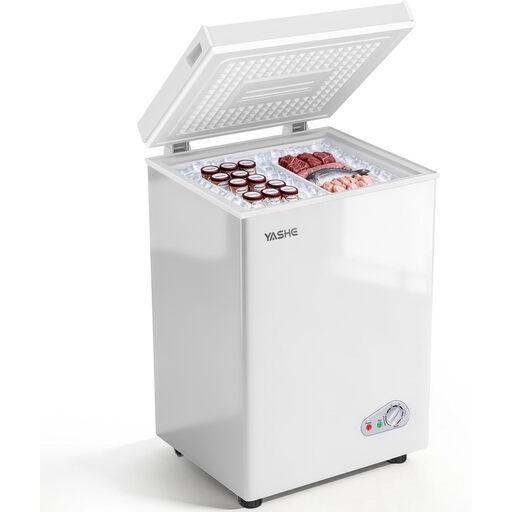
YASHE BC-100Q-EU chest freezer, 100 l
A compact option if you need extra freezer space without taking up too much room.
Features include two removable baskets, six temperature settings, energy rating E and annual energy consumption of 185 kWh.
View at Joybuy
 No image available
AUCMA Convertible chest freezer, 141 l
This medium-sized model could suit you if you regularly need extra freezer space for food as well as dough.
Features include energy rating E, annual energy consumption of 179 kWh, seven thermostat settings, a removable basket and a convertible fridge and freezer function.
View at Joybuy
 No image available
AUCMA Convertible chest freezer, 95 l
A compact option for extra freezer space, with food stored separately for easy access.
Features include energy rating E, annual energy consumption of 165 kWh, seven thermostat settings and a removable basket.
View at Joybuy
 No image available
AUCMA Convertible chest freezer, 291 l
The larger capacity is better suited to households that want to store other food as well as dough.
Features include energy rating E, annual energy consumption of 226 kWh, five digital temperature settings, LED lighting and a removable basket.
View at Joybuy
 No image available
AUCMA Convertible chest freezer, 197 l
This size could be a good fit if you regularly freeze other food as well as dough.
Features include energy rating E, annual energy consumption of 197 kWh, five digital temperature settings and a removable basket.
View at Joybuy
Frequently asked questions
What temperature should I use to store portions of dough?
The Verbraucherzentrale recommends −18 °C as the optimum temperature for a freezer or chest freezer. This is usage advice, not a statutory minimum requirement for every model covered here.
Does freezing raw cookie dough make it safe for children to snack on?
No. The German Federal Institute for Risk Assessment advises against eating cookie dough unbaked; STEC bacteria are not reliably killed in a freezer either. Handle flour, dough and kitchen utensils hygienically, and bake the dough before eating it.
How can I keep track of prepared portions?
Use freezer-safe containers and label them with their contents and the date they were frozen. Before buying, check whether the baskets in the specific model suit the way you portion your dough.
What does the energy label tell me about running costs?
The EU energy label for household freezers shows, among other things, the A–G rating and annual energy consumption in kWh. To estimate your electricity costs, multiply the annual consumption by your electricity tariff per kWh. Actual consumption also depends on how and where you use the appliance.
Can I put an old chest freezer in my household rubbish?
No. According to the German Federal Ministry for the Environment, old electrical appliances must be taken separately to authorised collection points. Retailers only take appliances back under the applicable conditions, so check the arrangements for returning or collecting your old appliance before completing your purchase.


