If your existing freezer can hold your cooled weekly portions in their containers, and you’re not planning to freeze larger batches, you may not need an additional chest freezer. If you regularly freeze larger quantities, choose a model that suits your containers, freezing capacity and available space. Compare annual energy consumption too, not just capacity. A chest freezer won’t replace rapid cooling, an insulated cool bag or access to refrigeration at work — precautions recommended by the German Federal Institute for Risk Assessment (BfR) for pre-prepared meals.
Who is a chest freezer right for?
Weekly meal preppers with limited space
If you portion out curry for the working week but have very little floor space to spare, both your containers and the freezer need to fit the available space. The consumer advice centre recommends choosing an appliance to suit the amount of food you actually store.
Meal preppers who cook in larger batches
If you regularly freeze lots of portions at once after cooling them, check the freezing capacity of the specific appliance as well as its usable capacity. The BfR also advises keeping food chilled while transporting it and at the place where it will be eaten.
Stocking up while keeping an eye on energy use
If you plan to keep your chest freezer running all the time, compare the stated annual energy consumption of models with a usable capacity that suits your stock. The EU energy label includes figures such as kWh per year.
What should you look for when buying?
The consumer advice centre recommends choosing capacity to suit your actual needs. Its guide of 50–80 litres per person isn’t a minimum size for curry portions: count the containers you’ll store at the same time, and measure the available space and clearance to open the lid.
Keep using your existing freezer compartment
A good fit if: Your cooled weekly portions fit inside and you rarely freeze larger quantities at once.
The trade-off: You won’t need another appliance, but you’ll be limited by the space you already have.
Compact chest freezer
A good fit if: Your freezer compartment isn’t big enough, but you have limited space and don’t need to store a large amount.
The trade-off: A smaller chest freezer has less capacity than larger models, and its size alone doesn’t guarantee lower energy consumption.
Medium-sized chest freezer with helpful storage features
A good fit if: You store several batches or other frozen food, and want to keep your portions organised.
The trade-off: It takes up more space. Less ice build-up doesn’t mean you’ll never need to defrost it.
| Priority |
What to check before buying |
Who considers this important? |
| Usable capacity and available space |
Compare the number and dimensions of your containers, the appliance’s external dimensions, required wall clearance and the space needed to open the lid. |
If I have very little floor space, my containers need to fit and the lid must open freely. Around 33% of consumers would say that the right size and a suitable place to install it are their top priority. |
| Freezing larger batches |
Check the freezing capacity in kg/24 h and the suitable freezing range. The consumer advice centre recommends −18 °C as the optimum temperature for freezers. |
If I prepare lots of portions at once on my meal-prep day, I want to know whether the appliance can handle that batch. Around 27% of consumers would prioritise freezing larger quantities. |
| Energy use during continuous operation |
Compare kWh/year for models with enough usable capacity. The EU energy label also shows the energy efficiency class. |
If my chest freezer keeps running between cooking days, I want to take its stated annual energy consumption into account. Around 27% of consumers would put energy use first. |
| Finding your portions again |
Check the number of baskets and whether the specific model has interior lighting. Label your containers with their contents and freezing date. |
If I want to take out individual lunch portions quickly, keeping everything well organised helps. Around 13% of consumers would say that good organisation and quick access are their top priority. |
Common buying mistakes
-
Buying the biggest chest freezer you can find
More capacity isn’t necessarily an advantage if you only store a few weeks’ worth of portions. The consumer advice centre warns against buying a freezer that’s larger than you need. A bigger appliance can also take up more floor space.
First, work out how many portions and other supplies you’ll store at the same time. Then compare suitably sized models by their stated annual energy consumption.
-
Assuming less ice build-up means no defrosting
Manufacturer claims about reduced ice build-up don’t guarantee that you’ll never need to defrost the appliance.
Check the defrosting method in the manual for the specific model, and resolve any conflicting feature information before you choose.
Defrosting can take time and may mean moving the contents elsewhere temporarily.
-
Measuring only the width of the appliance
External dimensions alone aren’t enough for a chest freezer. Wall clearance and the space needed to open the lid will determine whether you can use it in your chosen spot.
Measure the space where it will stand, the route for getting it there and the clearance above the lid. Follow the installation guidance for the specific model too.
-
Thinking a chest freezer will keep an unrefrigerated lunchbox safe
The BfR recommends keeping food chilled during transport and at the place where it will be eaten. Storing it in a freezer beforehand doesn’t cover these steps.
Take an insulated cool bag for your commute and check whether you can refrigerate your food at work.
Brands to consider
Exquisit
The GT100-050E in black is a manufacturer example of a compact chest freezer with 99 litres of usable capacity.
- Exquisit states that this model uses 169 kWh/year and measures 54.5 × 83.5 × 48 cm externally. It can be switched between cooling and freezing modes.
- In cooling mode, the appliance can’t also function as a freezer. You’ll also need to allow for the stated wall clearance.
Severin
The GT 8849 is a manufacturer example with 200 litres of usable capacity for storing larger quantities.
- Severin states that it uses 128 kWh/year, has energy class C and a freezing capacity of 9 kg/24 h, and comes with one basket.
- The product information also mentions three freezer drawers and Total NoFrost. Check the specific features against the EU product information sheet and the instruction manual.
Beko
The HSM22340 is a 230-litre option for larger quantities, provided you have enough space.
- Beko states that it has energy class D, is 110.5 cm wide and uses a static cooling system. MinFrost is the manufacturer’s term for reduced ice build-up.
- MinFrost is a manufacturer’s term, not an independent measurement or a guarantee that you won’t need to defrost the appliance.
Liebherr
According to Liebherr, the CFc 1875 Plus has 192 litres of capacity and is designed for use in a particular cold environment.
- Liebherr states that FrostProtect allows ambient temperatures down to −15 °C, and that the model features SmartFrost and StopFrost.
- The stated suitability down to −15 °C applies to this model only. Don’t assume it applies to other chest freezers or any installation location.
Haier
The HCE200C is a chest freezer with 196 litres of capacity, suitable for a medium-sized supply of food.
- Haier states that it has energy class C, measures 91.5 × 55.5 × 84.5 cm, and features a fast-freeze function and interior lighting.
- Check that its dimensions fit your available space, and make sure its freezing capacity suits the amount you plan to store.
Chest freezers at Joybuy
This selection at Joybuy includes freestanding chest freezers in a range of sizes, including models with baskets or switchable cooling and freezing modes.
 No image available
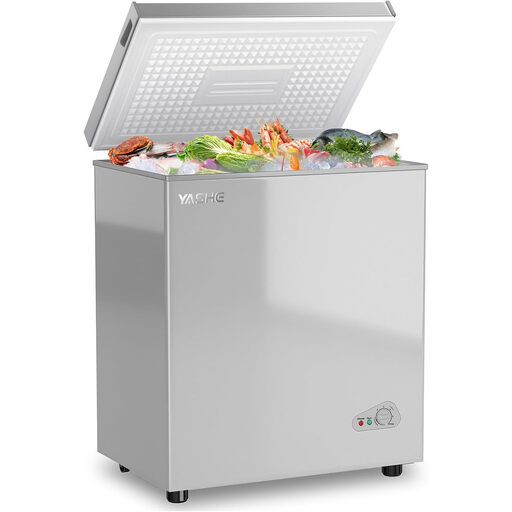
YASHE BC-150Q-EU chest freezer, 150 l
An option if you want to store several portion containers separately and within easy reach.
Listed features include 150 l of usable capacity, two removable baskets, six temperature settings, a fast-freeze function and 157 kWh/year.
Joybuy
 No image available
AUCMA chest freezer, 141 l, switchable
A compact option if you need a separate freezer for your prepared portions.
Listed features include 141 l of usable capacity, a four-star freezer rating, 179 kWh/year, a removable basket and a defrost drain. It measures 632 × 554 × 848 mm.
Cooling and freezing are switchable modes, not functions that can be used at the same time.
Joybuy
 No image available
AUCMA chest freezer, 291 l, switchable
The larger capacity could suit you if you want to store lots of portions or other supplies together.
Listed features include 291 l of usable capacity, a four-star freezer rating, 226 kWh/year, LED lighting and a removable basket. It measures 1100 × 597 × 872 mm.
Cooling and freezing are switchable modes, not functions that can be used at the same time.
Joybuy
 No image available
AUCMA chest freezer, 197 l, switchable
A medium-sized option if you regularly freeze several portions of curry.
Listed features include 197 l of usable capacity, a four-star freezer rating, 197 kWh/year, a removable basket and a defrost drain. It measures 816 × 554 × 848 mm.
Cooling and freezing are switchable modes, not functions that can be used at the same time.
Joybuy
 No image available
Gorenje FH15E6W5 chest freezer, 141 l
An option if you want to freeze a whole batch at once or need to take a particularly cold installation space into account.
Listed features include 141 l of usable capacity, a four-star freezer rating, a freezing capacity of 8 kg/24 h, a fast-freeze function and 182 kWh/year. FreezeProtect is rated for ambient temperatures down to −15 °C; a flexible wire basket is also specified.
The description says to defrost the appliance when ice has built up.
Joybuy
Frequently asked questions
Is my existing freezer compartment big enough for curry portions?
Yes, if it can fit the suitable containers you need to store at the same time, and you don’t regularly need to freeze larger quantities at once. The consumer advice centre says a fridge-freezer can be a suitable alternative if you only freeze small amounts occasionally.
How should I cool pre-cooked curry and take it to work?
For longer-term storage, cool food quickly to below 7 °C, then freeze it in suitable, labelled portions. For your commute, the BfR recommends using an insulated cool bag and checking in advance whether you can refrigerate your food where you’ll be eating it. Freezing won’t undo any temperature-related problems that occurred earlier.
What should I bear in mind when preparing curry with rice?
Cool the food especially carefully and quickly. The BfR explains that spores of Bacillus cereus can survive normal heat treatments, and that unsuitable storage conditions can encourage them to multiply. A freezer therefore can’t replace safe cooling and transport practices.
What do the energy label and annual consumption figures tell me?
The EU energy label for fridges and freezers shows information including the energy efficiency class on a scale from A to G, as well as kWh/year and usable capacity. The EU explains that the consumption figures are based on standardised conditions; how you use the appliance and where it’s installed can affect its actual energy use at home.


