For the occasional portion of crumble, your existing freezer compartment should be enough, as long as the containers fit alongside your other frozen food. A separate chest freezer is more useful if you regularly freeze larger batches or want to store other foods too. In that case, consider your container dimensions, how much you need to freeze at once, how easy it is to reach individual portions, the space available and annual energy consumption – not just capacity or energy rating. The German Federal Institute for Risk Assessment recommends cooling hot food quickly before storing it for longer periods; a chest freezer does not replace this step.
Who is a chest freezer right for?
Households that regularly cook in batches
If you freeze cooled crumble alongside other prepared dishes, plan separately for storage space and the amount you need to freeze at once. The German Consumer Advice Centre explains how to choose a suitable capacity, while the German Federal Institute for Risk Assessment recommends cooling hot food quickly before storing it for longer periods.
Households where people eat at different times
If you regularly take individual portions from a shared supply, suitable containers, labels and an easy-to-reach basket can help. The German Federal Centre for Nutrition recommends noting the contents and date on the packaging.
Households short on space
If you need extra freezer space, weigh up the external dimensions, access to the lid and stated annual energy consumption against your actual storage needs. The German Consumer Advice Centre points out that an oversized freezer can use more electricity than necessary.
Which buying criteria matter?
Keep using your existing freezer compartment
A good fit if: you only occasionally freeze cooled, packaged portions of crumble and they fit alongside your other frozen food.
The trade-off: you won't need another appliance, but the available space and the amount you can freeze at once will remain limited.
Compact chest freezer
A good fit if: you regularly have extra portions to freeze but space is limited. The Beko HSM14550, with a capacity of 148 l, is one example of a model – not a general minimum size.
The trade-off: a smaller footprint means less room for a mix of frozen food. Check freezing capacity and annual energy consumption separately.
Larger chest freezer for a range of frozen food
A good fit if: you regularly store other foods or freeze larger batches alongside your crumble.
The trade-off: more storage space takes up more room, and an oversized appliance can use electricity unnecessarily. Make sure the lid and baskets remain easy to access.
| What you need |
What to check when buying |
Who is this important to? |
| Space for new batches |
Count and measure your containers; compare usable capacity in litres and freezing capacity in kg/24 h separately. |
If I’m adding several portions on cooking day, I need space for the containers and enough freezing capacity. Around 33% of consumers give the ability to freeze new batches regularly their highest priority. |
| Finding individual portions again |
Check the container format, basket layout and space for clear labels. |
If we eat at different times, I want to take out individual portions without rearranging the rest of the food. Around 27% of consumers prioritise easy access to individual portions. |
| A suitable place to put it |
Check the external dimensions, delivery route and lid opening. If it will be kept in a cold room, also check the permitted ambient temperature for the specific model. |
When space is limited, the freezer needs to fit in its intended position with the lid open. Around 20% of consumers prioritise finding a suitable spot for their appliance. |
| Ongoing electricity use |
Compare annual consumption in kWh for appliances of a similar size, and consider how much frozen food you actually need to store. |
If the appliance runs all the time, I don’t want to maintain freezer space I don’t need. Around 20% of consumers put the greatest emphasis on ongoing electricity consumption. |
Common buying mistakes
-
Confusing usable capacity with freezing capacity
Usable capacity tells you how much can be stored; kg/24 h refers to how much new food the appliance can freeze. A high capacity in litres alone therefore won’t tell you whether the appliance can handle a planned batch of food.
Check both figures for the specific model and compare its stated freezing capacity with the amount you plan to freeze at once.
-
Choosing a large chest freezer for occasional leftovers
An appliance that is much larger than you regularly need takes up space and can use more electricity than necessary.
First check whether your occasional portions will fit in your existing freezer compartment. Only choose a chest freezer based on the amount you regularly store overall.
-
Assuming less ice means you never need to defrost
Liebherr describes SmartFrost and StopFrost as ways to reduce frost build-up; they don’t mean that defrosting is no longer needed.
Read the care and defrosting instructions for the specific model before you buy. Defrosting from time to time takes time and means temporarily moving your frozen food elsewhere.
-
Assuming every chest freezer is suitable for an unheated room
Any stated suitability for very low ambient temperatures applies only to the specific model.
Check the permitted ambient temperature and the dimensions of the specific appliance, including the space needed to open the lid.
Brands and models to consider
Beko
The HSM14550 is an example of a compact model with 148 l of usable capacity.
- Beko lists this model as energy class D, with a static freezer compartment.
- Check the stated freezing capacity for your batch as well as the usable capacity.
Haier
The HCE200C is an example of a model for a medium-sized supply; Haier lists its usable capacity as 196 l.
- Haier lists this model as energy class C, with Fast Freeze and an interior light.
- Whether it can handle a particular batch depends on its stated freezing capacity. The manufacturer's claim for the fast-freeze function is not an independently measured result.
Liebherr
The CFd 2085 Plus is a 248-litre model for larger mixed supplies.
- Liebherr states that this model features FrostProtect down to −15 °C.
- According to the manufacturer, SmartFrost and StopFrost help reduce frost build-up, but they are neither NoFrost nor a guarantee that defrosting will never be needed. FrostProtect is a model-specific claim.
Exquisit
The GT100-010E weiss is an example of a slim chest freezer, with a stated width of 54.6 cm.
- Exquisit lists this model at 167.09 kWh/year and energy class E.
- The manufacturer's specifications list a usable capacity of 95 or 96 l. Check the specification sheet for the specific offer if this difference matters when choosing a size.
Chest freezers at Joybuy
The models below include compact chest freezers for regular portions and larger models for storing a shared supply. If you’re freezing new batches, check the stated freezing capacity separately.
 No image available
Exquisit chest freezer, 142 l, 4-star compartment
A compact option if you want to store extra portions regularly.
The product title lists a fast-freeze function, electronic temperature control with an LED display, a reversible door and castors. Check the stated freezing capacity for new batches separately.
Manual defrosting; a water drain is listed.
View at Joybuy
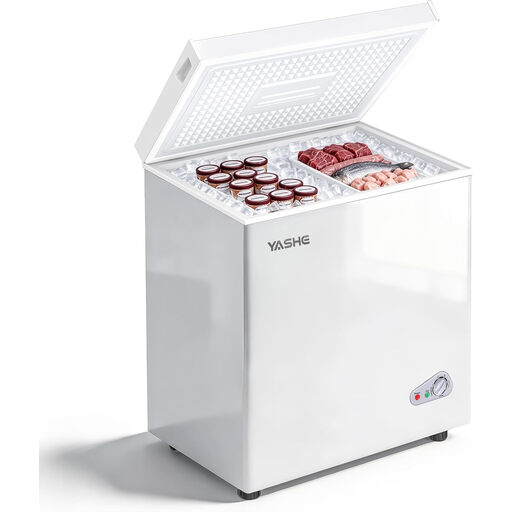 No image available
YASHE BC-150Q-EU chest freezer, 150 l
The stated usable capacity gives you a clear figure to plan for when adding extra storage.
The product title lists a freestanding design, two removable baskets and six temperature settings. No freezing capacity in kg/24 h is specified.
View at Joybuy
 No image available
AUCMA chest freezer, 141 l, convertible, energy class E
The stated capacity can help you plan how much extra frozen food to store.
The product title lists switchable fridge and freezer modes. Energy class E, seven temperature settings and a removable basket are also specified. No freezing capacity in kg/24 h is listed.
The stated external dimensions are 632 × 554 × 848 mm.
View at Joybuy
 No image available
AUCMA chest freezer, 291 l, convertible, energy class E
The larger stated usable capacity may suit a shared supply of different foods.
The product title lists switchable fridge and freezer modes, LED lighting, five-level digital temperature control and a removable basket. No freezing capacity in kg/24 h is specified.
The stated external dimensions are 1100 × 597 × 872 mm; make sure you have enough space for it.
View at Joybuy
 No image available
AUCMA chest freezer, 197 l, convertible
The stated usable capacity gives you a useful figure for planning a larger shared supply.
The product title lists switchable fridge and freezer modes, five-level digital temperature control and a removable basket. No freezing capacity in kg/24 h is specified.
The stated external dimensions are 816 × 554 × 848 mm.
View at Joybuy
Frequently asked questions
Does fruit crumble need to cool before freezing?
Yes. The German Federal Institute for Risk Assessment recommends quickly cooling hot food to below 7 °C before storing it for longer periods. Then portion and package the crumble hygienically; freezing won’t undo unsafe storage beforehand.
How can we keep track of portions when we eat at different times?
Choose freezer-safe containers that suit your preferred portion size, and label them with the contents and date. The German Federal Centre for Nutrition recommends adding this information to help you keep track and use the food later.
How can I compare energy use and maintenance?
For appliances with a similar usable capacity, compare annual consumption in kWh and consider how much frozen food you actually need to store. The German Consumer Advice Centre warns that oversized appliances use energy unnecessarily; reduced frost build-up doesn’t automatically mean a chest freezer never needs defrosting.
What are the rules in Germany for energy labels and disposing of an old chest freezer?
New household refrigeration appliances covered by the rules must comply with EU requirements for energy labels and product information. The current label uses classes A to G rather than the previous plus classes. The German Environment Agency explains that electrical waste must be collected separately and that municipal collection points generally accept it free of charge. Check the details of any retailer take-back scheme for the specific way you’re buying.


