Occasional hosts
If you want to portion out cheese for a get-together, first check whether there’s enough room in your existing freezer compartment.


For a single portion of cheese, a separate chest freezer is usually unnecessary, as long as there’s enough room in a suitable freezer compartment. A dedicated chest freezer is more worth considering if you regularly freeze other food too. If you do, choose one based on its usable capacity, the space you have available and its annual energy consumption.
If you want to portion out cheese for a get-together, first check whether there’s enough room in your existing freezer compartment.
If you regularly freeze larger shops or prepared meals, factor in the extra storage space you’ll need for these supplies.
If space is tight, check the appliance’s external dimensions and allow enough room to open the lid. For an unheated room, you’ll also need to check the minimum and maximum ambient temperatures permitted for the specific model.
A good fit if: You only occasionally prepare cheese for a meal and have room left in a suitable compartment.
The trade-off: You avoid running an additional appliance, but you’ll need to make sure there’s genuinely enough room for the cheese.
A good fit if: Your existing freezer compartment regularly runs out of space and you only want to store a limited amount of extra food.
The trade-off: A smaller chest freezer takes up less room than larger models, but still uses electricity on an ongoing basis.
A good fit if: You regularly freeze larger shops or prepared meals as well as cheese.
The trade-off: More usable capacity gives you extra storage space, but could be more than you need for a single occasion. Check the space it will take up and its annual energy consumption too.
| What matters | What to consider | Who it matters most to |
|---|---|---|
| Additional appliance and size | Check the space available in your existing freezer, what else you plan to store, the usable capacity and the external dimensions. | If I’m only preparing cheese for a get-together, I want to know first whether my freezer compartment is big enough. Around 33% of consumers focus on whether they need an additional appliance and how much usable capacity is right for them. |
| Ongoing energy consumption | Compare the annual consumption in kWh of appliances with a suitable usable capacity; where you place and how you use the appliance will also affect its actual consumption. | If running costs matter to me, I compare the stated energy consumption rather than just the efficiency class. Around 27% of consumers focus primarily on energy consumption. |
| Other food supplies | Check the usable capacity and, if you regularly freeze larger quantities of fresh food, the model’s freezing capacity. A basket can make smaller packs easier to reach. | If I regularly freeze other food as well as cheese, I’ll need extra freezer space. Around 20% of consumers prioritise having space for regular supplies. |
| Where it will go and access | Check the route for moving it, the floor space available, the room needed to open the lid and, for unheated rooms, the ambient temperature range permitted for the specific model. | If the space is tight or unheated, the appliance must be the right size and suitable for the room, and I’ll need to be able to reach the portions easily. Around 20% of consumers put available space and access first. |
The usable capacity should suit your actual needs. As well as the purchase price, an additional appliance will bring ongoing energy consumption.
First check whether your existing freezer compartment is big enough and what other food you regularly need to store.
An additional appliance uses electricity on an ongoing basis, even when you don’t have a get-together coming up.
The energy class alone doesn’t show the appliance’s total annual consumption. The stated figure is measured under standardised conditions, while how you use the appliance and where you place it can also affect consumption at home.
Compare the annual consumption in kWh of appliances with a usable capacity that suits your needs.
Large frozen portions are harder to divide, and unsuitable or poorly sealed packaging can affect the quality.
Before freezing, divide the cheese into portions for the quantities you’ll need for cooking. Use suitable freezer packaging and label it with the contents and date.
Whether an appliance can operate at low ambient temperatures depends on the specific model. Information for one chest freezer doesn’t automatically apply to others.
Before placing your chosen model in a cellar or garage, check its permitted ambient temperature in the specifications.
The GT100-050E black is a compact model with 99 l of usable capacity.
Beko describes the HSM14550 as a freestanding chest freezer with 148 l of usable capacity.
According to the manufacturer, the GT 8849 is an example of a medium-sized chest freezer with 200 l of usable capacity.
According to the manufacturer, the CFe 1870 Pure is designed for larger supplies and has a total capacity of 281 l.
These models include compact chest freezers and appliances for storing extra supplies. The key considerations are the usable capacity you need, the space available and the appliance specifications.
 No image available
For a limited amount of extra food when your existing freezer compartment isn’t big enough.
141 l usable capacity; switches between fridge and freezer functions; energy class E.
 No image available
For a limited amount of extra food if you’re looking for a compact chest freezer.
95 l usable capacity; switches between fridge and freezer functions; energy class E.
 No image available
For households that regularly freeze other supplies as well as cheese.
197 l usable capacity; switches between fridge and freezer functions; energy class E.
 No image available
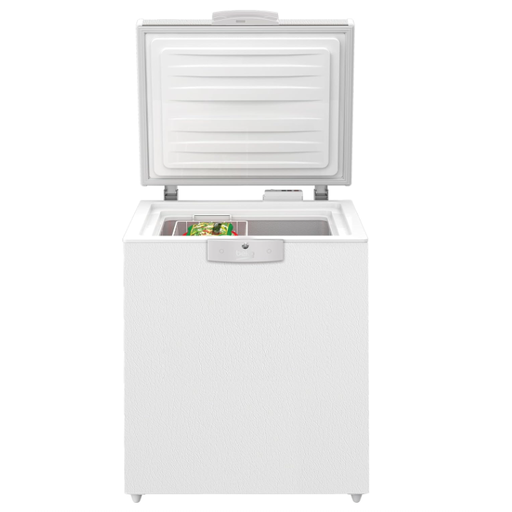
For extra supplies; the freezer basket can help you keep smaller packs organised.
148 l usable capacity; one freezer basket; energy class D. According to the product information, manual defrosting is required if more than 5 mm of ice builds up.
 No image available
For households that regularly store larger quantities of food as well as cheese.
291 l usable capacity; switches between fridge and freezer functions; energy class E. This is a generous amount of space if you’re only storing cheese.
No. A four-star freezer compartment is essential for freezing fresh food; a compartment designed to store food that is already frozen isn’t suitable for the same purpose. The Federal Centre for Nutrition recommends −18 °C for long-term freezer storage.
According to the regional dairy associations, hard and semi-hard cheeses with a higher fat content are suitable for freezing and are particularly good for baking or cooking afterwards. Portion out the amount you’ll need beforehand, use suitable freezer packaging and label it with the contents and date.
For household freezers covered by the EU energy label, it shows the energy efficiency class and standardised annual consumption in kWh, among other details. Compare the absolute consumption for appliances with a suitable usable capacity; where and how you use one can affect its actual consumption.
No. The German Environment Agency advises that waste electrical and electronic equipment must be collected separately. When you buy a new appliance of the same type, large old appliances can also be returned free of charge with online purchases that include delivery. Check with the retailer to confirm how returns are handled.