For the occasional small portion of cheese, your existing freezer compartment is often enough, provided there’s room. A separate chest freezer is more likely to be worth considering if you regularly freeze several portions and other food at the same time. If so, make sure its usable capacity, footprint, freezer basket, annual energy consumption and permitted ambient temperature suit your needs. The specific advice about freezing in portions applies to pre-grated Parmesan and isn’t a general storage recommendation for every grated cheese mix.
Who would benefit from a chest freezer?
Portion planners
You need grated cheese for meals at different times and want to find and take out individual portions easily, without having to rummage through a larger supply. The Federal Centre for Nutrition recommends measuring out the amount you need before freezing and packing it in individual portions.
Households short on space
You regularly freeze food for later, but need to check that the chest freezer, route in and space to open the lid will all fit in the room you have in mind.
Bulk buyers
You want to freeze other foods as well as cheese, and are weighing up extra usable capacity against floor space and annual energy consumption. The consumer advice centre recommends choosing an appliance size that matches your actual needs.
What should you look for when buying?
Existing freezer compartment
A good fit if: you only add small portions of cheese occasionally and there’s room in your existing freezer.
The trade-off: It can be harder to keep several separate packs organised and easy to find.
Compact chest freezer
A good fit if: you regularly freeze several portions and other food at the same time.
The trade-off: A chest freezer needs extra floor space and runs continuously, so compare the figures for the specific model.
Larger chest freezer
A good fit if: you regularly store larger quantities of other food as well as cheese.
The trade-off: If you’re only freezing a few portions of cheese, the extra capacity may not justify the space it takes up or the potential increase in energy use.
The consumer advice centre recommends a temperature of −18 °C for freezers and advises against choosing an appliance that is much larger than your storage needs. The following points can help you find a chest freezer that suits the way you’ll use it.
| What matters |
What to check when buying |
Who is it especially relevant to? |
| Easy access to portions |
Check whether the freezer basket can be removed. Pack individual portions in freezer-safe packaging and label them with the contents and date. |
If I only need one portion of cheese at a time for meals at different times, I want to take it out separately without a long search. That’s why around 36% of consumers prioritise easy access to individual portions. |
| Capacity to suit your needs |
Work out how much you’ll store at once, then compare the usable capacity and external dimensions with the route for delivery and the space needed to open the lid. |
If you regularly need extra freezer space but have limited room, you won’t want an oversized chest freezer. Around 29% of consumers focus above all on choosing an appliance of the right size. |
| Annual energy consumption |
Compare the annual consumption in kWh for the exact model variant; the energy efficiency class doesn’t replace this figure. |
If an additional freezer is running continuously, its stated annual energy consumption matters to me. Around 21% of consumers put energy consumption first when buying. |
| Where you’ll put it |
Check that the permitted ambient temperature for the complete model is suitable for the conditions at your chosen location. |
If you plan to put the chest freezer in a possibly unheated cellar or garage, you’ll need to know whether the specific appliance is suitable. Around 14% of consumers pay particular attention to whether an appliance is suited to its location. |
The ‘Zu gut für die Tonne!’ initiative suggests freezing pre-grated Parmesan in portions. This advice can’t necessarily be applied to every type or mix of cheese.
Avoiding buying and storage mistakes
-
Buying a large chest freezer just for a few portions of cheese
An appliance with far more usable capacity than you need takes up unnecessary space and may use more electricity than necessary. The consumer advice centre recommends choosing a size that matches your needs.
First check whether your existing freezer compartment is enough and how many portions you’ll need to store at once.
-
Assuming the energy efficiency class tells you the annual consumption
The efficiency class alone doesn’t show how many kilowatt-hours per year are stated for the exact model variant. Actual consumption at home may differ from the standardised conditions used for the energy label.
Compare the annual consumption in kWh and the energy efficiency class for the specific models you’re considering.
-
Putting a chest freezer in a cold garage without checking the model
The permitted ambient temperature varies by model. An appliance specified for warmer rooms shouldn’t be planned for an unheated location unless the manufacturer confirms it’s suitable.
Compare the temperature range at your chosen location with the stated range for the complete model name.
-
Storing small portions in an unlabelled large pack
A large frozen block isn’t easy to portion as needed. Without a label, it’s also harder to keep track of what’s in the pack and when it was frozen.
Divide the amount you need before freezing and label suitable freezer packs. The specific advice about freezing in portions applies to pre-grated Parmesan.
Brands to consider
Exquisit
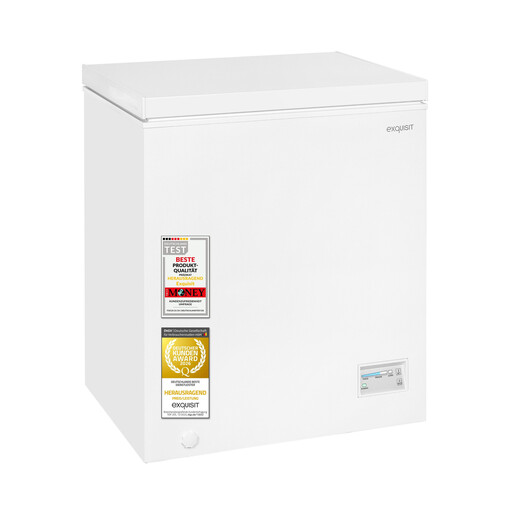
Exquisit offers compact chest freezers such as the GT100-010E weiss. The manufacturer lists a removable basket for this model.
- The stated external dimensions can help you check whether you have room for it.
- Exquisit lists the capacity as 95 or 96 l in different places. Check the usable capacity against the product data sheet. An additional three-year warranty is subject to buying from the Exquisit online shop and other conditions.
Beko
Beko offers chest freezers in various sizes. The manufacturer gives the HS210530N a usable capacity of 104 l.
- Beko describes MinFrost on the HS210530N as a feature that helps reduce ice build-up.
- The manufacturer’s MinFrost claim doesn’t mean you won’t need to defrost the appliance. Beko lists the HS210530N as energy class F with a static cooling system; check the annual consumption for the specific variant.
Bomann
Bomann lists the compact GT 7355 as having a usable capacity of 100 l and a removable freezer basket.
- Bomann states an annual consumption of 135 kWh for the GT 7355.
- The manufacturer gives an ambient temperature range of +16 to +38 °C for this model. Unless the manufacturer specifies otherwise for the model, it isn’t confirmed as suitable for a colder, unheated location.
Amica
The GT 311 105 W is a compact chest freezer for which Amica lists a usable capacity of 99 l and its external dimensions.
- Amica gives the GT 311 105 W an energy class of E.
- The energy class alone doesn’t show whether this model will save you money on electricity compared with others. Compare the annual consumption in kWh to find out.
Liebherr
The CFd 2085 Plus is a larger chest freezer with a manufacturer-stated usable capacity of 248 l.
- For this exact model, Liebherr specifies FrostProtect for ambient temperatures as low as −15 °C.
- The manufacturer describes SmartFrost as reducing ice build-up. If you’re only storing a few portions of cheese, the extra capacity isn’t in itself a reason to choose a larger chest freezer.
Chest freezers at Joybuy
The Joybuy models below are chest freezers for food you need to store regularly and separately. The selection includes models with smaller and larger usable capacities; what matters is your own needs and the space you have available.
 No image available
Exquisit chest freezer, 142 l
The removable basket gives you a way to organise frequently used packs separately.
142 l usable capacity; freezing capacity: 7 kg in 24 hours; annual consumption: 182 kWh; 4-star freezer compartment. Manual defrosting is specified.
View at Joybuy
 No image available
AUCMA convertible chest freezer, 141 l
The removable basket can make it easier to organise food stored separately.
141 l usable capacity; switches between fridge and freezer modes; energy class E; annual consumption: 179 kWh; external dimensions: 632 × 554 × 848 mm.
View at Joybuy
 No image available
AUCMA convertible chest freezer, 95 l
The removable basket offers a way to organise smaller amounts of food stored separately in the freezer.
95 l usable capacity; switches between fridge and freezer modes; energy class E; annual consumption: 165 kWh; external dimensions: 550 × 475 × 848 mm.
View at Joybuy
 No image available
AUCMA convertible chest freezer, 291 l
The larger usable capacity makes this an option if you want room for a substantial amount of food as well as cheese.
291 l usable capacity; energy class E; annual consumption: 226 kWh; external dimensions: 1100 × 597 × 872 mm; removable basket and integrated LED lighting.
View at Joybuy
 No image available
AUCMA convertible chest freezer, 197 l
The removable basket can help you organise food stored separately in the freezer.
197 l usable capacity; switches between fridge and freezer modes; energy class E; annual consumption: 197 kWh; external dimensions: 816 × 554 × 848 mm; 5-stage temperature control.
View at Joybuy
Frequently asked questions
Is my existing freezer compartment big enough for grated cheese?
If you only freeze small portions occasionally and have enough room, check your existing freezer compartment first. The consumer advice centre recommends choosing an appliance size that matches your actual storage needs and gives −18 °C as the optimum temperature for a freezer or chest freezer.
Can I portion grated cheese in advance for meals at different times?
For pre-grated Parmesan, the ‘Zu gut für die Tonne!’ initiative suggests freezing opened packs in portions. According to the initiative, small amounts can be added straight from the freezer to hot pasta. This doesn’t establish that other types or mixes of cheese can be used in the same way or stored for a particular length of time. Freezer-safe, labelled individual packs make it easier to stay organised.
Can I put any chest freezer in an unheated cellar or garage?
No. The permitted ambient temperature depends on the specific model. Bomann gives a range of +16 to +38 °C for the GT 7355, while Liebherr lists FrostProtect down to −15 °C for the CFd 2085 Plus. Check the manufacturer’s information for the full model against the conditions at your chosen location.
How do I compare the energy consumption of chest freezers?
Compare the stated annual consumption in kWh for the exact model variant and also look at its energy efficiency class. The consumer advice centre points out that household consumption may differ from the standardised conditions used for the energy label.
Do I still need to defrost a chest freezer with MinFrost or SmartFrost?
Yes. These manufacturer claims don’t mean that defrosting is no longer necessary. Beko describes MinFrost on the HS210530N as a feature that helps reduce ice build-up; Liebherr describes SmartFrost on the CFd 2085 Plus as reducing ice build-up. Follow the care instructions for the specific model.


