For a few portions of chopped herbs, you probably don’t need an additional chest freezer if there’s enough room in your existing freezer compartment. The Federal Centre for Nutrition recommends freezing finely chopped herbs in portions with a little water. If you regularly run out of space, or freeze other food as well as herbs, compare the usable capacity and annual energy consumption of specific appliances before choosing a size. More storage takes up more floor space, and according to the consumer advice centre, an appliance that’s too large can use unnecessary electricity.
Who might benefit from a separate chest freezer?
Herb portioners short on space
If you freeze small amounts for meals at different times, first check whether your existing freezer compartment is big enough. The Federal Centre for Nutrition recommends freezing chopped herbs with a little water in ice cube trays.
Cost-conscious stockpilers
If you need extra freezer space but don’t want to run an unnecessarily large appliance, compare usable capacity and the stated annual energy consumption. The consumer advice centre recommends choosing an appliance size to suit your needs.
Households with larger quantities to freeze
If you regularly freeze larger quantities or prepared meals as well as herbs, overall capacity and floor space become more important. If you’re placing the appliance in an unheated area, check that the specific model is suitable for the ambient temperature there.
What should you look for when buying?
Existing freezer compartment
A good fit if: There’s already enough room for labelled individual portions and you don’t regularly add larger quantities to freeze.
The trade-off: You won’t need another appliance, but your stock is limited by the available capacity and how easy it is to keep everything organised in your existing freezer.
Compact separate chest freezer
A good fit if: Your existing freezer regularly runs out of room, but you only need to store a modest amount of extra food and have a suitable place for the appliance.
The trade-off: A basket can make it easier to reach smaller packs, but a chest freezer is still an additional appliance that runs continuously.
Larger chest freezer
A good fit if: You regularly need space for larger harvests, prepared meals or other frozen food as well as herbs.
The trade-off: More storage takes up more floor space. If you’re using a cold outbuilding or room, check that the specific model is rated for those conditions.
The consumer advice centre recommends choosing an appliance size to suit your needs, while the Federal Centre for Nutrition explains how to freeze chopped herbs in portions. The figures below give an indication of the main considerations when making this choice.
| Consideration |
What to check when buying |
Who is this especially important to? |
| Finding and taking out portions |
Check there’s room for the containers you actually need; with a chest freezer, look at the baskets and how easy they are to reach. |
When I need herbs at different times, I want to find small portions and take them out individually. Around 50 % of consumers say this is their top priority. |
| Energy consumption |
Compare the usable capacity and stated kWh/year of specific models; use EU energy label figures as standardised comparison values. |
I want an extra appliance to give me more space without having to keep more freezer room than I need. Around 30 % of consumers prioritise the appliance’s running costs. |
| Larger stocks and location |
Check your total freezer stock and the appliance’s external dimensions; if it’s going in a cold room, check the specific model’s permitted ambient temperature. |
If I regularly freeze larger quantities as well as herbs, or the planned location is cold, the capacity and suitability for that location need to work together. Around 20 % of consumers say this is their main consideration. |
Common buying and storage mistakes
-
Buying a large chest freezer too soon for a few portions of herbs
You don’t need a separate chest freezer if your portions fit in your existing freezer compartment. The consumer advice centre points out that an oversized freezer can use unnecessary electricity.
First check how much space is available in your existing appliance and how large your total frozen stock really is. Then choose the usable capacity that suits it.
-
Assuming a standard climate class means it’s suitable for a garage
The permitted ambient temperature varies by model. Bomann specifies +16 °C to +38 °C for the GT 7355, while Liebherr advertises FrostProtect down to −15 °C for the CFe 1870 Pure.
If you’re placing a chest freezer in a cold cellar or garage, check the details for the exact model. Don’t assume that because one appliance is suitable, other models from the same brand will be too.
-
Comparing old A++ ratings with the current EU energy label
Since 1 March 2021, the European Commission has used a rescaled A to G energy label for household fridges and freezers. An older rating can’t be read as a direct equivalent of today’s classification.
For the specific model, compare the current energy efficiency class and the stated kWh/year.
-
Freezing chopped herbs in one large block
A large frozen block is harder to divide up for individual meals. The Federal Centre for Nutrition recommends measuring out the amount you need and freezing it in portions.
Pack the herbs in individual portions and label them so you can take out the right amount later.
Brands and models to consider
Bomann
The GT 7355 and GT 7356 chest freezers offer different usable capacities and freezing capacities.
- Bomann specifies 100 l, a removable basket and 135 kWh/year for the GT 7355. For the GT 7356, the manufacturer gives a freezing capacity of 12 kg/24 h.
- Bomann specifies a climate class of +16 °C to +38 °C for the GT 7355. This means it shouldn’t be assumed to be suitable for cold outbuildings or rooms.
Exquisit
The GT100-050E weiss is a compact chest freezer that the manufacturer says can also be switched to cooling mode.
- Exquisit specifies a usable capacity of 99 l, external dimensions of 54,5 × 83,5 × 48 cm and energy consumption of 169 kWh/year.
- Make sure the dimensions suit your available space, and check that the stated capacity is enough for your total stock.
Beko
The HSM14550 offers 148 l of usable capacity for extra freezer space.
- Beko specifies a D energy efficiency class and LED interior lighting for the HSM14550.
- Compare the appliance’s size and specific energy consumption figures with your total freezer needs.
Liebherr
Liebherr says the CFe 1870 Pure is designed for larger stocks and locations with low ambient temperatures.
- Liebherr specifies a capacity of 281 l, a width of 104 cm and FrostProtect for ambient temperatures down to −15 °C. The manufacturer describes SmartFrost and StopFrost as features that help reduce frost build-up.
- Its capacity and width may be more than you need just for herbs. The stated frost protection and frost-reduction features apply to this model.
Amica
Amica’s range includes chest freezers with a choice of usable capacities.
- For the GT 313 105 W, Amica specifies a capacity of 199 l, an E energy efficiency class and a fast-freeze function.
- Choose a size that suits your total stock; the description of the function is provided by the manufacturer.
Chest freezers at Joybuy
This selection includes separate chest freezers for extra freezer space, from compact appliances to models for larger stocks. A larger capacity makes most sense for herb portions if you also regularly freeze other food.
 No image available
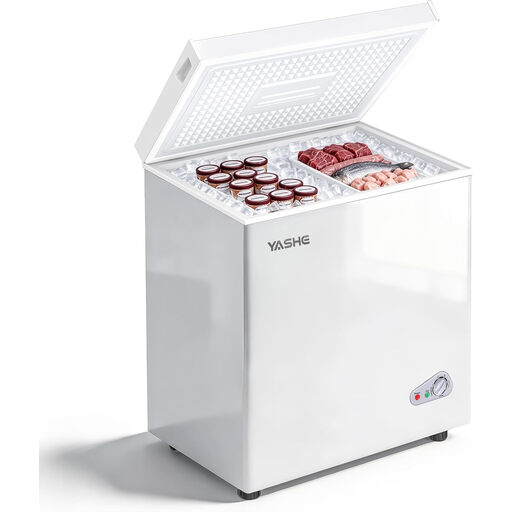
YASHE BC-150Q-EU, 150 l
A separate chest freezer with two removable baskets could be a good choice if you need extra freezer space as well as room for herbs.
150 l usable capacity, two removable baskets, six temperature settings, freestanding, white.
View at Joybuy
 No image available
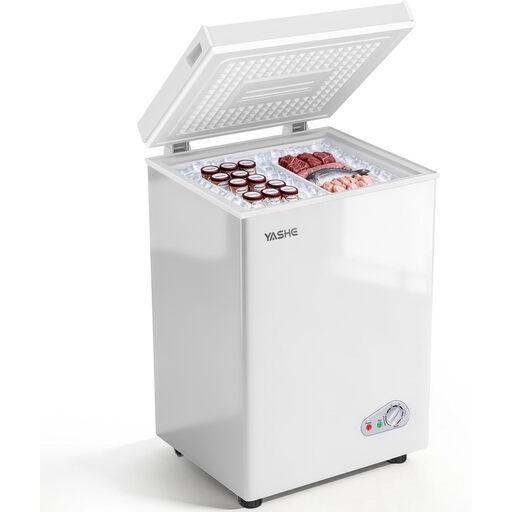
YASHE BC-100Q-EU, 100 l
A more compact separate chest freezer could suit a modest amount of extra food, as long as you have a suitable place for it.
100 l usable capacity, two removable baskets, six temperature settings, freestanding, white.
View at Joybuy
 No image available
AUCMA chest freezer, 95 l, convertible
Its compact capacity could suit a small amount of extra food. Before buying, check that the convertible function works for the way you plan to use it.
95 l, switches between cooling and freezing modes, one removable basket, seven thermostat settings, E energy efficiency class.
View at Joybuy
 No image available
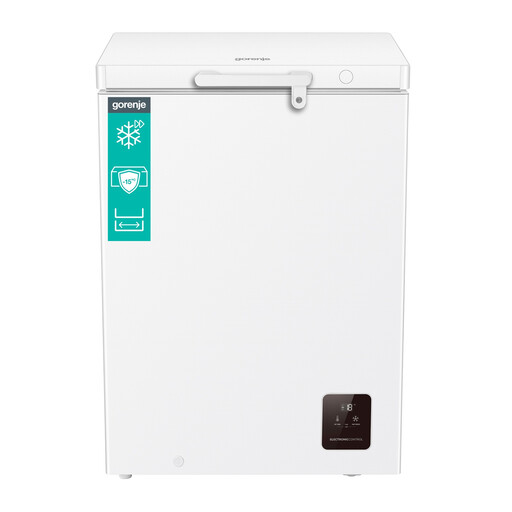
Gorenje FH15E6W5, 141 l
Its stated suitability for low ambient temperatures could be useful if you’re placing it somewhere cold. Check that the conditions are right for your location.
141 l usable capacity, FreezeProtect for ambient temperatures down to −15 °C, flexible basket, electronic controls.
View at Joybuy
 No image available
AUCMA chest freezer, 197 l, convertible
This larger capacity is more likely to suit households that freeze other food as well as herbs. The consumer advice centre recommends avoiding oversized appliances.
197 l, switches between cooling and freezing modes, one removable basket, five digital temperature settings, E energy efficiency class.
View at Joybuy
Frequently asked questions
Do I need to buy a separate chest freezer for chopped herbs?
No, not if there’s enough room in your existing freezer compartment. The Federal Centre for Nutrition recommends freezing finely chopped herbs with a little water in ice cube trays. An additional chest freezer is mainly a question of capacity if your existing freezer doesn’t have enough room for the food you plan to store.
How can I tell portions apart when I need them at different times?
Measure out the amount you need before freezing and label suitable freezer bags or containers with the contents, quantity and date. That way, you won’t have to break up a larger frozen block later.
How do I compare the energy consumption of chest freezers?
Compare the stated annual energy consumption in kWh alongside the usable capacity. The EU energy label shows standardised consumption figures, but actual energy use may vary depending on where you place the appliance.
Which labelling and disposal rules apply in Germany?
Household freezers carry the EU energy label, with an A to G scale and details including annual energy consumption and capacity. According to the German Environment Agency, old electrical appliances must not be put in household rubbish. When you buy a new appliance of the same type, large old appliances can also be returned free of charge when the new one is delivered, including with online purchases.


