What should you look for when buying?
Use your existing freezer compartment
A good fit if: you only prepare small amounts of herbs now and then and have room for the containers.
Consider: you won’t need another appliance or extra floor space, but your existing freezer may not have enough room for larger stocks.
Compact chest freezer
A good fit if: herb portions are part of a regular but modest stock-up routine, and you genuinely need extra freezer space.
Consider: even a compact extra appliance needs room and uses electricity. Beko and Exquisit offer examples with usable capacities of 98 l and 99 l respectively.
Larger chest freezer
A good fit if: you also regularly store larger quantities of meals, home-grown produce or frozen food, and will make use of the extra capacity.
Consider: more space can make small portions of herbs harder to reach. The consumer advice centre warns that an appliance that’s too large for your needs can use more electricity than necessary.
The Federal Centre for Nutrition recommends ice cube trays for small amounts of herbs. If you’re considering an extra appliance, the key things to check are its usable capacity, space for your containers and annual energy consumption.
| Consideration |
What to check before buying |
Who is this important to? |
| Extra appliance or existing freezer compartment |
How often and how much do you freeze besides herbs? Is there already room for an ice cube tray in your existing freezer? |
If I only prepare herbs for shared meals now and then, I’d rather not add another appliance if my freezer has enough room; around 36% of consumers focus on whether they need an extra appliance. |
| Taking out small portions |
Check whether there’s a basket, whether it’s easy to reach and whether your containers will fit inside. |
If I store small portions of herbs alongside other supplies, I want to find and take them out quickly; around 29% of consumers prioritise easy access to small portions. |
| Space for other supplies |
Make a note of what you regularly freeze, then compare usable capacities and external dimensions. |
If I regularly freeze meals or other supplies too, I need enough space for the quantities I store; around 21% of consumers put the storage capacity they need first. |
| Energy use and positioning |
Compare the kWh/year figure and noise level on the EU label. Check the available space and the specific model’s permitted ambient temperature. |
If I’m adding an appliance that will run all the time, I want to understand its energy use and where it can be placed before buying; around 14% of consumers prioritise running costs and positioning. |
Chest freezers at Joybuy
The selection includes compact chest freezers for smaller extra stocks, as well as larger models for households that regularly freeze more food.
 No image available
AUCMA Convertible chest freezer, 141 l
An option if herb portions are part of a regular stock-up routine and you need extra freezer space.
Usable capacity: 141 l, energy class E, 179 kWh/year and a removable basket.
View at Joybuy
 No image available
AUCMA Convertible chest freezer, 95 l
A compact option if you want to freeze extra supplies regularly, but in limited quantities.
Usable capacity: 95 l, energy class E, 165 kWh/year and a removable basket.
View at Joybuy
 No image available
AUCMA Convertible chest freezer, 291 l
A larger option if you regularly freeze substantial quantities of other supplies as well as herbs.
Usable capacity: 291 l, energy class E, 226 kWh/year and a removable basket.
View at Joybuy
 No image available
AUCMA Convertible chest freezer, 197 l
An option if you need room for herb portions alongside other supplies you freeze regularly.
Usable capacity: 197 l, energy class E, 197 kWh/year and a removable basket.
View at Joybuy
 No image available
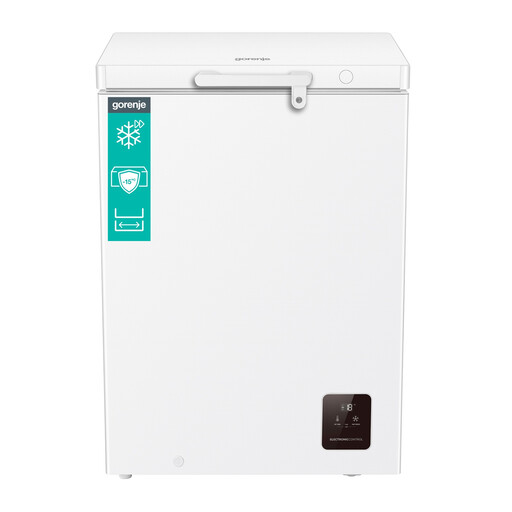
Gorenje FH15E6W5 chest freezer, 141 l
An option if you need extra freezer space and a basket to help organise frozen food.
Usable capacity: 141 l, 182 kWh/year and a flexible wire basket. FreezeProtect is listed for this model for ambient temperatures down to −15 °C.
View at Joybuy
Frequently asked questions
How can I freeze chopped herbs for future meals?
The Federal Centre for Nutrition recommends finely chopping fresh herbs and freezing them in ice cube trays with a little water. If you want to use the herbs fresh that same evening, there’s no need to freeze them first.
What is a suitable freezer temperature?
The consumer advice centre gives −18 °C as the optimum temperature for freezers. If your chest freezer can switch between chilling and freezing, make sure it’s set to freezer mode for frozen food.
Can any chest freezer go in an unheated cellar?
No, you can’t tell from the design alone. Check the permitted ambient temperature for the specific model. Liebherr says its appliances are suitable down to −15 °C only if they’re equipped with FrostProtect.
Which energy label applies when buying in Germany?
The household freezers covered here use the EU energy label, with classes from A to G. Among other details, it shows annual energy consumption, freezer volume and noise emissions. The European Commission explains the labelling system but doesn’t specify a particular class as the one to buy.
How do I dispose of an old chest freezer?
An old chest freezer shouldn’t go in your household rubbish. The German Environment Agency lists recycling centres as an option and says you can return a large, like-for-like old appliance free of charge when buying a new one, including online purchases with delivery. Check how the arrangements work before placing your order.


