Who is this relevant to?

Occasional hosts

If you’re preparing a side dish for a meal with others, first check whether your existing freezer has enough room for the portioned containers. The Verbraucherzentrale and the German Federal Institute for Risk Assessment emphasise that the freezer space available should match your needs.

Regular batch cooks

If you regularly freeze several portions, consider both the storage space you need and how much the appliance can freeze in a day. The German Federal Institute for Risk Assessment recommends allowing enough room for prepared food.

Stocking up with limited space

If you want to store other supplies in the chest freezer as well as prepared meals, make sure the appliance’s dimensions, the space needed to open the lid and the conditions at your chosen location are all suitable. Check these details for the specific model.

What should you look for when buying?

Existing freezer compartment

A good fit if: you only freeze mashed potato occasionally for a meal with others and have enough room for the containers.

The trade-off: you won’t need another appliance running all the time, but preparing several dishes at once may use up the space you already have.

Compact chest freezer

A good fit if: you regularly freeze several extra portions but don’t need to store large quantities of food.

The trade-off: you’ll need extra floor space, and should choose the usable capacity, freezing capacity and access to smaller containers to suit your routine.

Larger chest freezer

A good fit if: you regularly store larger batches or other supplies as well as mashed potato, and have enough room.

The trade-off: a chest freezer that’s too large for your actual needs can use more electricity than necessary; the Verbraucherzentrale recommends matching your needs to the appliance’s capacity.

Priority What to check when buying Who is it important to?
Space that suits your needs Check the free space in your existing appliance; compare the usable capacity in litres with your portioned containers. If I only batch-cook for the occasional meal with others, I want to know first whether my existing freezer is big enough. Around 37% of consumers put the space they need first.
Freezing new batches If you often freeze larger quantities, compare the freezing capacity in kg/24 h; divide larger amounts of food into shallow portions to cool them. If several cooled portions are going into the appliance at once, I look at how much it can freeze. Around 27% of consumers prioritise freezing new batches.
Energy consumption When comparing appliances of a suitable size, check annual energy consumption in kWh, not just the efficiency class. If an extra chest freezer will run between meals shared with others, I want to be able to estimate how much electricity it will use. Around 18% of consumers focus first on running costs.
Location and access Measure the floor space and clearance above the lid; if the room is cold, check the temperature range approved for the specific model. If I have limited space or the location isn’t heated, I need suitable dimensions and explicit approval for the ambient temperature. Around 18% of consumers prioritise where the appliance will go.

Common buying misconceptions

  • Buying a large chest freezer just for one meal

    A chest freezer with far more capacity than you need can use more electricity than necessary. The Verbraucherzentrale recommends checking the freezer space you already have and your own needs first.

    If you batch-cook regularly, estimate the space you need based on your containers before choosing an extra appliance.

  • Confusing usable capacity with freezing capacity

    Capacity in litres doesn’t tell you how many new portions an appliance can freeze in 24 hours. AEG lists a freezing capacity of 15 kg/24 h for the AHB531D1LW model; this figure applies to that model only.

    If you often freeze larger batches, also compare the freezing capacity in kg/24 h stated for the specific model.

  • Assuming LowFrost means you’ll never need to defrost

    AEG describes LowFrost on the AHB531D1LW model as a feature that reduces ice build-up. It doesn’t mean that defrosting will never be necessary.

    Check the defrosting system of the specific model and bear in mind that it may still need defrosting.

  • Using an unheated garage without checking first

    Approval for low ambient temperatures only applies to models for which the manufacturer specifies it. Gorenje and Liebherr each list this information for certain chest freezers.

    Compare the expected temperature at the location with the ambient temperature range explicitly approved for the appliance you’ve chosen.

Key brands at a glance

Beko

Chest freezers in a range of sizes; the CF316EWN is an example of a larger appliance for regularly storing supplies.

  • Beko lists 308 l of freezer space, a width of 112 cm, efficiency class E and a static cooling system for the CF316EWN.
  • Its capacity may be more than you need if you only freeze small portions occasionally.

Gorenje

The FH30EAW is an option to compare if you freeze new batches or need a chest freezer explicitly suited to a cold location.

  • Gorenje lists FastFreeze, flexible baskets and suitability for ambient temperatures down to −15 °C for this model.
  • These are the manufacturer’s specifications for the FH30EAW, not independent proof of its freezing performance; the model is listed with efficiency class E.

AEG

The AHB531D1LW is worth comparing if freezing capacity, organisation and less frequent defrosting are important to you.

  • AEG lists a capacity of 308 l, a freezing capacity of 15 kg/24 h, 188 kWh/year and three baskets for this model.
  • According to AEG, LowFrost reduces ice build-up; defrosting may still be necessary.

Haier

The HCE321T is an example from the CHEST SERIE 3 range for comparing capacity and dimensions.

  • Haier lists a capacity of 319 l, efficiency class D and external dimensions of 1410 × 745 × 845 mm.
  • Manufacturer claims about airflow or seals aren’t, by themselves, independent proof that cooked food can be stored hygienically.

Liebherr

The CFd 2085 Plus is an option to consider if you need a chest freezer explicitly approved for a cold location.

  • Liebherr lists a total capacity of 248 l, a width of 125 cm and FrostProtect down to −15 °C.
  • The information on suitability for cold conditions and reduced frost build-up applies to this model; less frost doesn’t mean you’ll never need to defrost it.

Chest freezers at Joybuy

This selection includes compact and larger chest freezers for extra space and freezing prepared portions.

Exquisit chest freezer with 142 l usable capacity

Exquisit chest freezer, 142 l

Could suit you if you need extra space for portions and are looking for a compact chest freezer with a stated freezing capacity.

142 l usable capacity; freezing capacity of up to 7 kg/24 h. Electronic temperature control with LED display, fast-freeze function, removable basket, reversible door hinge and castors. Manual defrosting is required.

Joybuy
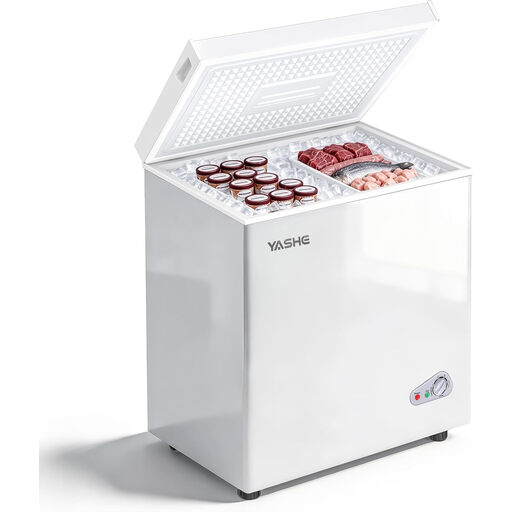
YASHE BC-150Q-EU chest freezer with 150 l capacity

YASHE BC-150Q-EU chest freezer, 150 l

Could be worth considering if you need extra freezer space and separate access to smaller portions.

150 l capacity, two removable baskets and six temperature settings. Described as a freestanding appliance.

Joybuy
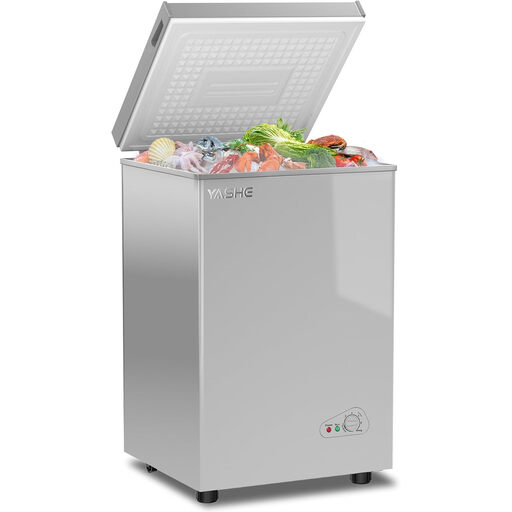
YASHE BC-100Q-EU chest freezer with 100 l capacity

YASHE BC-100Q-EU chest freezer, 100 l

Could suit smaller extra supplies if you’d like removable baskets to help keep things organised.

100 l capacity, two removable baskets and six temperature settings. Stated annual energy consumption is 185 kWh.

Joybuy

AUCMA chest freezer with 291 l capacity and switchable fridge and freezer modes

AUCMA chest freezer, 291 l, convertible

Could suit larger quantities if you’d also like the option to switch between fridge and freezer modes.

291 l capacity and efficiency class E. A removable shelf and LED lighting are listed. According to the product information, a minimum clearance of 10 cm around the appliance is needed for ventilation.

Joybuy

AUCMA chest freezer with 197 l capacity and switchable fridge and freezer modes

AUCMA chest freezer, 197 l, convertible

Could provide extra freezer space if a removable basket for smaller portions would be useful.

197 l capacity and efficiency class E. Listed features include 197 kWh/year, digital temperature control with five settings, a removable basket and a drain outlet.

Joybuy

Frequently asked questions

Can I put freshly cooked mashed potato straight into the chest freezer?

Divide larger quantities into shallow portions and cool them quickly rather than leaving one large, warm container to stand for a long time. The German Federal Institute for Risk Assessment recommends cooling leftovers to below +7 °C within a few hours. A chest freezer doesn’t replace this step.

What temperature should a freezer reach?

The Verbraucherzentrale recommends −18 °C as the ideal temperature for a freezer. Check the temperature setting; a fast-freeze function is a separate feature.

What should I check before putting it in a cellar or garage?

Compare the expected ambient temperature with the approval for the specific model, and measure the floor space and clearance needed to open the lid. Gorenje lists the FH30EAW, and Liebherr the CFd 2085 Plus, as suitable for ambient temperatures down to −15 °C; this doesn’t mean other chest freezers are approved for the same conditions.

What running costs and rights should I compare when buying?

Compare the stated annual energy consumption in kWh; your electricity costs will also depend on your tariff and how you use the appliance. In Germany, the statutory guarantee from the seller is separate from a voluntary warranty. For purchases made from 31.07.2026, the Verbraucherzentrale explains that the guarantee period may be extended to three years if a fault is repaired within the first two years.

Does a new chest freezer in Germany need an energy label?

For household refrigerating appliances covered by the rules, EU Regulation 2019/2016 sets out requirements for energy labels and product information. Compare the current A-to-G label; since the 2021 rescaling, the older plus-rated classes are no longer the current benchmark for this category of appliance.