Weekly batch cooks
If you regularly freeze several portions of cooled lunches, allow space for the new batch as well as your other frozen food.


An extra chest freezer isn’t always necessary. If your existing freezer has enough room for the cooled portions as well as your other frozen food, it may be all you need. If you regularly freeze larger quantities, compare the total storage space you need with the amount the appliance can freeze in a day. Also factor in energy consumption, where it will go and how easy it is to reach individual portions. The Verbraucherzentrale recommends checking how much space you actually need. A freezer doesn’t replace the need to cool food safely and keep it chilled until you eat it.
If you regularly freeze several portions of cooled lunches, allow space for the new batch as well as your other frozen food.
If you need extra freezer space, consider not only the external dimensions but also the clearance needed to open the lid.
If you plan to put it in a cellar or another location that can get very cold, check the minimum ambient temperature permitted for the specific model.
If your existing freezer doesn’t have enough capacity, start by working out the size of your largest fresh batch and how much food you store in total. You can then compare freezing capacity, volume, energy consumption, the space available and how easy it is to reach individual portions.
| What you need | What to check before buying | Who should pay particular attention? |
|---|---|---|
| Freezing a new weekly batch | Compare the weight of your largest fresh batch with the freezing capacity in kg/24 h; check that the freezer has a suitable freezing section. | If I freeze a larger fresh batch every week, the appliance needs to be able to handle that amount. Around 27% of consumers would look at freezing capacity first in this situation. |
| Space for portions and other frozen food | Allow room for your containers and other frozen food together; compare the usable capacity of the freezer compartment. | If you want to store other food alongside your lunch portions, you need enough room for everything. Around 27% of consumers would prioritise extra storage capacity. |
| Ongoing energy consumption | Compare the current EU energy label for the exact model and its annual consumption in kWh. | If I’m going to run an extra appliance all the time, I want to weigh up its energy consumption against the storage space I need. Around 20% of consumers would look at running costs first. |
| Installation space and room temperature | Measure the route for moving it in, the floor space and the clearance above the lid; if it’s going in a cold utility room, check the minimum permitted temperature. | If space is limited or the freezer is going in a cold utility room, the location may affect your choice. Around 13% of consumers would first consider the floor space or ambient temperature. |
| Finding individual portions | Check the number and layout of the baskets; label containers with their contents and the date they were frozen. | If I often take out individual lunch portions, I want to be able to find them quickly among the other frozen food. Around 13% of consumers would prioritise easy access to individual portions. |
Capacity in litres and freezing capacity measure different things: usable volume tells you how much food will fit inside, while kg/24 h refers to how much the specific model can freeze in a day. The Umweltbundesamt recommends using the annual consumption shown on the current EU energy label to compare appliances.
Usable volume doesn’t tell you how much fresh food the appliance can freeze in a day. The manufacturer gives the Exquisit GT5150-E-041E a usable capacity of 142 l and a freezing capacity of 7 kg per 24 hours.
Estimate the total volume of your frozen food in litres and the largest fresh batch you’ll freeze in a day in kilograms, separately.
A freezer can’t make food safe after it has been stored incorrectly. The Bundesinstitut für Risikobewertung warns of the risks of not keeping food sufficiently chilled.
Cool food promptly after cooking and keep it sufficiently chilled on the way to lunchtime, too.
The information below relates to specific example models and isn’t a general assessment of a brand’s entire range.
The GT5150-E-041E is a compact example model for extra storage space.
The 148 l HSM14550 is another example model in the compact capacity range.
The GT 8849 is an example for homes that regularly want to store other frozen food alongside lunch portions.
The CFc 1875 Plus is an example model for a cold utility room.
This selection includes chest freezers offering extra room for prepared portions and other frozen food. According to their product names, some models can be switched between fridge and freezer modes.
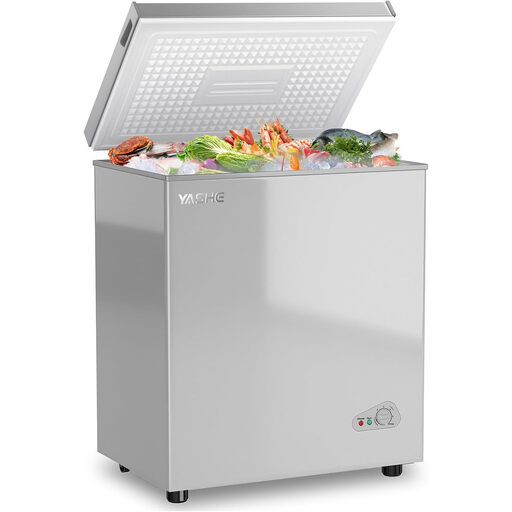 No image available
Extra freezer space if your existing compartment doesn’t have enough room for prepared portions.
150 L; freestanding; two removable baskets; six temperature settings.
 No image available
An option for extra portions if your existing freezer doesn’t have enough capacity.
141 L; switches between fridge and freezer modes; energy class E; 7-setting temperature control; removable basket; defrost drain.
 No image available
For homes that need space for lunch portions as well as other frozen food.
291 L; switches between fridge and freezer modes; energy class E; 5-setting digital temperature control; removable basket; integrated LED lighting; defrost drain.
 No image available
An option for extra portions and other frozen food if you need more space than individual lunch containers require.
197 L; switches between fridge and freezer modes; energy class E; 5-setting digital temperature control; removable basket; defrost drain.
 No image available
An option for extra freezer space. If you plan to put it somewhere cold, check that the specifications suit the ambient conditions.
141 L; FastFreeze; FreezeProtect −15 °C; InverterCompressor; flexible baskets; electronic controls.
No, not if your existing freezer has enough room to hold and freeze the new portions along with your other frozen food. If you regularly freeze larger quantities, an extra chest freezer may be useful. First check how much space you need and the appliance’s freezing capacity.
Cool the food promptly after cooking, portion it out and keep it sufficiently chilled until it’s frozen, and again after defrosting. Label suitable containers with their contents and the date they were frozen, then reheat the food thoroughly before eating.
Only if the permitted ambient temperature for the exact model covers the temperatures at your chosen location. Liebherr specifies FrostProtect down to −15 °C for the CFc 1875 Plus; this rating doesn’t automatically apply to other appliances.
Use the current EU energy label for the specific appliance; the old plus ratings are no longer current. The Umweltbundesamt notes that the label shows annual consumption in kilowatt-hours. So compare the model and its kWh/year figure rather than relying on an older energy class.
Don’t put an old chest freezer in your household rubbish. Take it to an authorised collection point, such as a municipal recycling centre. The Umweltbundesamt notes that public waste disposal authorities generally accept appliances free of charge at collection points.