What should you look for when choosing one?
Existing freezer compartment
A good fit if: you only have leftover sauce occasionally and there’s enough freezer space available.
The trade-off: The available space limits how many portions you can store at once.
Compact chest freezer
A good fit if: you regularly have extra portions to freeze but space is limited.
The trade-off: Less capacity means less room for sauce and other food supplies.
Medium or large chest freezer
A good fit if: you regularly freeze larger quantities of sauce and other food, and have enough room for the appliance.
The trade-off: More storage space takes up more room, and an additional appliance adds to your ongoing electricity use. The Verbraucherzentrale warns against choosing an oversized appliance.
When choosing a freezer for pasta sauce in Germany, the key factors are how much you need to store at once, the space available, energy consumption and how easily you can access individual portions.
| Priority |
What to check when buying |
Who is this important for? |
| Freezer space for portions and food supplies |
Check the available freezer space and how much you usually store; compare usable capacity rather than relying on a general size description. |
If I regularly freeze several portions of sauce and other food, I need enough room without choosing an unnecessarily large appliance. Around 36% of consumers prioritise capacity for regular batches of food. |
| Space and appliance dimensions |
Measure the width, depth, route for moving the appliance and the clearance needed to open the lid at its intended location. |
If space is limited, the appliance must fit in the intended area with the lid open. Around 29% of consumers prioritise finding an appliance that fits the available space. |
| Energy consumption |
Consider kWh/year, usable capacity and the EU energy efficiency class together; actual consumption also depends on how and where the appliance is used. |
If I’m going to run another appliance continuously, I want to take its stated consumption into account before deciding on extra capacity. Around 21% of consumers prioritise ongoing costs. |
| Portions and access |
Check the baskets and how easy the contents are to reach; use suitable containers, fill them with individual portions and label them with the contents and date. |
If I want to find individual portions or different sauces easily, keeping things organised is important. Around 14% of consumers prioritise being able to take out individual portions easily. |
Chest freezers at Joybuy
This selection includes compact to medium-sized chest freezers for regular portions of sauce and extra food supplies.
 No image available
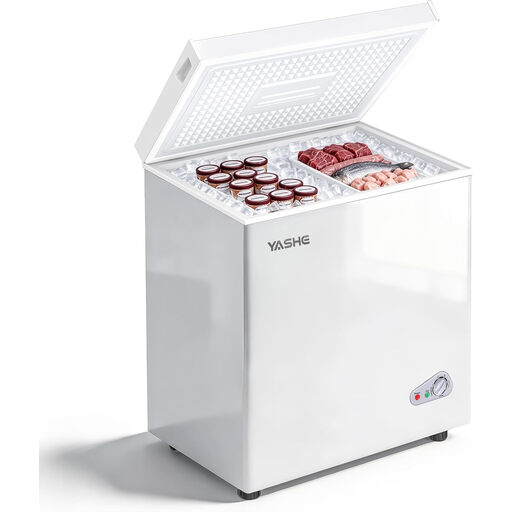
YASHE BC-150Q-EU chest freezer, 150 l
For regular portions of sauce and other food supplies; two baskets make it easier to keep things separate.
Usable capacity: 150 l.
Annual energy consumption: 157 kWh.
Two removable baskets and six temperature settings.
Freestanding appliance with integrated wheels; check that the dimensions suit your space.
View at Joybuy
 No image available
AUCMA convertible chest freezer, 141 l
For regular portions and extra frozen food; whether it’s right for you also depends on the space available.
Usable capacity: 141 l; energy efficiency class E according to the product information.
Annual energy consumption: 179 kWh.
Switches between fridge and freezer modes; the product information lists one removable basket and a defrost drain.
External dimensions according to the product information: 632 × 554 × 848 mm.
View at Joybuy
 No image available
AUCMA convertible chest freezer, 95 l
A more compact option for regular extra freezer space when room is limited.
Usable capacity: 95 l; energy efficiency class E according to the product information.
Annual energy consumption: 165 kWh.
Seven thermostat settings and one removable basket.
External dimensions according to the product information: 550 × 475 × 848 mm; switches between fridge and freezer modes.
View at Joybuy
 No image available
CHiQ chest freezer, 99 l, 4-star freezing
For extra frozen food when space is limited; the product information lists a wire basket for keeping items organised.
Usable capacity: 99 l; energy efficiency class E according to the product information.
Freezing capacity: 4.5 kg/24 h.
External dimensions according to the product information: 54.5 × 47.6 × 83.5 cm; wheels are listed.
View at Joybuy
 No image available
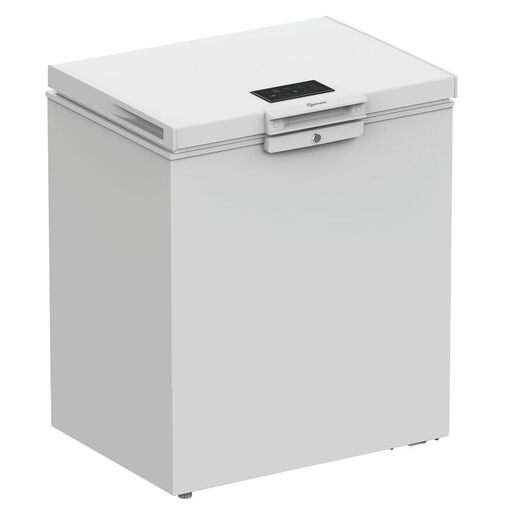
Bauknecht GTE 150MD chest freezer, 142 l
For regular batches of food to freeze; check that the dimensions suit the intended location.
Usable capacity: 142 l; energy consumption: 146 kWh/year.
Freezing capacity: 8 kg/24 h; one basket is listed.
The product information states WinterProof down to −15 °C; check the ambient temperature at the intended location against this figure.
External dimensions according to the product information: 70.5 × 55.0 × 85.0 cm.
View at Joybuy
Frequently asked questions
What size freezer do I need if I only have sauce left over from one meal?
First, check whether there’s room in your existing freezer. The Verbraucherzentrale recommends a separate freezer mainly for regularly storing larger quantities, and advises against choosing a size that exceeds your needs.
How should I pack pasta sauce for freezing?
Divide the sauce into portions that you’ll need later and use suitable freezer containers. Label them with the contents and date, and leave some room in the container for liquid food. The Verbraucherzentrale recommends filling it to only around three-quarters full.
Can I put any chest freezer in an unheated cellar?
No, it depends on the specific model and the ambient temperature. Liebherr states that FrostProtect works down to −15 °C for the CFd 2085 Plus; this doesn’t mean other appliances are suitable for those conditions.
What should I check about energy consumption and delivery?
Compare the stated annual consumption in kWh with the usable capacity and how you plan to use the appliance. Also check the individual offer to see whether delivery into your home, installation and removal of your old appliance are included; these services aren’t covered by the appliance specifications.
What should I know about energy labels and disposing of an old appliance in Germany?
The EU energy label for new freezers uses classes from A to G. Your Europe points out that appliances requiring a label must also display it in online shops. Electrical appliances must not go in household waste; take them to an authorised collection point instead. Retailers’ take-back obligations apply under certain conditions.


