What should you look for when buying?
Keep using your existing freezer compartment
A good fit if: occasional portions, already cooled, will fit alongside your other frozen food.
The trade-off: You won’t be adding another appliance that needs to run all the time, but space and freezing capacity will remain limited.
Compact to medium-sized chest freezer
A good fit if: you regularly freeze extra portions and other food, but have limited space.
The trade-off: The interior layout needs to suit your portions. You’ll also need to consider the floor space, defrosting and energy consumption.
Larger chest freezer for regular batches
A good fit if: you regularly freeze larger quantities of fresh food as well as your usual stock.
The trade-off: More usable capacity doesn’t guarantee suitable freezing performance. If the freezer will be kept in an unheated space, check that the specific model is approved for those conditions.
The Verbraucherzentrale recommends choosing capacity to suit the amount of food you actually store. For meals at different times, the Federal Centre for Nutrition recommends measured portions that can be taken out individually.
| What matters |
What to check before buying |
Who is this important to? |
| Freezing capacity |
Work out the weight of your largest fresh batch of peas and compare it with the exact model’s freezing capacity in kg per 24 hours. Check separately whether it has a fast-freeze function. |
If I have several freshly blanched batches to freeze at once, what matters is how much the appliance can freeze in 24 hours. Around 31% of consumers put enough capacity for their largest batch first. |
| Individual portions |
Check that the baskets and interior can accommodate the portion containers you plan to use, with room to label them. |
If meals are eaten at different times, I want to be able to find and take out individual portions of peas. Around 25% of consumers prioritise portions that are easy to access. |
| Storage space and footprint |
Compare the total amount of food you’ll store at once with the usable capacity, and check the width, depth, height and clearance needed to open the lid. |
If I’m putting other food in the freezer as well as peas, there needs to be enough room without the appliance taking up too much of the available space. Around 25% of consumers put a suitable size and footprint first. |
| Annual energy consumption |
For models of a suitable size, compare the annual consumption in kWh shown on the current EU energy label. |
If an extra chest freezer is going to run all the time, I want to take into account the consumption of a suitable model. Around 19% of consumers prioritise ongoing energy consumption. |
Chest freezers at Joybuy
The following Joybuy products include chest freezers for extra storage and freezing food in portions. Compare the freezing capacity, usable capacity, dimensions and annual energy consumption of each model.
 Image unavailable
Exquisit chest freezer, 142 l
A removable basket is listed, making it easier to store extra food and take items out separately.
142 l usable capacity; freezing capacity up to 7 kg per 24 hours; 182 kWh per year; fast-freeze function; manual defrosting.
View at Joybuy
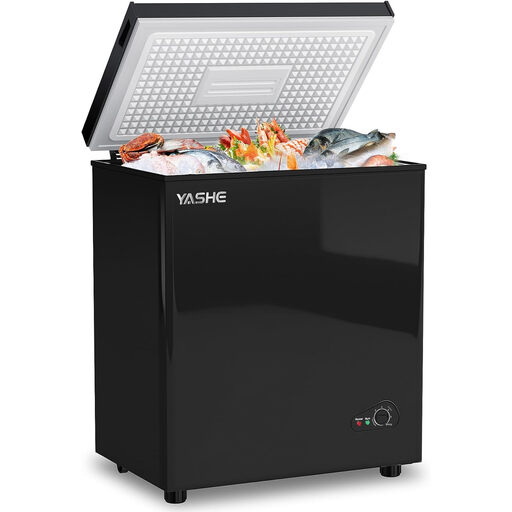 Image unavailable
YASHE BC-150Q-EU chest freezer, 150 l
The two removable baskets can help keep different food stores neatly organised.
150 l; two removable baskets; six temperature settings; fast-freeze function; 157 kWh per year.
View at Joybuy
 Image unavailable
AUCMA convertible chest freezer, 197 l
A removable basket is listed for extra storage, and the model is described as a convertible chest freezer.
197 l; 4-star freezer compartment; energy efficiency class E; five-stage digital temperature control; external dimensions 816 × 554 × 848 mm.
View at Joybuy
 Image unavailable
TCL CF182EWE0 chest freezer, 140 l
A storage basket is listed to help keep smaller amounts of food organised separately.
140 l; energy efficiency class E; one storage basket; counterbalanced lid; adjustable temperature control; external dimensions 637 × 556 × 846 mm.
View at Joybuy
 Image unavailable
TCL CF126EWE0 chest freezer, 98 l
The smaller stated usable capacity may suit a more limited amount of extra food; a storage basket is also listed.
98 l; energy efficiency class E; counterbalanced lid; adjustable temperature control; external dimensions 54,5 × 47,6 × 83,5 cm.
View at Joybuy
Frequently asked questions
Should you cool and portion blanched peas before freezing them?
Yes. The Federal Centre for Nutrition recommends cooling blanched vegetables in iced water, then freezing measured portions in suitable packaging, with as little air as possible inside. Label each pack with its contents, quantity and date, so it’s easier to identify individual portions later.
How should I store fresh peas alongside food that’s already frozen?
Where possible, don’t place food that hasn’t frozen yet directly on top of frozen food, as this could cause it to start thawing. The Verbraucherzentrale gives −18 °C as the optimum temperature for freezers.
Which energy label applies when buying in Germany?
Household freezers use the EU energy label, which has used an A to G scale since 1 March 2021. The European Commission says it includes information such as annual energy consumption, freezer capacity and noise emissions.
Can I put an old chest freezer in household waste?
No. According to information from the German Federal Ministry for the Environment, old electrical appliances must be taken to an authorised collection point or handed to an appropriate take-back provider. Whether a retailer will take back an old appliance depends, among other things, on the legal requirements and, in some cases, on buying an equivalent new appliance. Check in advance whether collection is available.


