Choose a chest freezer based on how much you freeze at a time, the size of your overall frozen stock and the space available. If you eat at different times, it’s also worth packing and labelling the peas in individual portions. The Federal Centre for Nutrition recommends freezing measured portions, while the consumer advice centre warns that an oversized appliance can use more electricity than necessary.
Who is a chest freezer suitable for?
Households with staggered mealtimes
If you want to take out small portions of peas at different times, you can measure them out, pack them individually and label them. The Federal Centre for Nutrition recommends freezing food in portions, so you won’t have to break up a large frozen block later.
Households with a larger pea harvest
If you regularly blanch and freeze larger quantities, look beyond the usable capacity and check the freezing capacity of the specific model too. For example, Bauknecht lists a capacity of 16 kg per 24 hours for the GTE 220.
Households with limited space
If space is tight or the room is unheated, check the dimensions, the clearance needed to open the lid and, where relevant, whether the appliance is approved for low ambient temperatures. Gorenje states that the FH20E6W5 can operate at ambient temperatures down to −15 °C.
What should you look for when buying?
When freezing blanched peas for staggered mealtimes, your priorities will depend on whether easy access to portions, larger batches, the location or running costs matter most.
| What matters |
What to look for |
Who is this especially important for? |
| Finding portions again |
Check the baskets and how easy it is to reach the bottom of the freezer; pack and label portions separately. |
If I take out peas at different mealtimes, I don’t want to have to break up a large frozen block. That’s why around 33 % of consumers prioritise individual portions. |
| Freezing larger batches |
Compare the amount you plan to freeze each time with the freezing capacity in kg/24 h and usable capacity in litres. Bauknecht lists 16 kg/24 h and 219 l for the GTE 220. |
If I prepare several batches of blanched peas, the freezer needs to hold everything I plan to freeze at once. Around 27 % of consumers consider freezing capacity their top priority. |
| Space and surroundings |
Measure the available space and access route; if the room is cold, check the exact model’s approved operating temperature. |
If space is limited or the room is unheated, I want to know in advance whether the freezer will fit and can be used there. Around 20 % of consumers put the location question first. |
| Energy use and maintenance |
Compare the annual energy consumption in kWh, usable capacity and defrosting system for the same model. Don’t assume LowFrost and NoFrost are the same. |
If I’m considering running costs and the effort involved in defrosting, I want to avoid unnecessary capacity and unrealistic expectations about maintenance. Around 20 % of consumers prioritise running costs and maintenance. |
Avoid common buying mistakes
-
Confusing usable capacity with freezing capacity
A large storage space doesn’t tell you how much freshly blanched food an appliance can freeze in 24 hours.
Check the usable capacity in litres and freezing capacity in kg/24 h separately for the exact model.
-
Buying an oversized freezer just for the occasional portion of peas
The consumer advice centre warns that an appliance larger than you need can use more electricity than necessary.
Estimate the total amount of frozen food you plan to store and compare the stated annual energy consumption of suitable models.
-
Assuming LowFrost and NoFrost are the same
These terms refer to different features on different models. AEG describes LowFrost on the AHB531D1LW as reducing ice build-up; Gorenje describes the FHNC28D6W5 as a NoFrost model.
If maintenance requirements matter to your decision, check the defrosting technology of the specific appliance.
A LowFrost model may still need to be defrosted, which takes time.
-
Assuming a cold cellar is suitable without checking the model’s approval
Approval for use at low ambient temperatures on one model doesn’t automatically apply to other chest freezers.
Check the model’s approved operating temperature against the lowest temperature you expect the room to reach. Gorenje lists operation down to −15 °C for the FH20E6W5.
Brands and models at a glance
Exquisit
The GT100-050E white is a compact chest freezer with a usable capacity of 99 l.
- Exquisit lists dimensions of 54.5 × 83.5 × 48 cm and annual energy consumption of 169 kWh for this model.
- Usable capacity is limited, so check whether it will hold your other frozen food as well as the peas.
Beko
The CF200CWN and CF316EWN come in different sizes.
- Beko lists a capacity of 198 l and energy efficiency class C for the CF200CWN. For the CF316EWN, the manufacturer lists 308 l and energy efficiency class E.
- Compare the features and energy consumption of each model; these two models aren’t enough to draw an overall conclusion about the brand.
Bauknecht
The GTE 220 combines a usable capacity of 219 l with three baskets and a fast-freeze function.
- Bauknecht lists a freezing capacity of 16 kg per 24 hours and annual energy consumption of 132 kWh for this model.
- At 118 cm wide, this freezer needs plenty of floor space.
Gorenje
The FH20E6W5 is approved for use in cold rooms, while the FHNC28D6W5 is a NoFrost model.
- Gorenje lists both models as approved for ambient temperatures down to −15 °C. The FHNC28D6W5 is specified as NoFrost.
- Check the freezing capacity and energy consumption of the specific model; the NoFrost feature doesn’t apply to the FH20E6W5.
AEG
The AHB531D1LW is a 308-l chest freezer with LowFrost, three baskets and a temperature alarm.
- AEG lists annual energy consumption of 188 kWh and a freezing capacity of 15 kg per 24 hours for this model.
- LowFrost means less ice build-up, not that defrosting is no longer needed. The appliance is 112 cm wide.
Joybuy products for portioned food stocks
This selection includes compact and larger chest freezers for storing portioned food. If you want to freeze larger batches at once, check the freezing capacity of each model as well as its usable capacity.
 No image available
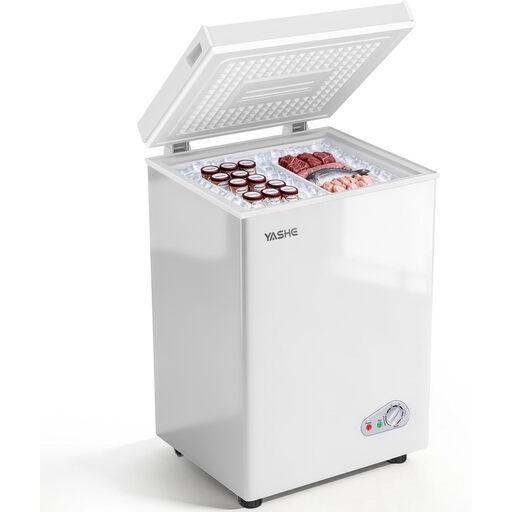
YASHE BC-100Q-EU chest freezer, 100 l
The two removable baskets provide an extra storage level for keeping packets separate.
100 l usable capacity; two removable baskets; six temperature settings.
Joybuy
 No image available
AUCMA chest freezer, 141 l, convertible
The removable basket provides extra storage for packets you want to keep separate and within easy reach.
141 l; switches between fridge and freezer modes; energy efficiency class E; seven thermostat settings.
Joybuy
 No image available
AUCMA chest freezer, 291 l, convertible
With a capacity of 291 l, this model is designed for larger food stocks. Check that its dimensions fit the space you have in mind.
291 l; switches between fridge and freezer modes; energy efficiency class E; five digital temperature settings; removable basket.
Joybuy
 No image available
AUCMA chest freezer, 197 l, convertible
The removable basket provides an extra storage level for packets you reach for regularly.
197 l; switches between fridge and freezer modes; energy efficiency class E; five digital temperature settings; removable basket.
Joybuy
 No image available
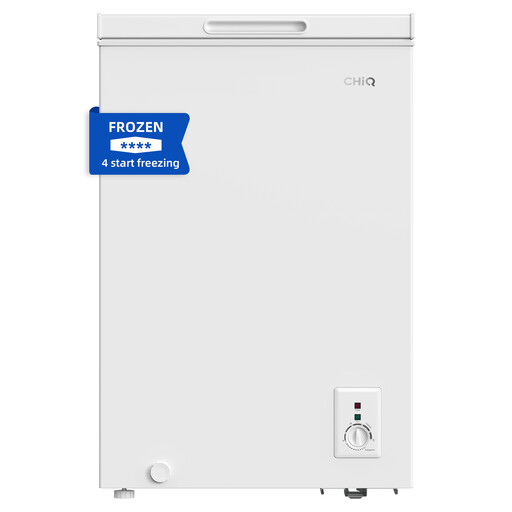
CHiQ chest freezer, 99 l, energy efficiency class E
This compact model is designed for a smaller food stock, and a wire shelf provides an extra storage level.
99 l; 4-star freezing; energy efficiency class E; thermostat control; wire shelf.
Joybuy
Frequently asked questions
How should I prepare blanched peas for different mealtimes?
Cool the blanched vegetables in iced water, then divide them into portions and pack them in suitable freezer containers, removing as much air as possible. Label each pack with its contents, quantity and date. The Federal Centre for Nutrition recommends freezing food in portions, so you won’t have to break up a large frozen block later.
What temperature should I set the chest freezer to?
The consumer advice centre recommends −18 °C as the optimum temperature for freezers. Where possible, don’t place newly frozen food directly next to food that’s already frozen, as this can cause it to start thawing.
How can I compare running costs?
Multiply the annual energy consumption in kWh stated for the exact model by your electricity price per kWh. The EU energy label shows, among other things, the energy efficiency class, annual energy consumption and freezing capacity; actual consumption also depends on the location and how you use the appliance.
Does a chest freezer need defrosting?
It depends on the features of the specific model: AEG describes LowFrost on the AHB531D1LW as reducing ice build-up, while Gorenje describes the FHNC28D6W5 as a NoFrost model. These manufacturer claims apply to the respective models and aren’t a general feature of all chest freezers.
How do I dispose of an old chest freezer in Germany?
Electrical appliances must not be put in household waste. The German Environment Agency says you can take them to a recycling centre free of charge. When buying a similar new appliance, you can also return a large old appliance free of charge with an online order for delivery. Check the return arrangements when placing your order.


