What should you look for when buying?
Choose your freezer based on the largest amount you will store at once, how easily you can access individual portions, its annual energy consumption and where you plan to put it.
| What matters |
What to check before buying |
Who is this important to? |
| Suitable capacity |
Work out the size and number of freezer containers you need, along with any other frozen food; then compare this with the usable capacity and internal dimensions. |
If I want to store several batches of sauce and other food at the same time, I need enough usable space. Around 33% of consumers put the amount of food they need to store at once first. |
| Access to individual portions |
Check that the basket and internal layout suit your labelled, freezer-safe containers. |
If we eat at different times, I want to be able to find and take out one portion without having to divide up a larger frozen supply. For around 27% of consumers, easy access to individual portions is the top priority. |
| Annual energy consumption |
Compare the kWh/year figures on the energy labels of suitable models, taking usable capacity into account. |
If I choose a freezer of the right size, I also want to compare its stated annual energy consumption. Around 20% of consumers put the appliance’s energy consumption first. |
| Installation location and use |
Check the dimensions, space needed to open the lid and the permitted ambient temperature for the installation location; allow for a storage temperature of −18 °C. |
If space is limited or the cellar is cold, the freezer needs to fit and work properly there. For around 20% of consumers, choosing a suitable installation location is the top priority. |
Joybuy products for storing individual portions
The following Joybuy products include chest freezers in different sizes and with a range of features for storing food in portions. For the specific model, check that it reaches the required −18 °C and is approved for use in your intended installation location.
 No image available
AUCMA 141L convertible chest freezer
The 141-L version is worth considering if you need extra freezer space for food stored in portions; check that its usable capacity suits your containers.
141 l; switches between fridge and freezer functions; energy class E; 7-setting thermostat; removable basket; defrost drain.
View at Joybuy
 No image available
AUCMA 95L convertible chest freezer
The compact 95-L version could suit a smaller storage need; check whether your freezer containers and other food will fit.
95 l; switches between fridge and freezer functions; energy class E; 7-setting thermostat; removable basket; defrost drain.
View at Joybuy
 No image available
AUCMA 291L convertible chest freezer
The 291-L version is an option if you want to store several batches and other food together; remember to consider how much space it will need.
291 l; switches between fridge and freezer functions; energy class E; LED lighting; 5-setting digital temperature control; removable basket with defrost drain.
View at Joybuy
 No image available
AUCMA 197L convertible chest freezer
The 197-L version offers another size option for storing several portions; consider how much you want to keep in the appliance at once.
197 l; switches between fridge and freezer functions; energy class E; 5-setting digital temperature control; removable basket with defrost drain.
View at Joybuy
 No image available
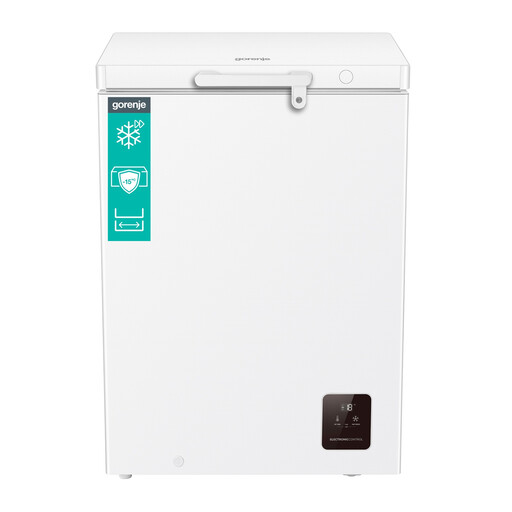
Gorenje FH15E6W5
This model may be worth considering if features for a cold installation location matter to you; check the manufacturer’s conditions for your specific location.
141 l; FastFreeze; FreezeProtect rated to −15 °C; flexible baskets; electronic controls; inverter compressor.
View at Joybuy
Frequently asked questions
How should I prepare cooked tomato sauce for freezing?
For longer storage, cool hot food quickly to below 7 °C, as recommended by the German Federal Institute for Risk Assessment. Then transfer the sauce to freezer-safe containers sized for individual portions and label them with the contents and date. A chest freezer does not replace cooling the sauce beforehand.
What information helps when comparing energy consumption?
For chest freezers with a suitable usable capacity, compare the stated annual energy consumption in kWh/year. The German Environment Agency identifies this figure on the energy label as a basis for comparison; the energy efficiency class alone does not show the model’s specific annual consumption.
What should I know about the energy label and disposing of my old appliance?
The EU energy label must be clearly visible online for refrigeration and freezing appliances that require one. Old electrical appliances should be taken to an authorised take-back point or a local council collection point, not put in household waste. Whether a retailer is required to take back your old appliance depends, among other things, on the retailer’s size and the circumstances of your purchase. Check the arrangements for returning it when your new appliance is delivered before you buy.
Are statutory warranty rights and a manufacturer’s guarantee the same thing?
No. If a product is faulty, your statutory warranty rights are against the seller; a guarantee is an additional, voluntary promise with its own terms and conditions. The Verbraucherzentrale makes this distinction explicitly.


