A chest freezer is a good fit if you regularly have several cooled portions of soup to store and its usable capacity and footprint suit the amount you actually keep. If you only have a few portions, a suitable existing freezer compartment may be enough. You should also consider its freezing capacity in kg/24 h for a large batch, practical ways to organise food for several people, and the annual energy consumption of similarly sized models. The Verbraucherzentrale (German consumer advice centre) recommends −18 °C as the optimum temperature for freezers. The German Federal Institute for Risk Assessment advises cooling hot food quickly to below 7 °C before storing it for longer.
Who is this buying guide for?
Households that batch-cook together
If you regularly freeze several cooled portions of soup, you’ll need space and a way to organise supplies for everyone sharing the freezer. The Verbraucherzentrale recommends filling containers with liquid foods such as soup to only three-quarters full.
Kitchens with limited space
If you need extra freezer space, make sure the chest freezer’s width and depth, as well as the clearance needed to open its lid, fit the space available.
Energy-conscious regular users
If you’ll be running a freezer all the time, compare the stated annual energy consumption of models of a similar size. The energy label shows energy consumption, although actual household use may vary, as Your Europe explains.
Which buying criteria matter when sharing a freezer?
First work out how many containers you usually want to store and freeze at once. Then compare freezing capacity, the internal layout, annual energy consumption and the space required against your kitchen and the amount of food you store.
| What you need |
What to look for |
Who is it most important for? |
| Space for the right amount of food |
Check the usual number and size of your containers against the usable capacity and available floor space; don’t fill containers to the brim. |
When several people store food, I need enough room without choosing an oversized chest freezer. Around 27% of consumers prioritise having enough storage space without having more than they need. |
| Freezing several portions |
Compare the specific model’s freezing capacity in kg/24 h with the amount you usually freeze at once; cool the soup quickly beforehand. |
When I’ve cooked a large batch, I want to know whether the appliance can handle the amount I usually freeze. Around 20% of consumers put freezing several portions first. |
| Finding portions again |
Check how many baskets there are and where they’re positioned, as well as the space for labelled containers; note the contents, quantity and date stored. |
When several people store containers, I want to be able to identify them and find them easily. Around 20% of consumers prioritise keeping shared portions organised. |
| Energy use and maintenance |
Compare kWh/year for appliances of a similar size and energy efficiency class, separately from the information about defrosting. |
If the freezer will be running all the time, I look at its stated energy consumption and the maintenance it needs. Around 20% of consumers put energy use and maintenance first. |
| Space and noise |
Check the external dimensions and clearance above the lid; also check the noise level in dB(A) on the energy label. |
If the chest freezer is in a shared kitchen, its size and noise level need to suit everyday life there. Around 13% of consumers consider floor space and noise to be key constraints. |
Common buying mistakes
-
Choosing the biggest chest freezer just in case
An appliance that is much larger than you need takes up unnecessary space and can use more electricity. The Verbraucherzentrale advises choosing a size that suits your needs.
First work out how many soup containers you usually store at once, then compare models with a suitable usable capacity.
-
Confusing usable capacity with freezing capacity
Capacity in litres tells you how much storage space is available. Freezing capacity in kg/24 h is a separate model specification that may matter when freezing a large fresh batch.
Check both figures separately and compare the freezing capacity with the amount you usually freeze at a time.
-
Freezing soup in full, unlabelled containers
The Verbraucherzentrale recommends filling containers with liquid soup to only three-quarters full and labelling them with the contents, quantity and date. This leaves room for the liquid to expand as it freezes and makes it easier to identify each portion.
Use suitable freezer containers, leave room at the top and label each portion before storing it.
Brands and suitable product ranges to consider
The information below applies to the models and product ranges listed. Any advertised features are claims made by the manufacturer, not the result of an independent comparison.
Bauknecht
Bauknecht lists the GTE 150MD as having a 142 l capacity and a freezing capacity of 8 kg in its four-star compartment.
- The manufacturer lists a basket, a lock and a Super Freeze function for this model.
- A single basket may mean you need extra ways to organise food for several people. The advertised TurboFreeze function doesn’t replace checking the model’s freezing capacity.
Haier
Haier lists the HCE200C as having a 196 l capacity and a width of 91.5 cm.
- The manufacturer lists LED lighting, a display and Fast Freeze among its features.
- According to the manufacturer, this model needs to be defrosted manually. Make sure its dimensions and lid clearance suit the space available.
Liebherr
The manufacturer lists the CFc 1875 Plus as having a total capacity of 192 l and a width of 104 cm.
- Liebherr lists LED lighting, as well as SmartFrost and StopFrost, as features of this model.
- The manufacturer advertises less frost build-up and less frequent defrosting; this doesn’t mean defrosting is no longer needed. Also check how much clearance the lid needs.
Beko
Beko lists the HSA29540N as having a 284 l capacity and a width of 129 cm.
- This model offers plenty of storage if you need space for a large amount of food shared between several people.
- Its large capacity and width may be impractical if you have limited storage needs or floor space. MinFrost is a feature advertised by the manufacturer.
Chest freezers at Joybuy
The Joybuy products below are chest freezers for storing portioned food; their stated capacities range from 99 l to 197 l.
 No image available
Exquisit chest freezer, 142 l, four-star compartment
An option if you’re looking for a chest freezer with a four-star compartment and a quick-freeze function.
142 l; electronic temperature control with LED display; Quick-Freeze function. According to the product description, it needs to be defrosted manually.
View at Joybuy
 No image available
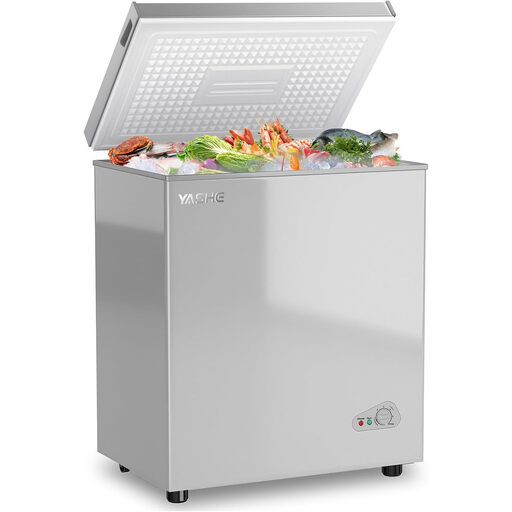
YASHE BC-150Q-EU, 150 l
Two removable baskets give you a way to sort food stored by several people.
150 l; six temperature settings; quick-freeze function.
View at Joybuy
 No image available
AUCMA convertible chest freezer, 197 l
The larger capacity may suit you if several people regularly want to store larger amounts of food.
197 l; switches between fridge and freezer modes; energy efficiency class E; five-level digital temperature control; removable basket and defrost drain.
View at Joybuy
 No image available
Gorenje FH15E6W5, 141 l
Flexible baskets give you a way to organise portions for several people.
141 l; FastFreeze; FreezeProtect down to −15 °C; electronic temperature control.
View at Joybuy
 No image available
CHiQ chest freezer, 99 l, four-star compartment
The more compact capacity may be worth considering if floor space is limited and you don’t need to store much.
99 l; wire shelf; quick-freeze function; thermostat control.
View at Joybuy
Frequently asked questions
Can I put freshly cooked vegetable soup straight into the chest freezer?
No. The German Federal Institute for Risk Assessment recommends cooling hot food quickly to below 7 °C before storing it for longer. Then transfer the soup to suitable containers, leaving some room at the top: the Verbraucherzentrale recommends filling them to three-quarters full.
How can I organise soup portions for several people?
Label freezer containers with their contents, quantity and date of storage. Separate baskets or allocated sections can make it easier to keep track of whose food is whose; check the internal layout of the specific model you’re considering.
How do I compare the energy consumption of chest freezers?
Compare the stated annual energy consumption in kWh for appliances with a similar usable capacity. The energy label gives you information about energy consumption; the Verbraucherzentrale points out that an appliance that’s too large for your needs may use more electricity than necessary.
How often does a chest freezer need defrosting?
It depends on the model and how you use it. For the CFc 1875 Plus, Liebherr advertises less frequent defrosting with SmartFrost and StopFrost; this doesn’t mean defrosting is no longer needed. Follow the instructions for the model you buy.
Do commercial food hygiene rules automatically apply in a shared kitchen?
No. Shared use alone doesn’t determine how the kitchen is classified under the law. EU Regulation 852/2004 sets out hygiene requirements for food business operators. If food is prepared or supplied in the kitchen as part of a food business, the responsible person should check which requirements apply to that specific operation.


