Making room for sauce when space is limited
If you regularly freeze pasta sauce, first check that the appliance’s dimensions, ventilation clearances and lid-opening space are suitable for your chosen location.


If you regularly freeze cooled pasta sauce, first check that the freezer will fit in your kitchen with the required ventilation clearances and enough space to open the lid. Then compare its usable capacity and freezing capacity with the amounts you usually cook; for the occasional small portion, your existing freezer compartment may be enough. The Verbraucherzentrale (German consumer advice centre) points out that a freezer that is too large for your needs can use more electricity than necessary.
If you regularly freeze pasta sauce, first check that the appliance’s dimensions, ventilation clearances and lid-opening space are suitable for your chosen location.
If you prepare several portions at once, check the stated freezing capacity for fresh food as well as the storage space available.
If you already have freezer space, compare the extra space required and annual energy consumption with the amount you actually want to store. The Verbraucherzentrale recommends choosing an appliance size that suits your needs.
First, measure the space available and think about how much sauce you want to freeze at once and keep in storage. Only compare energy consumption among models that meet these requirements.
For each chest freezer suitable for pasta sauce in a small kitchen, compare the most important buying criterion.
| Criterion | What to check before buying | Who it matters most to |
|---|---|---|
| A suitable location | Check the appliance’s width, depth and height, the route for moving it into place, the manufacturer’s ventilation clearance requirements and the space needed to open the lid. | If there’s little free space in my kitchen, I mainly want to be sure there’s room for the freezer and its open lid. Around 36% of consumers say the space available is their most important buying criterion. |
| Freezing capacity | Compare the amount you typically cook in one batch with the stated freezing capacity in kg/24 h. Consider usable capacity separately for food already in storage. | If I freeze several portions at once, what matters is how much fresh, cooled sauce the specific model can take. For around 29% of consumers, freezing larger batches is the top priority. |
| Energy consumption | Compare the kWh/year figures on the energy labels of models with a suitable usable capacity. Your individual electricity costs will also depend on your own electricity tariff. | If I already have a freezer running, I want to know how much extra energy another chest freezer will use each year. Around 21% of consumers give greatest weight to ongoing energy consumption. |
| Access to portions | Check whether baskets or suitable containers will make it easier to organise portions as you’d like; label each portion with its contents and date. | If I want to take out individual portions without searching through the whole stock, an organised layout matters to me. Around 14% of consumers put easy access to individual portions first. |
Usable capacity doesn’t tell you whether the freezer will fit in the space you have in mind or whether you’ll be able to use it with the lid open. The appliance dimensions alone also don’t automatically account for the required clearance from the wall.
Measure the space and the route for moving the freezer into place, and check the installation instructions from the manufacturer.
Usable capacity describes the available storage space; freezing capacity in kg/24 h refers to fresh food being frozen. Both figures matter when you’re freezing larger batches.
Compare the amount you typically cook in one batch with the specific model’s freezing capacity, and cool the sauce quickly beforehand.
A freezer that’s larger than you need for your actual food stocks can use more electricity than necessary. The Verbraucherzentrale therefore recommends taking your needs into account when choosing the appliance size.
First check whether your existing freezer compartment is big enough for the number of portions you usually store. Then compare the annual energy consumption of suitable models.
The CF100EWN is a freestanding chest freezer for a space that can accommodate its external dimensions.
The GT100-050E white is a 99-l option; take its stated depth into account when planning where to put it.
The GT 7355 white is a 100-l model whose stated freezing capacity and energy consumption are worth comparing.
The MDRC207SLF01G offers greater capacity if you regularly need to store more than a compact stock of food.
This selection includes a freestanding 100-l chest freezer and larger models with capacities of 140 and 197 l. Before choosing, check each appliance’s dimensions against the space available.
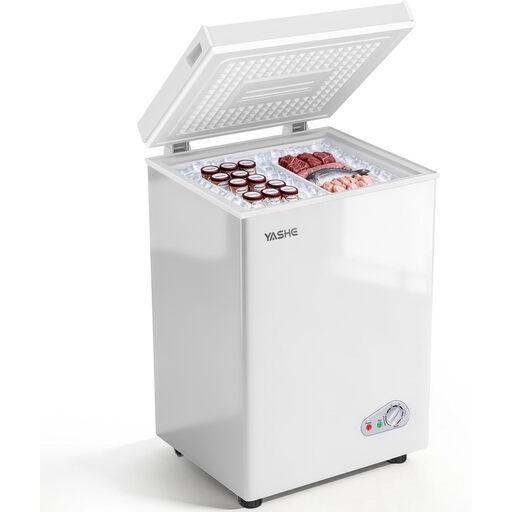 No image available
For regular stocks of sauce, if a freestanding freezer with 100 l of usable capacity will fit in the space available.
Two removable baskets and six temperature settings. Stated annual energy consumption: 185 kWh; energy class E.
 No image available
For larger food stocks, provided you can make room for it in your kitchen.
Five temperature settings, a removable basket and external dimensions of 816 × 554 × 848 mm. The appliance can be switched between fridge and freezer modes; to freeze sauce, make sure it’s set to freezer mode.
 No image available
A larger option if you need 140 l of usable capacity and the dimensions suit the space you have in mind.
A storage basket, wheels and a counterbalanced lid are listed. External dimensions: 637 × 556 × 846 mm; energy class E.
If you only occasionally freeze small amounts and there’s enough room in your existing freezer compartment, it may be sufficient. An additional chest freezer is more worth considering if you want to store larger stocks regularly; remember to factor in the extra space it’ll take up and its ongoing energy consumption.
Cool the sauce quickly and transfer it to suitable freezer containers, ideally in portions you can remove individually. The Verbraucherzentrale recommends filling containers for liquid foods to around three-quarters full. Label each portion with its contents and date so it’s easy to identify later. The German Federal Centre for Nutrition recommends cooling food quickly before storing it in the fridge.
Measure more than just the appliance itself: allow for the clearance from the wall specified by the manufacturer and space to open the lid. Check the instructions for your chosen model to find out how to ventilate it and, if necessary, defrost it.
The EU energy label lets you compare the stated annual consumption in kWh. Your actual costs will also depend on your electricity tariff and how you use the appliance; the label figure isn’t a guaranteed measurement of your household’s energy consumption.
Usable capacity in litres describes the storage space available; freezing capacity in kg/24 h shows how much fresh food can be frozen within 24 hours. If you freeze larger batches, compare the latter figure with the amount you typically cook, and consider the usable capacity for food already in storage separately.