People who regularly batch-cook soup
If you prepare several individual portions at once, check whether your existing freezer compartment is big enough or whether a small chest freezer would better suit the amount you want to store.


A suitable existing freezer compartment should be enough for a few portions of soup, provided the containers fit without being crammed in. An additional chest freezer is more worthwhile if you regularly store larger quantities. The Verbraucherzentrale considers a separate appliance worth considering mainly when you regularly freeze larger amounts. Before buying, check how much room your freezer containers need, the appliance’s dimensions including the required clearances, and its stated annual energy consumption.
If you prepare several individual portions at once, check whether your existing freezer compartment is big enough or whether a small chest freezer would better suit the amount you want to store.
If you plan to run an additional appliance all the time, factor its stated annual energy consumption into your decision.
If floor space is limited, compare the external dimensions and check how much room is needed to open the lid.
A good fit if: you only need to store a few labelled individual portions and they fit without being crammed in.
The trade-off: you won’t need another freestanding appliance, but you’ll have to make do with the freezer capacity available.
A good fit if: you regularly freeze several batches of food and have a suitable spot with enough room to open the lid.
The trade-off: you’ll gain extra storage space, but need to allow for the floor space it takes up and its ongoing electricity use.
A good fit if: you plan to store a substantial amount of food in addition to soup.
The trade-off: more capacity takes up more space; extra volume alone is no advantage if you’re only freezing soup for one person.
If you’re cooking for one and want to freeze cooled vegetable soup in portions, the main things to consider are the capacity you actually need, where you’ll put the appliance, its energy consumption and how easily you can access individual containers.
| Priority | What to look for when buying | Who it matters most to |
|---|---|---|
| Suitable capacity | Count the containers you need to store at once and compare their dimensions with the usable capacity and internal layout. | If I want to store several batches of food at the same time, having enough room matters more than choosing the biggest appliance possible. Around 33% of shoppers put suitable capacity first. |
| Energy consumption | Compare the stated annual consumption in kWh and use your own electricity tariff to estimate running costs. | If the appliance will run all the time, I want to understand its stated energy use before buying. Around 27% of shoppers pay particular attention to energy consumption. |
| Floor space | Measure the space available, the route for getting the appliance there and the room needed to open the lid; allow for the required clearance from walls. | If there’s limited space in my kitchen or storage room, the freezer needs to fit there with the necessary clearances. Around 20% of shoppers make available space their main priority. |
| Keeping track of portions | Check that the basket and internal layout suit your containers; label suitable freezer containers. | If I’m storing lots of small portions, I want to be able to find them and take them out individually. Around 20% of shoppers prioritise keeping portions organised and easy to access. |
Your existing freezer compartment may be enough for a few portions; extra storage space is only useful if you use it regularly.
In practice, an additional appliance that you don’t use takes up floor space and uses electricity all the time.
Work out how many portions you want to store at once and check your containers’ dimensions before deciding on the capacity.
Chest freezers with a similar usable capacity can still differ in stated annual energy consumption and external dimensions. For example, the manufacturer lists the Exquisit GT100-050E weiss as 48 cm deep, or 58 cm deep including wall clearance.
Compare the details for the exact model, including installation requirements and the space needed to open the lid.
A large container makes it harder to take out individual portions, and not every food container you reuse is suitable for freezing.
Use suitable containers marked as freezer-safe, divide the soup into portions and label each container with its contents and the date.
A compact chest freezer to consider if you want extra space for portions: the GT 7355 model researched has a usable capacity of 100 l.
The GT100-050E weiss is a chest freezer with a usable capacity of 99 l and switchable fridge and freezer modes.
The German manufacturer’s range includes the 99-l chest freezer GT 311 105 W alongside larger models.
Beko’s specifications include the freestanding HSM10440 model, with a usable capacity of 104 l.
The Joybuy picks below are chest freezers for storing food frozen in portions. Compare the usable capacity and external dimensions with your containers and the space you have in mind.
 No image available
The usable capacity gives you room for a larger stock of food, provided your planned containers fit inside.
Usable capacity of 142 l; 4-star freezer compartment; freezing capacity of up to 7 kg in 24 hours; 182 kWh/year.
Dimensions: 70,5 × 84,5 × 55 cm. Includes a removable basket and electronic temperature control with an LED display; manual defrosting is specified.
 No image available
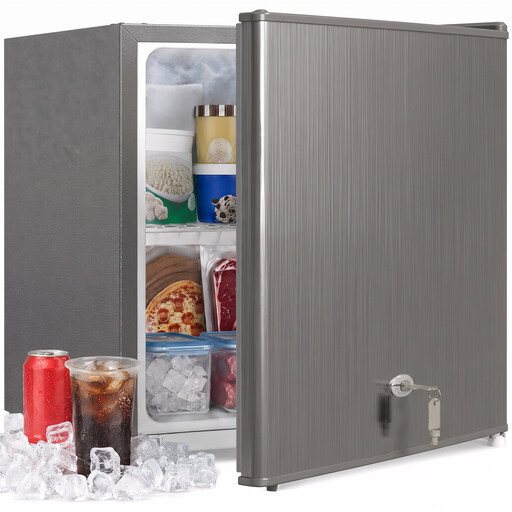
The smaller stated capacity may suit you if you only want to store a small number of individual portions.
Usable capacity of 35 l; five temperature settings from −14 to −24 °C are specified.
Dimensions: 47 × 44,2 × 48,8 cm. Includes a removable shelf and reversible door.
 No image available
The stated capacity provides room for several portions, provided the freezer fits in the space you have planned.
Usable capacity of 141 l; 4-star freezer compartment; 179 kWh/year.
Dimensions: 632 × 554 × 848 mm. Includes a removable basket; select freezer mode to store frozen soup.
 No image available
The stated capacity may suit a smaller stock of food; compare it with the number and size of your containers.
Usable capacity of 95 l; 4-star freezer compartment; 165 kWh/year; seven thermostat settings.
Dimensions: 550 × 475 × 848 mm. Includes a removable basket; select freezer mode to store frozen soup.
 No image available
The stated capacity may be suitable for storing portions; check that your containers will fit before you buy.
Usable capacity of 99 l; 4-star freezer compartment; freezing capacity of up to 4,5 kg in 24 hours.
Dimensions: 54,5 × 47,6 × 83,5 cm. Includes a wire basket.
If you’re planning to store cooked food for longer, cool it quickly to below 7 °C, as recommended by the Bundesinstitut für Risikobewertung. Then transfer the soup to suitable freezer containers and label them with the contents and date; the Bundeszentrum für Ernährung recommends labelling to make it easier to keep track of what you have.
Check the freezer compartment and the freezing capacity of the specific model. For example, Bomann states that the GT 7355 has a freezing capacity of 4,5 kg per 24 hours; this manufacturer’s figure does not indicate how quickly each individual container of soup will freeze.
Compare the stated annual consumption in kWh and factor in your own electricity price per kWh; consider the purchase price separately. For comparing appliance costs, the Verbraucherzentrale recommends looking at the purchase price and annual energy consumption alongside your own electricity tariff details.
Newly sold fridges and freezers are covered by EU energy labelling rules; according to Your Europe, the label must also be clearly visible in online shops. End-of-life electrical appliances must not be put in household waste; they should be taken to an authorised collection point. In its FAQ dated 28 July 2022, the Bundesumweltministerium lists manufacturers, municipal collection points and retailers as possible return options. Whether and how a particular retailer is required to take back an appliance depends on the legal requirements.