Who would benefit from a chest freezer?

People who cook in batches together

If you regularly freeze larger quantities of cooled sauce, the batch size, available freezer space and the appliance’s freezing capacity all need to match. The Verbraucherzentrale recommends taking your own needs into account when choosing an appliance size.

Kitchen teams with limited floor space

If you need extra freezer space but have only a small area available, remember to allow room to open the lid as well as checking the external dimensions. Gorenje’s FH14EAW is an example of a compact model with a capacity of 142 l.

Shared households with separate supplies

If several people store their own portions, agree on a clear labelling system that includes the contents and date, as well as a shared rule for taking items out. The Bundeszentrum für Ernährung recommends labelling frozen food to keep supplies organised.

What should you look for when buying one?

Keep using your existing freezer compartment

A good fit if: you only freeze a few portions occasionally and there’s actually space in your existing appliance.

Consider: storage space and freezing capacity may be limited for larger batches.

Compact chest freezer

A good fit if: you regularly need extra freezer space but have limited room for an appliance.

Consider: there’s less room for supplies; check the dimensions of your containers, batch sizes and lid clearance in advance.

Larger chest freezer

A good fit if: several people regularly store larger batches of sauce and other supplies, and there’s enough floor space.

Consider: it takes up more space, and an oversized appliance may use more electricity than necessary.

What you need What to look for when buying Most relevant for
Freezing batches Compare usable capacity in l and freezing capacity in kg/24 h with the quantities you plan to freeze regularly. If I regularly have larger quantities of cooled sauce to freeze, the storage space and freezing capacity need to suit the batch size. Around 33 % of consumers put batch capacity first.
Keeping portions separate Check the number of baskets and how easy they are to access; agree on a system for labelling contents and dates. If several people store their own portions, I want to be able to find and identify them quickly. Around 25 % of consumers prioritise keeping supplies separate and easy to identify.
Finding a place for it Check the external dimensions, delivery route and space needed to open the lid at the intended location. If there’s only a small area free in the kitchen, the freezer needs to fit there with the lid open. Around 25 % of consumers prioritise the available space.
Weighing up energy consumption For suitable models, compare the current EU energy label and annual consumption in kWh. If I’m buying an additional appliance, I want to weigh its stated annual consumption against my need for freezer space. Around 17 % of consumers put ongoing electricity use first.

Common buying and usage mistakes

  • Choosing based on litres alone

    Usable capacity tells you how much storage space is available, while freezing capacity indicates how much food an appliance can freeze in 24 hours. So a large chest freezer isn’t automatically the right choice for a particular batch of sauce.

    First, work out how many portions you regularly need to freeze and how much space is free in your existing freezer. Then compare the specifications of the specific model with your needs.

    An unnecessarily large appliance takes up floor space and may use more electricity than necessary.

  • Treating a large pot of still-warm sauce as a standard batch for freezing

    Freezing capacity in kg/24 h doesn’t tell you how quickly hot food can be cooled safely. The Bundesinstitut für Risikobewertung notes that large quantities can take longer to cool.

    Divide larger quantities between suitably sized containers and let the sauce cool properly before freezing it. If you’re preparing food for commercial or organised communal catering, make sure you follow the relevant procedures separately.

  • Comparing old A+++ ratings directly with the current EU label

    Since March 2021, the rescaled energy label has used the A to G scale again. Comparing a rating from the old scale with one from the current scale can therefore be misleading.

    Compare the current label for the specific model and check its stated annual consumption in kWh too. The Umweltbundesamt explains the change to the labelling system.

  • Assuming baskets or a lock will keep everything organised

    Baskets and locks don’t automatically sort supplies by person, contents or storage date. Without a shared labelling system, finding portions can take longer.

    For shared use, agree how containers will be labelled and how food will be taken out. The Bundeszentrum für Ernährung recommends labelling items with their contents and date.

    Unlabelled portions can be harder to identify and take extra time to find.

Brands and example models to help you choose

Gorenje

The FH14EAW is an example of a compact model for limited space and smaller batches.

  • Gorenje lists a capacity of 142 l, freezing capacity of 7 kg in 24 hours, lighting and a lock for this model.
  • The model has one basket and needs to be defrosted manually. These specifications don’t prove it’s suitable for every batch of sauce or every location.

Bauknecht

The GT 219 A3+ is an example of a larger household chest freezer for storing more supplies.

  • Bauknecht lists a capacity of 219 l, freezing capacity of 16 kg in 24 hours and two baskets for this model.
  • Check the model number and latest product details before buying; the figures quoted apply to the GT 219 A3+.

Beko

The HSA24540N is an example from the manufacturer of a medium-sized chest freezer with a capacity of 230 l.

  • Beko describes this model as having static cooling and MinFrost to reduce ice build-up.
  • The manufacturer’s claim that it needs defrosting less often doesn’t mean that defrosting won’t be needed at all.

Liebherr

According to Liebherr, the CFe 1870 Pure is a larger chest freezer with a capacity of 281 l and a width of 104 cm.

  • For this model, Liebherr lists SmartFrost and StopFrost to help reduce frost build-up, as well as FrostProtect for ambient temperatures down to −15 °C.
  • These specifications apply to this model; they can’t be taken to mean that the entire brand is suitable for very cold locations.

Exquisit

The GT100-E-040E weiss is an example of a compact model with limited capacity.

  • For this model, the manufacturer lists a capacity of 98 l, freezing capacity of 8 kg in 24 hours, a removable basket and annual consumption of 168 kWh.
  • These figures apply only to the GT100-E-040E weiss; check the model number carefully when comparing products.

Chest freezers at Joybuy

The models below range from compact to larger chest freezers. Compare their capacity with the portions of sauce you plan to store, and check that there’s enough floor space and room to open the lid in your shared kitchen.
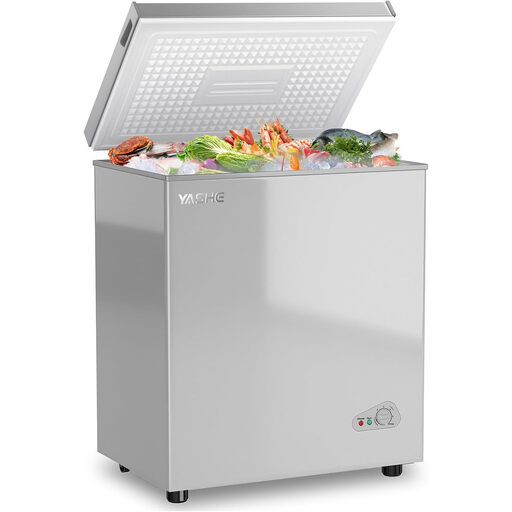
YASHE BC-150Q-EU chest freezer, 150 l, silver

YASHE BC-150Q-EU, 150 l

A 150 l chest freezer with two removable baskets could be worth considering if you need extra freezer space and want to keep supplies separate.

The product name also lists six temperature settings.

View at Joybuy

AUCMA chest freezer, 141 l, convertible to a fridge or freezer

AUCMA chest freezer, 141 l

With a capacity of 141 l, this model is an option if you need extra freezer space but have limited room.

The product name lists a convertible fridge and freezer function, energy class E, a removable basket and a defrost drain.

View at Joybuy

AUCMA chest freezer, 291 l, convertible to a fridge or freezer

AUCMA chest freezer, 291 l

The 291 l capacity stated in the product name could be useful for storing larger quantities. First, check that you have enough space for it.

The product name lists a convertible fridge and freezer function, energy class E and a removable basket.

View at Joybuy

AUCMA chest freezer, 197 l, convertible to a fridge or freezer

AUCMA chest freezer, 197 l

With a capacity of 197 l, this model offers a mid-sized option. Check that its capacity suits your usual batches of sauce and that it fits in the space available.

The product name lists a convertible fridge and freezer function, energy class E and a removable basket.

View at Joybuy

Gorenje FH15E6W5 chest freezer, 141 l, white

Gorenje FH15E6W5, 141 l

If you need extra freezer space but have limited room, compare the stated capacity of 141 l with your containers and the space available.

The product name lists FastFreeze, FreezeProtect down to −15 °C, a basket and a lock.

View at Joybuy

Frequently asked questions

Can I freeze cooled tomato sauce in portions?

Yes, you can freeze cooked sauce in portions. Use suitable freezer containers, don’t fill containers of liquid right to the top, and write down the contents and date you put them in the freezer. The Verbraucherzentrale recommends filling containers of liquid food to no more than three-quarters full, to leave room for expansion.

Can a chest freezer cool down a large batch of still-warm sauce?

Freezing capacity in kg/24 h doesn’t guarantee that hot food will be cooled safely. Let the sauce cool properly and divide large quantities between smaller containers. For communal catering, the Bundesinstitut für Risikobewertung describes rapid cooling. Whether these operating rules apply to your kitchen depends on how it is actually used.

What’s a suitable temperature for frozen food?

The Verbraucherzentrale recommends −18 °C for chest freezers and upright freezers. Set the temperature accordingly and, if you share the appliance, agree who will check it and the stored food regularly. This is practical advice, not a claimed legal requirement for private shared households.

What should I know about energy consumption and the legal guarantee?

For suitable appliances, compare the annual consumption in kWh shown on the EU energy label; actual consumption also depends on where and how the appliance is used. When you buy as a consumer in Germany, you’re generally entitled to a two-year statutory guarantee from the seller. This is different from a voluntary warranty; the Verbraucherzentrale explains these consumer rights.

Do the rules for communal catering automatically apply to a shared kitchen?

No, not automatically. Regulation (EC) No 852/2004 excludes the domestic preparation, handling and storage of food for private domestic consumption. Whether food business requirements apply to regular preparation for others or an organised operation can’t be determined in general without knowing how the kitchen is actually used. If necessary, check with your local food safety authority.