People living alone with limited freezer space
If you freeze individual portions of sauce, first check whether there’s enough room in your existing freezer compartment and whether a separate chest freezer would fit in your home.


If your existing freezer compartment is suitable for freezing and has enough room for your portions of sauce, you don’t need a separate chest freezer. If you regularly freeze other foods too, first compare the usable capacity you actually need with the space available, then check the stated annual energy consumption. A large appliance can take up more room than necessary if you only have a small supply to store. Cool cooked sauce quickly and divide it into portions in suitable, labelled containers.
If you freeze individual portions of sauce, first check whether there’s enough room in your existing freezer compartment and whether a separate chest freezer would fit in your home.
If you’re considering extra freezer space, compare the usable capacity you need with the stated annual energy consumption of suitable appliances.
If you freeze dishes as well as tomato sauce, clearly labelled portions that are easy to find are important. You may also need extra capacity.
First, check whether your existing freezer compartment can hold your usual portions. Only if you regularly run out of room is it worth weighing up the usable capacity, floor space and annual energy consumption of an additional appliance.
| Consideration | What to check before buying | Who it matters to |
|---|---|---|
| Space and usable capacity | Check the free space in your existing compartment, how much you usually store and the appliance’s external dimensions. The consumer advice centre suggests around 50–80 litres per person as a guide, not a fixed requirement. | If I’m only freezing a few portions of sauce, I don’t want an unnecessarily large appliance taking up space. Around 36% of consumers put space requirements first. |
| Energy consumption | For appliances with suitable usable capacity, compare the kWh/year shown on the EU energy label. The consumer advice centre points out that actual consumption depends on how and where the appliance is used. | If a second appliance is going to run continuously, I check its stated annual energy consumption. Around 29% of consumers prioritise running costs. |
| Portions and ease of use | Cool the sauce quickly: the German Federal Institute for Risk Assessment recommends cooling hot food to below 7 °C for longer-term storage. The consumer advice centre recommends filling freezer-safe containers with liquids to no more than three-quarters full and labelling them. | If I want to find individual portions easily later, suitable containers and clear labels are important. Around 21% of consumers prioritise how easy their portions are to handle. |
| Extra capacity for other food | Think about how much you usually freeze at once, and check the model’s freezing capacity in kg/24 h as well as the space it will need. | If I regularly freeze larger amounts of other food too, extra usable capacity could be useful. Around 14% of consumers put this kind of storage capacity first. |
If you don’t freeze much, an existing fridge-freezer may be all you need, as the consumer advice centre explains. An additional appliance takes up floor space and adds to your electricity bill.
Before buying, check how many portions you usually store and how much room is actually free in your existing freezer compartment.
As well as considering the space it will take up, factor in the additional running costs.
A large capacity won’t necessarily suit your needs. You should also consider the appliance’s total annual energy consumption and its external dimensions.
Compare appliances with a suitable usable capacity by their kWh/year rating, and measure the space where you plan to put yours.
Liquids expand as they freeze. Overfilled containers may be damaged, and without a label it can be difficult to tell your stored portions apart.
Fill freezer-safe containers to no more than three-quarters full, and note the contents and freezing date, as recommended by the consumer advice centre.
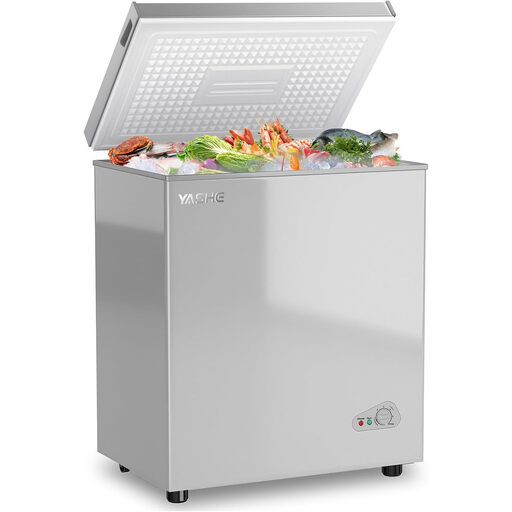
The GT 7355 is an example of a separate chest freezer with 100 litres of usable capacity.
The GT100-010E weiss is an example of a compact chest freezer for a narrow space.
The GT 8849 is an example of a model for larger supplies, while the DT 8760 fridge-freezer has a freezer compartment.
This selection of Joybuy products includes compact and larger chest freezers for individual portions or extra supplies. If you only have a small amount of sauce to store, compare the capacity with the space you actually need.
 No image available
An option if you need extra freezer space for more than just portions of sauce; 99 litres may be more room than you need if you’re only freezing individual portions.
The product information lists a freezing capacity of 4,5 kg/24 h and a wire basket.
 No image available
Better suited if you regularly need space for other supplies as well as sauce; its capacity may be more than you need for individual portions.
The stated freezing capacity is 7 kg/24 h, with energy consumption of 182 kWh/year and a removable basket. The dimensions are 70,5 × 84,5 × 55 cm.
 No image available
The larger capacity is better suited to extra frozen supplies than to a few portions of sauce.
The product information lists two removable baskets, six temperature settings and energy consumption of 157 kWh/year.
 No image available
An option if you regularly want to store other supplies as well as sauce; its capacity may be too large for a few individual portions.
The stated energy efficiency class is E, with energy consumption of 179 kWh/year, a removable basket and a seven-setting thermostat.
 No image available
Its 141-litre capacity could be useful if you regularly add other supplies; it may be more than you need for individual portions of sauce.
The product information lists a freezing capacity of 8 kg/24 h, energy consumption of 182 kWh/year and a fast-freeze function. Its stated operating limit is an ambient temperature of up to −15 °C.
Yes, if the freezer compartment is suitable for freezing and has enough room for your portions. A separate chest freezer is more likely to be worth considering if you regularly freeze larger quantities. Check how much space is available and whether your compartment is suitable.
For longer-term storage, cool hot food quickly to below 7 °C, as recommended by the German Federal Institute for Risk Assessment. Use freezer-safe containers, leave room for liquids to expand and label them with the contents and date. The consumer advice centre recommends filling containers for liquids to no more than three-quarters full.
The consumer advice centre recommends −18 °C for both upright freezers and chest freezers. When comparing appliances, look at annual energy consumption in kWh and usable capacity. Actual consumption also depends on how and where the appliance is used.
Relevant new refrigeration and freezing appliances are subject to EU labelling requirements. According to the European Commission, the energy label must also be clearly visible when products are sold online. This requirement applies to the sale of the product, not to registration by private buyers.