
Lieferung heute & morgen

Qualitätsgarantie

Willkommens-Angebote freischalten: KOSTENLOSE Lieferung | Bis zu 80 % RABATT | Kostenlose 30-Tage-JoyPlus-Testphase
App herunterladen
A chest freezer in the basement or garage is a practical solution for storing provisions, accommodating bulk purchases, or preserving your garden harvest. However, not every appliance is designed to operate in cool environments. Choosing the wrong model can lead to malfunctions, increased energy consumption, and, in the worst-case scenario, spoiled food.
This guide highlights the most common pitfalls and explains which technical features you need to look for to find a reliable and durable chest freezer for unheated spaces.
Many purchasing decisions are based on capacity and price, while critical technical details are overlooked. This often leads to problems that only become apparent during operation.
To avoid the issues mentioned above, you should check the following technical specifications before buying a large chest freezer. These determine whether an appliance is suitable for your intended location.
The climate class indicates the temperature range in which a refrigerator or freezer will function correctly. For an unheated basement or garage in colder climates, an extended climate class is crucial.
For year-round operation in a space that can get colder than 10°C in winter, models with the SN-T climate class are ideal. These cover a broad range from +10°C to +43°C. Some manufacturers also offer special technologies that enable operation at even lower temperatures. Look for corresponding information on the product data sheet.
The required capacity depends on your household size and usage habits. A good rule of thumb is 50 to 80 litres per person. For families who regularly buy in bulk or freeze a lot of food, a basement chest freezer with 200 to 300 litres or more is a sensible choice.
Measure the available space at the installation site carefully and plan for extra room for ventilation (usually 5-10 cm at the sides and back). An often-overlooked but very practical feature is a chest freezer with wheels. It makes moving the appliance for cleaning the floor underneath significantly easier.
Since 2021, a new scale for energy efficiency from A (very efficient) to G (less efficient) has been in effect. A higher efficiency class often means a higher purchase price, but it leads to noticeably lower electricity costs over the years.
Also, look out for the following features:
Instead of presenting an overwhelming list, we are highlighting a model that meets the typical requirements of users looking for a reliable solution for long-term food storage.
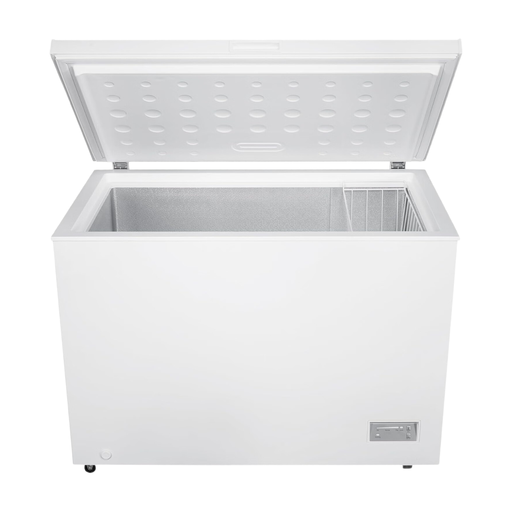
Why This Fits Their Persona: With a 308-litre capacity, this model offers ample space for bulk purchases, garden harvests, or stocking up for a large family. It is specifically designed for users who need a large and reliable storage solution.
The SN-T climate class ensures operation across a wide range of ambient temperatures. The integrated temperature alarm protects against food loss, and the operating noise of just 40 dB is pleasantly quiet.
Large 308-litre capacity with a 4-star freezing performance. Four transport wheels allow for easy movement and positioning of the appliance, even when fully loaded.
We have compiled a complete, real-time list of products that fully satisfy these strict selection criteria and UK safety regulations.
The climate class defines the permissible ambient temperature range in which the appliance operates efficiently and safely. For unheated spaces like basements or garages where the temperature can drop below +10°C in winter, a chest freezer with the SN (Subnormal) climate class or a special manufacturer technology for low temperatures is required. The SN-T class covers a very wide range and is often a good choice.
Power consumption depends on the energy efficiency class, capacity, and ambient temperature. A modern Beko 308L chest freezer with an E energy efficiency rating has an annual energy consumption specified on its product data sheet. In a cool basement, the appliance tends to work less than in a warm kitchen, which can have a positive impact on actual consumption, as long as the minimum temperature of its climate class is not undercut.
The frequency of defrosting depends on the humidity at the location and how it's used. A thick layer of ice (more than 5-10 mm) acts as insulation and increases electricity consumption. As a rule, manual defrosting should be done once or twice a year. Some models feature "Low Frost" technology, which reduces ice build-up and extends the intervals between defrosting.