Batch cooks
If you make stock in large batches and regularly freeze portions for the working week, the usable capacity and size of your appliance should suit the amount you usually prepare.


A chest freezer is most useful if you regularly freeze larger quantities of cooled vegetable stock or other food. For just a few portions, your existing freezer compartment may be enough. Germany’s consumer advice centre recommends choosing a size that matches your actual needs: compare usable capacity, dimensions and annual energy consumption in kWh, and allow space for labelled, freezer-safe containers. Cool cooked stock quickly, and keep prepared meals sufficiently chilled when you’re out and about.
If you make stock in large batches and regularly freeze portions for the working week, the usable capacity and size of your appliance should suit the amount you usually prepare.
If you want to find and take out individual portions of stock quickly for lunches, use freezer-safe, dated containers and keep them neatly arranged.
If the width, depth or lid clearance matters where you plan to put it, measure the space and check that the specific model is suitable for the ambient temperatures there.
A good fit if: You only store a few portions of stock and have room in your existing appliance.
The trade-off: There may not be enough space available at once for larger batches.
A good fit if: You regularly freeze larger batches or other supplies, and have enough floor space.
The trade-off: More storage space in one place also means an extra appliance that takes up room and uses electricity.
A good fit if: You’ll regularly store substantially more than just stock.
The trade-off: Haier states that the HCE420D has a capacity of 418 l. This may be more space than you need if you’re only freezing a few portions for lunch.
| What matters | What to check before buying | Who this matters to |
|---|---|---|
| Space for batches | Check the size of your usual containers and other frozen supplies; compare these with the model’s usable capacity and freezing capacity. | If I regularly freeze larger batches of stock, the freezer needs to suit my containers and supplies. Around 36% of consumers say batch capacity is their main concern. |
| Finding portions again | Check the number and layout of the baskets, and whether there’s room for your own freezer-safe containers; label the contents and date. | I want to take out individual portions for lunch without searching for ages. Around 29% of consumers prioritise being able to find and remove items easily. |
| Energy consumption | Compare the annual energy consumption in kWh and capacity on the EU energy label for specific models. | If an extra appliance is going to run all the time, I want to weigh up its energy consumption against the benefits. Around 21% of consumers say running costs are their main concern. |
| Where it will go and access | Measure the width, depth and height, as well as the space needed to open the lid; if the room is unheated, check the specific model’s stated suitability for the temperature. | If space is limited or the room is cold, the appliance needs to fit and be suitable for use there. Around 14% of consumers say this is their main concern. |
Germany’s consumer advice centre cautions against choosing a freezer that’s larger than you need.
Start by checking the size of your usual containers and any other frozen supplies. See whether your existing freezer compartment is enough before choosing an extra appliance.
An oversized appliance takes up space permanently and may use more electricity than necessary.
The EU energy label shows the annual energy consumption in kWh as well as the efficiency rating. For fridges and freezers, the European Commission describes a scale from A to G.
For specific models, compare both the consumption in kWh per year and the capacity.
Liquids expand when they freeze, which can damage full containers. Without a label, it can also be harder to tell what’s inside and when it was frozen.
Use freezer-safe containers. For liquids, follow Germany’s consumer advice centre recommendation to fill them to three-quarters full. Label each portion with its contents and the date.
Damaged containers and hard-to-find supplies make it more difficult to use the portions you’ve prepared.
Suitability for low ambient temperatures depends on the model, so you can’t assume that one chest freezer will perform like another.
Check the temperature conditions at the intended location against the information in the specific model’s manual.
Beko states that its HSM22340 chest freezer has 230 l of freezer space and an energy efficiency rating of D.
Haier offers two models for very different storage needs: the 196 l HCE200C and the 418 l HCE420D.
Liebherr states that the CFc 1875 Plus is a chest freezer with a total capacity of 192 l and external dimensions of 82 × 104 × 71 cm (H × W × D).
The Joybuy products below are chest freezers for storing individual portions of stock and other supplies. Check that the usable capacity, features and space required suit your actual needs.
 No image available
The removable basket can help you store frequently used portions separately; check that the capacity suits your containers.
142 l usable capacity; freezing capacity up to 7 kg/24 h; 4-star freezer compartment; fast-freeze function; electronic temperature control with LED display.
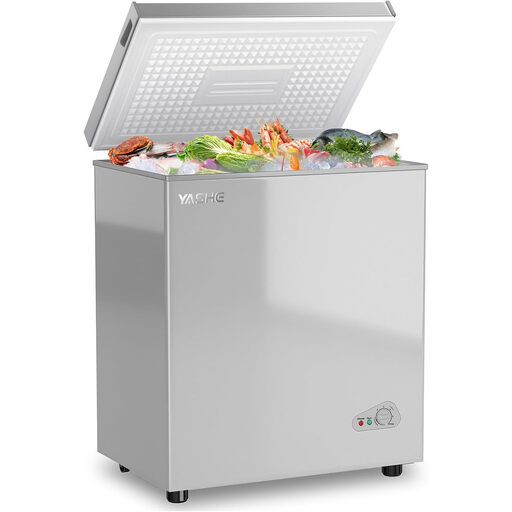 No image available
The two removable baskets can help keep smaller portions separate; check that the capacity suits the amount you store.
150 l; two removable baskets; six temperature settings; energy efficiency rating E; fast-freeze function.
 No image available
The removable basket can keep smaller supplies separate; measure the space you have in mind before choosing.
141 l; switchable fridge and freezer modes; 4-star freezer compartment; freezing capacity up to 2 kg/24 h; external dimensions 632 × 554 × 848 mm.
 No image available
The larger capacity may suit you if you have additional supplies to store; compare it with the space needed for your usual portions.
197 l; switchable fridge and freezer modes; 4-star freezer compartment; removable basket; energy efficiency rating E; external dimensions 816 × 554 × 848 mm.
 No image available
Its stated temperature suitability may be useful if you’re putting it somewhere cold; check it against the conditions at your own location.
141 l; 4-star freezer compartment; freezing capacity 8 kg/24 h; FastFreeze; FreezeProtect for ambient temperatures down to −15 °C; flexible wire basket.
Start by counting your usual portion containers and other supplies. Germany’s consumer advice centre gives 50 to 80 l per person as a rough guide for frozen food overall, but notes that your actual needs are what matter. If a few portions already fit in your existing freezer compartment, an extra chest freezer may not be necessary.
The German Federal Institute for Risk Assessment recommends cooling hot food quickly to below 7 °C if it’s to be stored for longer. Use freezer-safe containers. For liquids such as soup, Germany’s consumer advice centre recommends filling containers to only three-quarters full, as liquids expand when frozen, and labelling them with the contents and date. Keep perishable meals chilled when you’re out and about, as the chest freezer alone won’t keep them safe during transport later.
Measure the appliance and the space you have, including the clearance needed to open the lid. Germany’s Environment Agency recommends keeping freezers away from warm appliances and out of direct sunlight. In an unheated room, check that the specific model is suitable: Liebherr explicitly states that the CFc 1875 Plus is suitable for ambient temperatures down to −15 °C. Frost-reducing features don’t remove the need to clean or defrost the appliance when required.
For specific models, compare both the capacity and the annual energy consumption in kWh shown on the energy label. The European Commission lists energy efficiency ratings from A to G for household freezers; the rating alone doesn’t replace checking the stated annual consumption.
According to the European Commission, the EU energy label for household freezers shows information including the energy efficiency rating, annual energy consumption, capacity and noise level. Germany’s Federal Environment Ministry says that an electrical appliance at the end of its life should be taken to an authorised collection point, not put in household rubbish.