
Lieferung heute & morgen

Qualitätsgarantie

Willkommens-Angebote freischalten: KOSTENLOSE Lieferung | Bis zu 80 % RABATT | Kostenlose 30-Tage-JoyPlus-Testphase
App herunterladen
A new chest of drawers should create storage and blend seamlessly into your space. However, the search is often more complicated than it seems. Many models look appealing online or in the furniture store but prove to be impractical or unstable after a short time. Before you make a decision, it's crucial to know the typical weak points often hidden behind an appealing exterior.
This guide focuses on the decisive criteria that define a durable and functional chest of drawers. We'll highlight three common problems that lead to disappointment and show you what to look for in terms of material, construction, and dimensions.
To avoid a bad purchase, don't let design be your only guide. The following three technical aspects are crucial for the quality and longevity of your new chest of drawers, whether it's a sideboard for the living room or a changing table dresser.
The choice of material directly impacts stability, weight, and maintenance.
The stability of a chest of drawers largely depends on its back panel. A thin hardboard panel attached only with nails offers little structural strength. Look for models with a screwed-in or grooved back panel. This stiffens the entire body and prevents the typical side-to-side wobble.
Especially in households with children, but also generally for taller chests of drawers, an anti-tip kit is essential. This is a bracket or strap used to anchor the furniture to the wall. Reputable manufacturers include this component. This is an absolute must for a chest of drawers in a child's room or a changing table dresser.
Measure not only the available space in your room but also check the internal drawer dimensions. Compare these with the external dimensions to get a feel for the storage efficiency. For a credenza or sideboard, the division between drawers and door compartments is also relevant for its future use. Models with flexible applications, like a changing table dresser with a removable top, offer added value beyond the initial phase of use and can later be used as a classic chest of drawers.
Here are three recommendations tailored to different needs and living situations, which take into account the quality criteria mentioned above.
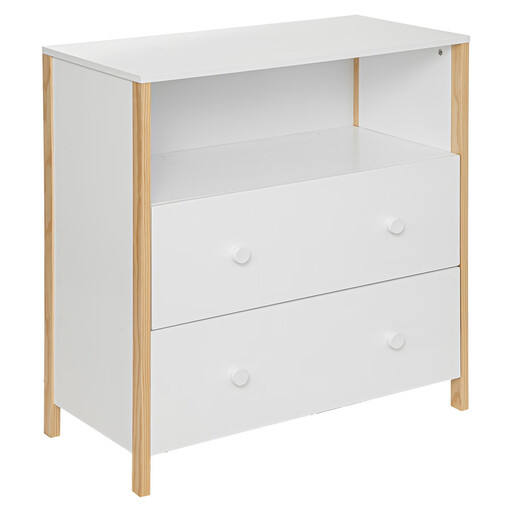
Why This Fits Their Persona: The simple, Scandinavian design fits perfectly into a modern child's room. The combination of two large drawers and an open compartment offers flexible storage for clothes, books, and toys.
The construction of E1-class MDF and solid pine legs provides a solid base, avoiding the instability of cheaper models. The specified maximum load capacity of 50 kg is a transparent indicator of its stability.
The mix of closed drawers and an open compartment offers versatile organisation options for a child's room chest of drawers.
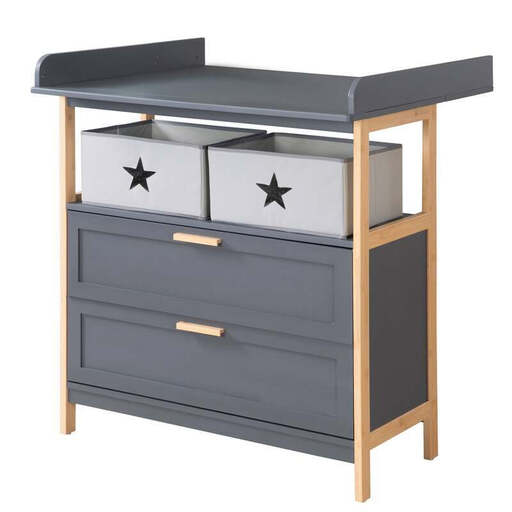
Why This Fits Their Persona: This changing table dresser is an investment in the future. After the nappy-changing phase, the top can be easily removed, transforming it into a fully-fledged, timeless chest of drawers for a child's or teenager's room.
The stability issue is actively addressed by its solid wood construction and the included wall mount (anti-tip kit). The ergonomic changing height of 92 cm is a thoughtful detail that makes daily life easier.
The 2-in-1 functionality as a changing table and later a chest of drawers offers excellent long-term value. The use of solid wood for the frame and handles signifies high material quality.
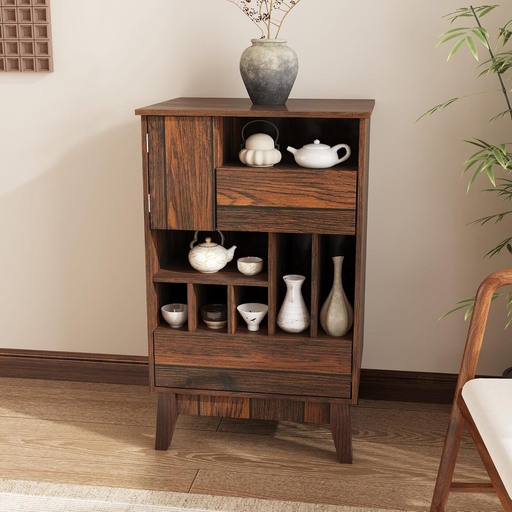
Why This Fits Their Persona: The asymmetrical, handleless design and dark wood-effect make this chest of drawers a statement piece in the living room or hallway. It functions as a modern sideboard that combines style and function.
The product description is transparent, describing it as a "dark wood-effect" on an MDF base, thus avoiding the trap of misleading material claims. The precise dimensions (80x50x40 cm) allow for accurate space planning.
The unique asymmetrical design with specialised compartments (bottle and door sections) sets it apart from a standard chest of drawers and offers targeted storage for the living area.
We have compiled a complete, up-to-date list of products that fully meet these strict selection criteria and safety standards.
Most chests of drawers come with an anti-tip kit, usually in the form of a metal bracket or a sturdy strap. To secure the chest, attach one end of the anchor to the top or back of the furniture and the other end to the wall. It is crucial to use screws and wall plugs suitable for your specific wall type (e.g., plasterboard, brick, concrete). These are typically not included. Check the tightness of the connection regularly.
Although the terms are often used interchangeably, there are traditional differences:
Proper care depends on the material. A solid wood chest of drawers should be protected from direct sunlight and high humidity. A slightly damp cloth is sufficient for cleaning. Depending on the surface finish (oiled or waxed), occasional re-treatment with a suitable oil or wax may be beneficial. A foil-finished chest of drawers (e.g., a white chest of drawers) is easier to care for and can be cleaned with a damp cloth and mild detergent. However, be careful with scratches, as they are difficult to repair, and moisture on damaged edges can cause the core board to swell.