
Lieferung heute & morgen

Qualitätsgarantie

Willkommens-Angebote freischalten: KOSTENLOSE Lieferung | Bis zu 80 % RABATT | Kostenlose 30-Tage-JoyPlus-Testphase
App herunterladen
A well-chosen chest of drawers not only creates order but also defines the character of a room. However, the search for the right piece of storage furniture can quickly become overwhelming. Superficial product descriptions and supposed bargains often lead to purchases you'll later regret. Before you invest, it's crucial to understand the common pitfalls that can make a piece of furniture impractical or short-lived.
This guide focuses on the decisive criteria that will help you make an informed choice—from material quality to functionality for your specific living space.
Many buyers focus primarily on design or price, overlooking functional flaws that only become apparent in daily use. Pay close attention to these three points to avoid a poor investment:
To make the right decision, you should focus on objective and measurable characteristics. These three core parameters determine the quality and practicality of your new chest of drawers.
The material influences not only the look but also the stability and lifespan.
Measure the available space precisely—in height, width, and depth. Also, consider the clearance you need to open drawers and doors.
Think carefully about what you want to store. The type of storage is crucial.
Instead of making a general recommendation, we have selected products tailored to clearly defined needs and living situations.
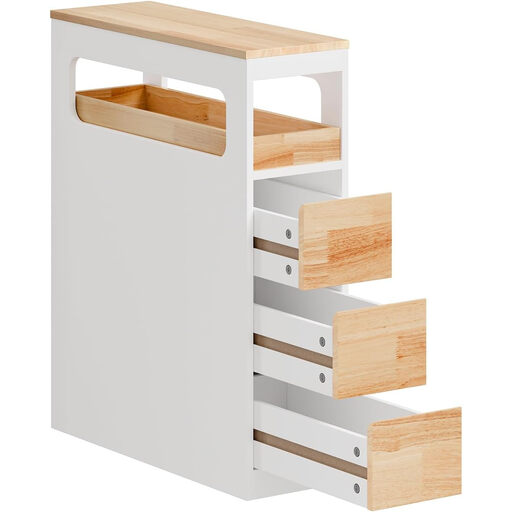
Why this model is a great fit: With a depth of just 23 cm, this cabinet is specifically designed for tight spaces. The wheels allow for flexible positioning and easy cleaning, which is especially practical in small bathrooms or guest toilets.
According to the manufacturer, the unit is made from E1-class MDF and a rubberwood worktop, making it suitable for humid environments and avoiding the "unsuitable materials" mistake.
The combination of three drawers, an open compartment, and a top shelf maximises storage on a minimal footprint. Its mobility, thanks to four wheels (two of which are lockable), is a clear functional plus.
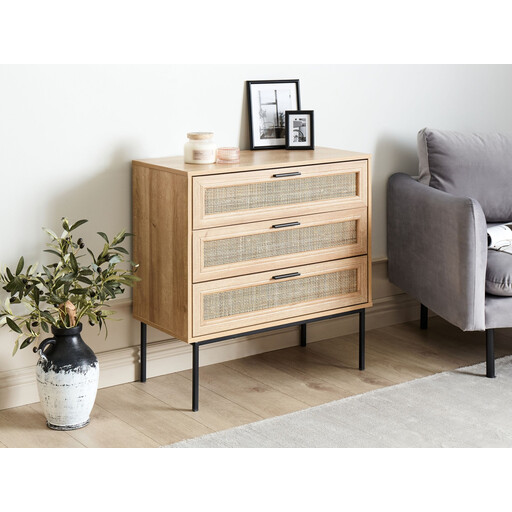
Why this model is a great fit: For design-conscious individuals seeking a piece of furniture with character. The fronts with Viennese caning (rattan) and the black metal legs make a clear design statement, fitting well with modern or boho interior styles.
The construction of fibreboard with a metal frame provides a stable base, avoiding the "unstable construction" pitfall. The carefully crafted details set it apart from purely functional yet faceless furniture.
Offers practical storage for textiles or accessories with three spacious drawers. The material combination of engineered wood, rattan, and metal creates an appealing look with high functionality.
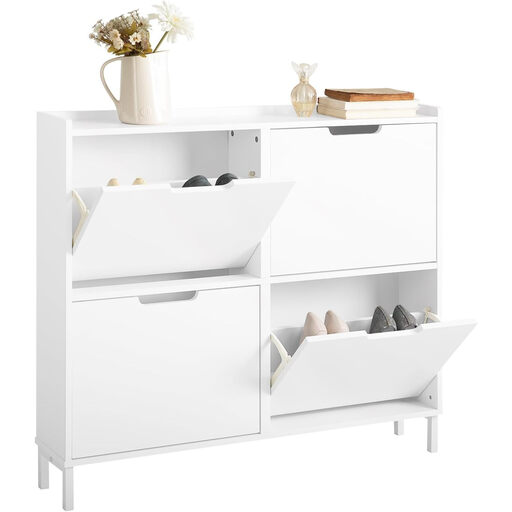
Why this model is a great fit: This piece is a specialised solution for the common problem of hallway clutter. With a depth of only 19 cm, it fits even in the narrowest entryways, creating order without getting in the way.
The special mechanism of the tilt-out compartments is optimised for storing shoes, bypassing the problem of unsuitable drawers. According to the manufacturer, a tip-over restraint is included, which counteracts the risk of an "unstable construction" in tall, narrow furniture.
Maximum space efficiency through minimal depth and vertical arrangement. The closed compartments protect shoes from dust and ensure a tidy appearance in the hallway. The top surface provides space for keys or decoration.
If the models presented here don't exactly match what you're looking for, you can find a wider selection of storage solutions in our main category, curated based on objective criteria like material and functionality.
Most manufacturers include a tip-over restraint, which consists of a bracket or a strap. This part is attached to the back of the chest and to the wall. For wall mounting, use wall plugs and screws that are appropriate for your wall type (e.g., concrete, drywall). This is an essential safety step, especially in households with children.
For damp environments like the bathroom, you should choose materials that are resistant to water vapour. These include lacquered or foil-coated MDF boards, solid wood with a protective oil or lacquer layer, or furniture made of plastic. Untreated particleboard is unsuitable as it absorbs moisture and will swell.
In narrow hallways, every centimetre counts. A depth of 20 to 30 cm is often ideal for a narrow shoe cabinet or a console table. This maintains sufficient clearance for walking. Before buying, measure the narrowest point of your hallway and ensure there is still enough space, even when drawers or doors are open.