
Lieferung heute & morgen

Qualitätsgarantie

Willkommens-Angebote freischalten: KOSTENLOSE Lieferung | Bis zu 80 % RABATT | Kostenlose 30-Tage-JoyPlus-Testphase
App herunterladen
A chest of drawers helps keep clothing, laundry, office supplies and accessories organised. However, choosing one based on a quick glance at its colour and price can often lead to a poor purchase. The number of drawers matters, but so do their internal dimensions, load capacity, stability and intended use.
This guide explains what households, home workers, studios and workshops should look for in a chest of drawers.
A chest with lots of drawers can be useful for sorting small items. For jumpers, towels or ring binders, however, the internal height and width are what matter. Narrow fabric drawers, for example, are ideal for accessories, while deeper drawers can also hold larger textiles or work materials.
Before buying, measure the space available and consider how you plan to use the chest. Also check that the drawers can open fully without hitting a wall, bed or desk.
Manufacturers’ load capacity figures often refer to the whole piece of furniture or its top surface. This doesn’t necessarily mean that each drawer can hold heavy items. With a fabric chest of drawers, the load capacity of each drawer may be considerably lower than that of the frame.
So check these three figures:
Tools, ring binders and printers have different requirements from clothing or light household items.
A mobile drawer unit or chest of drawers on castors can be moved around as needed. Castors are particularly useful in a home office, studio or workshop. At the same time, check whether at least two castors can be locked and whether the floor is level. An unsecured drawer unit may move when several drawers are opened.
For taller furniture, it’s also worth using the supplied anti-tip kit, if there is one. Whenever possible, store heavy items in the lower drawers.
Compare the overall dimensions with the space where you plan to put the unit. In smaller rooms, a narrow storage cabinet with a vertical layout is often a good choice. A wider model, on the other hand, provides more room for clothing, laundry or household accessories.
As well as width, depth and height, consider:
A bedroom chest of drawers with several equally sized compartments can make it easier to keep things organised. In an office, the drawers should be suitable for document formats, stationery or technical accessories.
The materials used can help you decide where a unit is best suited. Chipboard with a coated finish is commonly used for dry indoor spaces and can be cleaned with a damp cloth. Steel components in the frame, drawer runners or castors can provide added structural stability. Avoid overloading fabric drawers with heavy or sharp-edged items.
Also look for:
Easy assembly is convenient, but it’s still important to check all the screw connections. Once assembled, the chest should stand level and each drawer should move smoothly without catching.
A filing cabinet or office cabinet has different requirements from a chest of drawers for clothing. For documents, drawers need to be wide and deep enough. In a workshop, sturdy runners, a hard-wearing surface and easy-to-reach compartments for tools and accessories are more important.
Use the furniture in line with the manufacturer’s instructions. Do not exceed the stated maximum load capacity. With models on castors, only place heavy equipment on the top surface if it can safely support the weight.
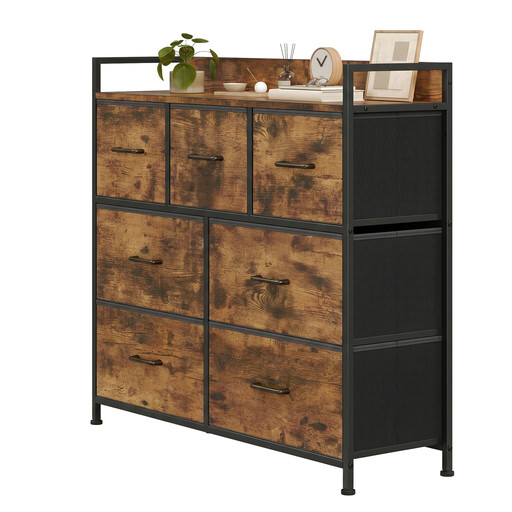
Why it’s a good match: With seven drawers and a width of 98 cm, this model is suitable for clothing, accessories and lightweight everyday items in the bedroom, hallway or living room.
The product details state a maximum static load of 3 kg per drawer and advise against storing heavy items in the fabric compartments.
Seven compartments, adjustable feet, raised edges and a supplied anti-tip kit. The stated total load capacity is 71 kg.
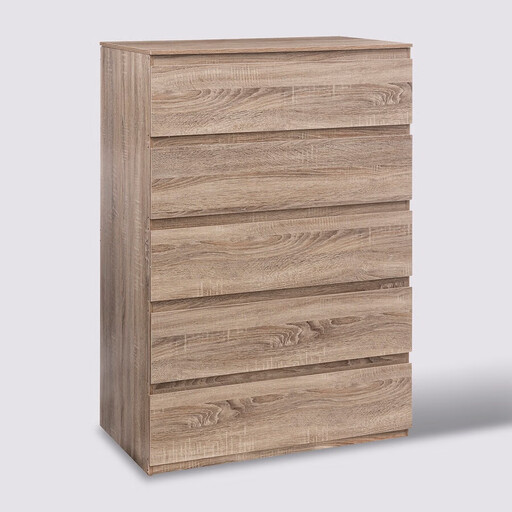
Why it’s a good match: Its steel components and chipboard construction are designed for long-term indoor use, for example in a bedroom, hallway or study.
The product description gives precise dimensions of 78 × 48 × 118,4 cm and a maximum total load capacity of 100 kg. This makes it easier to check that the unit will fit your space and suit your needs before buying.
Five drawers, steel fittings and drawer runners, a stated total load capacity of 100 kg, and an assembly time of around 20 minutes for one person.
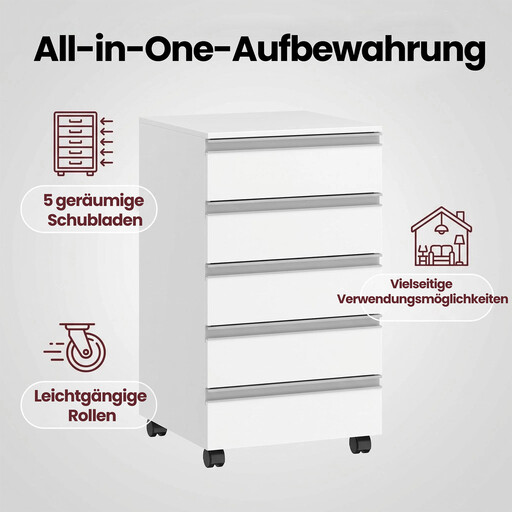
Why it’s a good match: This mobile model is designed for home workers, studios, workshops and offices where documents, drawings, tools or accessories need to be moved around regularly.
The product details list five drawers, reinforced runners, 360-degree castors and two lockable front wheels. These features make it easier to move the unit frequently and then secure it in place.
Compact dimensions of 40,5 × 40,5 × 65,5 cm, a stated total load capacity of 50 kg and a coated chipboard surface for indoor use.
Assemble the chest of drawers on a level floor. Once it’s put together, check that the frame is stable and the drawers run smoothly. Taller furniture should be secured to the wall, particularly in homes with children or pets.
A soft, slightly damp cloth is usually all you need for cleaning. Don’t use harsh cleaning products on coated chipboard or fabric fronts. Clean fabric drawers according to the product instructions and don’t soak them. Distributing weight evenly reduces strain on the base panel, drawer runners and frame.
We’ve put together a complete, regularly updated list of products that meet these strict selection criteria and fully comply with the safety regulations in force in the EU.
It depends on what you want to store. Several medium-sized drawers work well for clothing and laundry. For office supplies or tools, drawers in different sizes can make it easier to sort your belongings. Usable internal dimensions matter more than the number of drawers alone.
Its lifespan depends on the materials, load, assembly and care. A chest used within the stated load limits and protected from moisture will generally stay in good working order for longer. Check the screws, castors and drawer runners regularly.
Only if the manufacturer specifically says it is. Check the total load capacity, the capacity of each drawer and the load rating of the castors. Whenever possible, store heavy items in the lower drawers. If you place equipment on the top surface, make sure you also check its load limit.