A chest of drawers is a cornerstone of home organisation. Its primary function is to provide enclosed storage, typically in the form of drawers. However, depending on its design, height, and width, it may also be referred to as a sideboard, credenza, or multi-purpose cabinet and can be used in various rooms such as the living room, bedroom, or hallway. Selecting the right model depends on your individual storage needs, the available space, and your material preferences.
Buying Guide: What to Consider When Choosing a Chest of Drawers
The decision to purchase a storage unit should be based on objective criteria. The following aspects are of key importance.
Dimensions and Proportions
Precisely measure the intended space (width, depth, height). Consider the clearance needed to open doors and drawers, as well as the distance to other furniture, doorways, or radiators. A low, wide chest (often called a sideboard) is well-suited for placement under a window or as a stand for a television. Taller, narrower models make better use of vertical space and are ideal for alcoves or smaller walls.
Materials and Craftsmanship
The choice of material affects the furniture's durability, maintenance requirements, and overall aesthetic.
- MDF (Medium-Density Fibreboard): An engineered wood product made from compressed, fine wood fibres. It offers a smooth, uniform surface that is ideal for lacquering or applying veneers. MDF is dimensionally stable and often a cost-effective option.
- Solid Wood: Refers to furniture made entirely from a single type of wood (excluding back panels and drawer bottoms). Woods like pine or spruce are often lighter and more affordable, while oak or beech are known for their hardness and durability.
- Veneer: This involves applying thin sheets of real wood onto a substrate (often MDF or particleboard). This method combines the aesthetic of solid wood with the stability of the base material.
- Metals and Glass: Elements made of steel, iron, or tempered glass are often used for frames, doors, or handles to create a modern, industrial accent.
Functionality and Storage Type
Consider what you primarily plan to store.
- Drawers: Ideal for small items, linens, or documents. They provide a quick overview and easy access. Models with drawers are the classic type of chest.
- Doors with Shelves: Offer flexible storage for larger items like dinnerware, books, or binders. Adjustable shelves enhance adaptability.
- Open Compartments: Suitable for decorative objects or devices that need to be easily accessible.
Safety Considerations
An anti-tip restraint is essential, especially for taller and narrower chests. Many manufacturers include the necessary brackets and screws for wall anchoring. It is highly advisable to use this safety feature to prevent the furniture from tipping over, particularly in households with children.
Our Top Storage Recommendations
The following products illustrate different approaches to design, material, and function.
Atmosphera Danik Sideboard - Wood and Glass
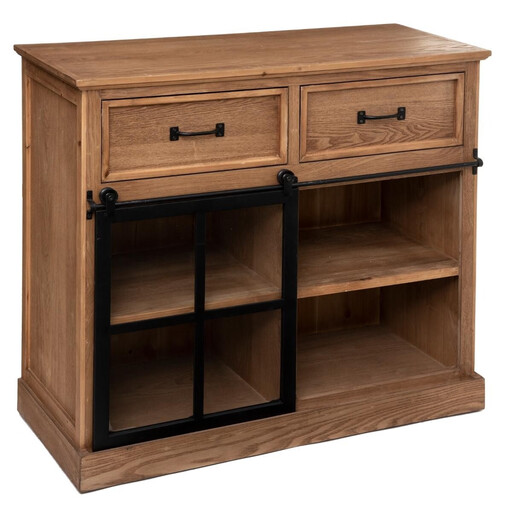
- Why we're featuring this product: The Danik Sideboard blends natural and industrial materials. Its spruce wood and veneer structure is paired with a sliding door of tempered glass and steel, creating a distinctive neo-vintage aesthetic.
- Objective Features:
- Combined storage: Two drawers and a cabinet section with two shelves.
- Material mix: Spruce wood, MDF, steel, and tempered glass.
- Dimensions: 94 cm (L) x 40 cm (D) x 85 cm (H).
- Maximum load capacity: 75 kg, according to the manufacturer.
- Best for: Users looking for a visually striking piece for the living room or dining area who appreciate the contrast between wood and metal.
View the Atmosphera Danik Sideboard
Yaheetech Multi-Purpose Cabinet for Bathroom or Hallway

- Why we're featuring this product: This cabinet stands out for its compact dimensions and versatile storage layout. It is designed as a side cabinet for various rooms where space is limited.
- Objective Features:
- Storage layout: One open compartment, two drawers, and a cabinet section with one shelf adjustable to three heights.
- Material: Made from MDF panels with metal elements.
- Dimensions: 60 cm (L) x 30 cm (W) x 104.5 cm (H).
- Safety feature: An anti-tip kit for wall mounting is included in the delivery.
- Best for: Individuals who need a space-saving and functional storage solution for the hallway, bathroom, or smaller living areas.
View the Yaheetech Multi-Purpose Cabinet
Caldion 3-Drawer Chest

- Why we're featuring this product: This model focuses on a single, clear function: maximising drawer storage. With its handleless fronts and a subtle oat-grey colour, the design fits well into modern-minimalist or Scandinavian interiors.
- Objective Features:
- Pure drawer storage: Three spacious drawers.
- Material: Made from MDF panels.
- Dimensions: 60 cm (W) x 40 cm (D) x 76 cm (H).
- Design feature: Recessed pulls instead of mounted handles for a smooth front.
- Best for: Users who prefer a simple, uncluttered look and are specifically looking for a pure drawer chest for the bedroom or office.
View the Caldion Chest
Discover More Options and Styles
The products featured here represent only a small fraction of the available configurations. The market offers a wide variety of sizes, materials, and designs tailored to specific needs.
For a broader selection of designs, sizes, and configurations, especially for models with drawers, we recommend exploring our Sideboards with Drawers category.
Frequently Asked Questions (FAQ)
What is the difference between a chest of drawers, a sideboard, and a credenza?
The terms are often used interchangeably, but there are functional and historical distinctions:
- Chest of Drawers: Traditionally a piece of furniture consisting primarily of drawers, usually waist-high or slightly taller. The focus is on storing clothing or smaller items.
- Sideboard: Generally lower and wider than a classic chest of drawers. It often combines drawers with doors and is typically placed in a living or dining room, also serving as a surface for decor or electronics.
- Credenza/Buffet: Historically used in the dining room for storing dinnerware and cutlery, as well as for serving food. It is similar to a sideboard but is often slightly taller and more robustly built.
What is the ideal height for a chest in the living room or hallway?
The ideal height depends on its intended use and placement:
- Under a window: The top of the chest should be below the windowsill to avoid blocking natural light.
- Next to a sofa: A height that matches or is slightly lower than the sofa's armrest (approx. 60-70 cm) creates a harmonious look.
- As a standalone piece in a hallway: A height of 80-100 cm is practical for placing keys or mail without having to bend down significantly.
- As a TV stand: A lower height of 40-60 cm is common, ensuring the screen is positioned at a comfortable viewing level.


