
Lieferung heute & morgen

Qualitätsgarantie

Willkommens-Angebote freischalten: KOSTENLOSE Lieferung | Bis zu 80 % RABATT | Kostenlose 30-Tage-JoyPlus-Testphase
App herunterladen
A chest of drawers is designed to keep clothing, documents or everyday items neatly organised while taking up as little space as possible. In practice, however, it’s not just the number of drawers or the design that leads to the right purchase decision. What really matters is load capacity, dimensions, materials and where the chest of drawers will be used.
A 5-drawer chest or 7-drawer chest might look generous at first glance. But small, shallow compartments are better suited to accessories, stationery or smaller items of clothing. For bedding, towels or larger textiles, wide and sufficiently deep drawers are far more practical.
So pay attention to the internal dimensions of the drawers, not just the external measurements. The number of compartments should also match how you plan to use the piece.
The maximum load on the top surface is not the same as the load capacity of each individual drawer. A storage unit might, for example, support a printer or television on top, while the fabric drawers are only intended for lightweight items.
Check each of these separately:
Heavy tools, ring binders or equipment should only go into a purpose-built office chest of drawers, a rolling cabinet or a filing cabinet with drawers.
A mobile chest of drawers is handy in a home office or studio if you regularly change its location. However, castors without a locking function can create an unstable work surface. Taller furniture also carries a higher risk of tipping over if several drawers are opened at the same time.
For large or tall models, anti-tip wall fixing should be included. When it comes to assembly, clearly labelled parts, a complete instruction manual and a suitable placement spot are all important factors.
Don’t just measure the available wall width – also consider the depth needed for the drawers to pull out fully. You’ll need enough space in front of the chest for the drawers to open completely. For narrow hallways or small bedrooms, a drawer chest with a shallow depth can be a smart choice. In an office or workshop, on the other hand, a wider model with a sturdy top is often more suitable.
Also take into account:
Furniture made from chipboard or MDF with a coating is widely used indoors. Melamine-coated surfaces can usually be cleaned easily with a slightly damp cloth when it comes to dust, light marks or liquid splashes. Even so, you should follow the manufacturer’s instructions, especially around edges and joints.
A fabric chest of drawers is lightweight and flexible, but it’s not suitable for heavy loads. Fabric drawers should not be washed or overfilled with sharp-edged items, unless the product description says otherwise. For tools or bulky files, drawers made from sturdy board materials with appropriate runners are far more practical.
Sturdy runners make opening and closing easier with frequent use. Adjustable feet can compensate for uneven floors. For a mobile chest of drawers, 360-degree swivel castors and at least two lockable castors are a good idea.
Stability also depends on how you load the unit: heavy items should be placed as low down as possible. Tall furniture must be secured against tipping over according to the instructions.
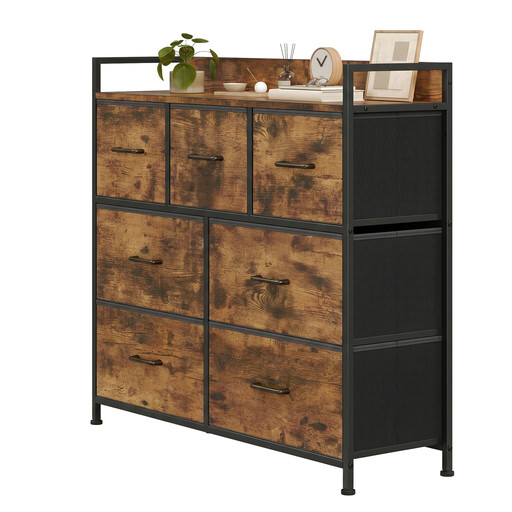
Why this product fits the profile: The seven drawers allow you to store clothing, laundry and small everyday items separately. At 98 × 28.5 × 85 cm, this model is suitable for bedrooms, dressing rooms or living areas.
The product details state a load limit of 3 kg per fabric drawer, so you can plan your use realistically. The included anti-tip fitting should be fixed to the wall.
Seven compartments, adjustable feet, raised edges and a stated maximum weight of 50 kg for the top surface.
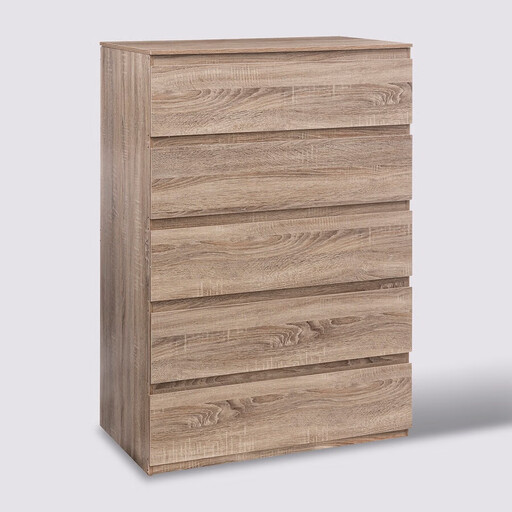
Why this product fits the profile: Measuring 78 × 48 × 118.4 cm, this piece has five drawers, steel components and a stated maximum load capacity of 100 kg. It suits households looking for a fixed indoor solution with greater weight tolerance.
The material and load specifications are clearly stated. However, before buying you should check whether the tall design can be secured against tipping over at your intended location.
Steel fittings and runners, five drawers and a stated assembly time of around 20 minutes by one person.
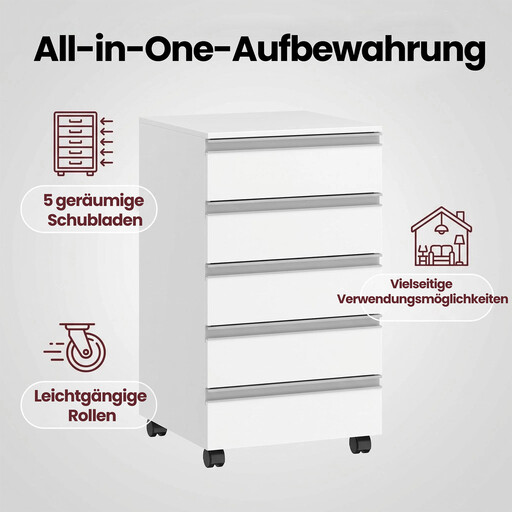
Why this product fits the profile: This model is designed for home offices, offices, studios and workshops. The five deeper drawers can hold documents, drawings, tools or materials, and thanks to the castors it can be moved around flexibly.
The 360-degree castors are designed for frequent repositioning; the two front castors can be locked. The stated overall load capacity is 50 kg, so the usage limits are clear.
Water, oil and abrasion-resistant melamine surface according to the product description, reinforced runners and compact dimensions of approximately 40.5 × 40.5 × 65.5 cm.
We’ve put together a full, regularly updated list of products that fully meet these strict selection criteria and the safety regulations in force in the EU.
That depends on the size of your wardrobe and how you want to organise it. Five drawers are often enough for a modest clothing collection. Seven drawers allow for finer sorting, for example by underwear, accessories, T-shirts and laundry. What really matters is the internal height and width.
The lifespan depends on the material, load, assembly and frequency of use. A chest of drawers should only be used within its stated load limits. Heavy items, uneven floors and drawers that are pulled out at an angle can put extra strain on the material and runners.
A mobile chest of drawers normally doesn’t need electricity. Running costs mainly come from cleaning, possibly replacement parts and swapping out damaged castors or runners. For care, a dry or slightly damp cloth is usually enough, depending on the material; avoid harsh cleaning products.