
Lieferung heute & morgen

Qualitätsgarantie

Willkommens-Angebote freischalten: KOSTENLOSE Lieferung | Bis zu 80 % RABATT | Kostenlose 30-Tage-JoyPlus-Testphase
App herunterladen
A chest freezer can provide additional storage space for families, bulk purchases or seasonal food. At the same time, some purchasing decisions can lead to unnecessary costs or everyday problems. The external dimensions are often confused with the actual usable interior space, energy consumption is judged solely by the efficiency rating, and suitability for a garage or cellar is overlooked.
This guide explains which specifications are relevant before buying a chest freezer and which models are suitable for different usage situations.
A 100-litre chest freezer is suitable for single households, couples or as an additional appliance. For families and regular bulk purchases, models of around 200 to 300 litres are often more practical. However, the internal layout is also important: one or more chest freezer basket solutions make it easier to access smaller packs.
In a chest freezer without sensible organisation, food can quickly end up stacked on top of one another. This means longer search times and more frequent opening of the lid.
The EU energy label ranges from A to G. However, the rating alone does not show how much electricity the appliance actually uses. You should therefore also compare the stated annual consumption in kWh. Despite having a similar efficiency rating, a larger appliance may use considerably more energy than a compact chest freezer.
The installation location also affects consumption. Direct sunlight, insufficient ventilation or a room that is too warm can impair cooling performance.
A chest freezer for a garage or unheated room requires a suitable climate class or an explicitly stated ambient temperature range. According to the product specifications, models such as the Beko HSM14550 and Beko HSM22340 are designed for unheated rooms down to −15 °C. This is not automatically the case for every upright freezer or chest freezer.
Before installation, you should check the information in the instruction manual. A dry, level surface, sufficient clearance from walls and unobstructed ventilation are also required.
Measure the intended installation space, including the movement of the door or lid. Also take transport routes, stairways and door widths into account.
An upright freezer with drawers usually provides easier access. A chest freezer, on the other hand, uses its interior flexibly for large and irregularly shaped food.
A 4-star rating on freezer appliances indicates storage at at least −18 °C. Freezing capacity is often stated in kilograms per 24 hours. This value shows how much fresh food the appliance can freeze under defined conditions.
A temperature alarm is particularly useful if the appliance is located in a garage, cellar or holiday home. However, it does not replace regular checks or suitable precautions during longer power cuts.
For living areas, open-plan kitchens or offices, a quiet chest freezer producing around 35 to 40 dB can be a sensible choice. Also look out for:
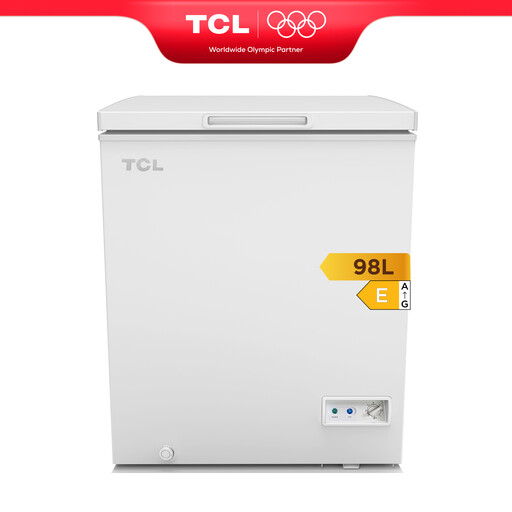
Why this product suits the profile: This compact chest freezer is designed for small households, offices or flats with limited floor space. The settings can be adjusted easily using the mechanical temperature control.
The 98-litre capacity helps limit overbuying and unnecessary space requirements. A removable basket helps you sort smaller food items.
E energy efficiency rating, 4-star freezing performance, castors and a front-mounted defrost water drain.

Why this product suits the profile: This chest freezer combines 198 litres of freezer capacity with digital controls and a switchable multi-zone for refrigeration or freezing.
The stated WinterProof function is designed for unheated rooms down to −15 °C. This means its suitability for a cellar or garage can be assessed using a specific temperature range.
C energy efficiency rating, annual consumption of 126 kWh according to the product specifications, two baskets and a noise level of 40 dB.
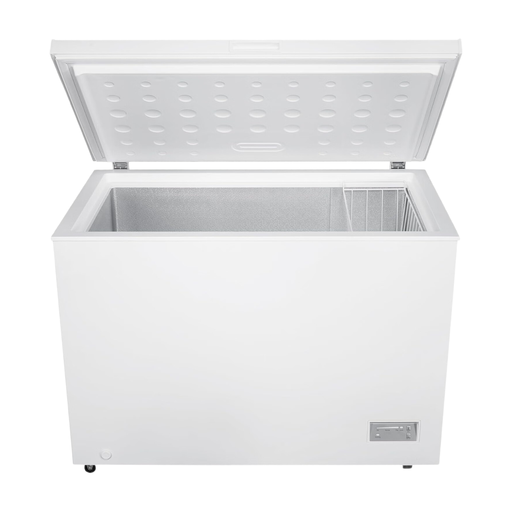
Why this product suits the profile: With 308 litres of net capacity, this model is aimed at families, users with larger supplies and small catering or commercial areas.
Its suitability for unheated rooms is specified by the SN-T climate class. A temperature alarm alerts you to rising internal temperatures.
Freezing capacity of 16 kg per 24 hours, four transport castors, one basket and a stated noise level of 40 dB.
We have put together a complete, regularly updated list of products that fully meet these strict selection criteria and the safety regulations applicable in the EU.
Place the chest freezer on a level, dry and stable surface. Maintain the ventilation clearance specified by the manufacturer and do not block any ventilation openings. After transport, the appliance should remain upright for several hours in accordance with the instructions before it is connected to the power supply.
Regular defrosting is advisable once a clearly visible layer of ice has formed. Do not use sharp objects or heating appliances that have not been approved for this purpose. For a rough running-cost calculation, use:
Annual consumption in kWh × your electricity price per kWh = annual electricity costs
Actual consumption depends, among other things, on room temperature, how full the appliance is, how often it is opened and the condition of the door seal.
For single households or as an additional appliance, 60 to 100 litres is often sufficient. Couples and smaller families can plan for 140 to 200 litres. For larger supplies, 230 to 300 litres or more is practical, provided there is enough installation space.
This depends on the stated climate class and the permitted ambient temperature range. For a garage or unheated cellar, the model should be explicitly approved for low temperatures. The room must also be dry and adequately ventilated.
It is not possible to state a fixed service life for every model. It depends on the compressor, usage, location, care and maintenance. Regular defrosting, a clean door seal and sufficient clearance from the wall can help ensure reliable operation.