
Lieferung heute & morgen

Qualitätsgarantie

Willkommens-Angebote freischalten: KOSTENLOSE Lieferung | Bis zu 80 % RABATT | Kostenlose 30-Tage-JoyPlus-Testphase
App herunterladen
Chests of drawers provide extra storage space in bedrooms, children’s rooms, living rooms and hallways. But the choice ranges from narrow drawer units and fabric shelving to wide sideboards. If you decide based solely on colour or a low price, it is easy to overlook important details.
Three typical buying problems are particularly common:
First measure the available wall width, maximum depth and height. With a chest of drawers, you also need enough space in front of the unit for the drawers to open fully. Doors likewise require sufficient clearance to swing open.
For small rooms, slim storage furniture can be a practical choice. For example, the textile 5five Simple Smart model measures 48 × 20 × 75 cm, making it easier to fit into narrow alcoves, hallways or beside a washbasin. By contrast, a large sideboard such as the Jahnke MOON SB 160 requires a considerably longer wall, measuring 160 × 39 × 80 cm.
Also consider:
A chest of drawers is suitable for clothes, accessories, documents or smaller household items. Drawers provide direct access, but they are only suitable for very heavy contents if the runners and load limits are designed for them.
A storage cupboard or sideboard with doors provides protected storage for larger items. Adjustable shelves make it easier to accommodate crockery, books or technology. A cable-management opening is useful for receivers, games consoles and other devices.
A bedside table or occasional cupboard serves a different purpose: here, a shallow depth, an easily accessible surface and a compartment for glasses, a remote control or reading material are key. For a child’s room, the chest of drawers should stand securely and be loaded in accordance with the manufacturer’s instructions.
A wooden chest of drawers or wood-effect model may be made from solid wood, MDF, chipboard or coated wood-based materials. MDF and chipboard are not automatically unsuitable; the specific construction, edge finish, fittings and care instructions are more important.
Check the following before buying:
Product specifications should always take priority over general marketing claims. For example, the Jahnke sideboard specifies a maximum load of 40 kg for the top surface and 5 kg for the shelves. Such individual figures provide more useful information for everyday use than a general statement about stability.
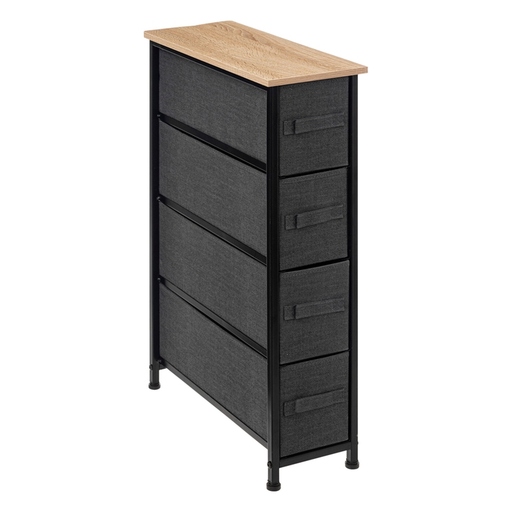
Why this product suits this profile: With a depth of just 20 cm, it is ideal for small rooms, narrow hallways or additional storage for cosmetics and accessories.
The dimensions and number of compartments are clearly stated. Four fabric drawers keep small items neatly stored, while the open shelf keeps frequently used items visible.
Four tiers, four fabric drawers, a metal frame and sturdy feet; colour: anthracite grey with a natural wood effect.
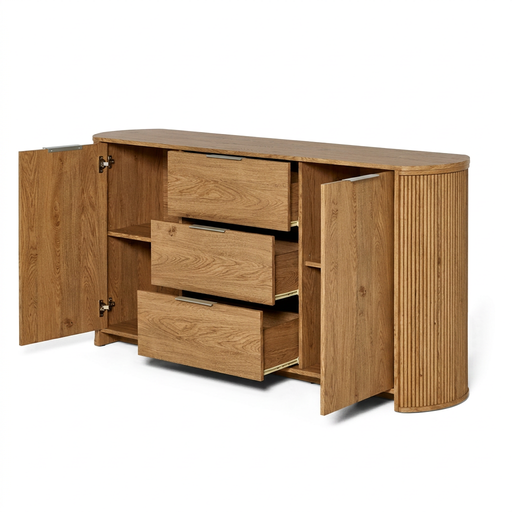
Why this product suits this profile: Measuring 160 cm wide, this unit combines three large drawers with two doors and adjustable shelves for the living room or dining area.
The layout and internal dimensions are documented. The cable opening at the back is designed for use with media equipment.
Three drawers, two doors, two adjustable shelves, metal handles and a cable-management opening; dimensions: 160 × 39 × 80 cm.
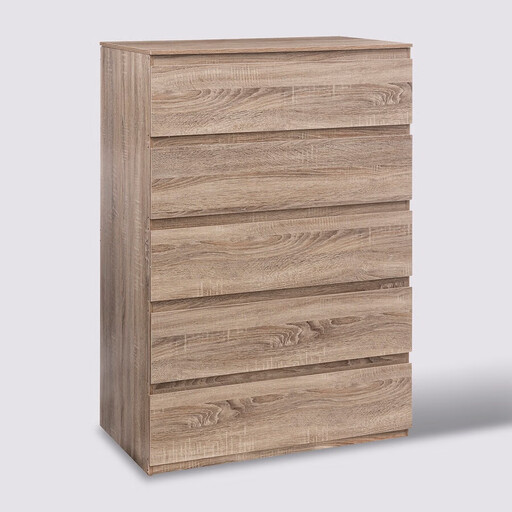
Why this product suits this profile: Five drawers provide a clear way to organise clothes, textiles or household accessories in the bedroom or utility room.
The manufacturer’s specifications include the dimensions, materials, assembly time and load limit. This makes it easier to plan how the unit will be used before buying.
Five drawers, steel fittings and steel drawer runners; dimensions: 78 × 48 × 118,4 cm, maximum load: 100 kg.
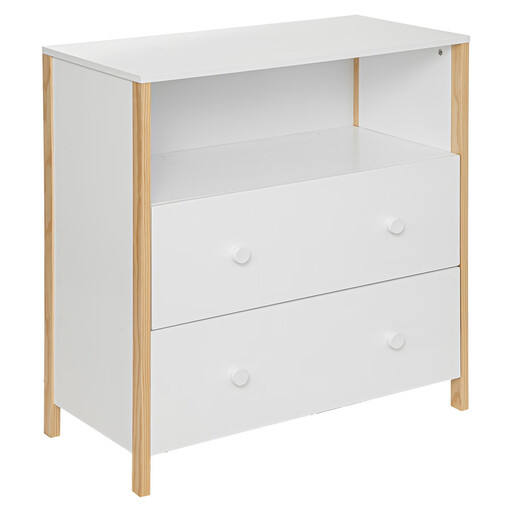
Why this product suits this profile: The white wood effect, two drawers and an open compartment are ideal for clothes, books or toys in a child’s room.
The construction is described as MDF E1, plywood chipboard and pine. The maximum load and two-person assembly requirement are also specified.
Two drawers, one open compartment, pine legs, dimensions: 80 × 40 × 85 cm, maximum load: 50 kg.
We have put together a complete, regularly updated list of products that fully meet these strict selection criteria and the safety regulations applicable in the EU.
Place the furniture on a level, load-bearing surface. Uneven floors can affect doors and drawers. Tall or narrow models should be secured against tipping in accordance with the assembly instructions. Heavy items should preferably be stored at the bottom.
For many coated surfaces, a soft, slightly damp cloth is all that is needed. Do not leave liquids on the surface for extended periods. Fabric drawers may need to be cleaned differently depending on the material, so follow the manufacturer’s instructions.
For hallways and small rooms, a depth of around 20 to 35 cm may be sufficient if you mainly need to store accessories or smaller items. Deeper drawers are often more practical for clothes. Before buying, plan the available wall space, drawer clearance and walkways together.
Their lifespan depends on the material, construction, load, assembly and care. A chest of drawers should not be loaded beyond its stated capacity on a permanent basis. Loose fittings should be checked and tightened promptly in accordance with the instructions.
The price depends, among other things, on the size, material, number of drawers, fittings and assembly condition. Do not compare just the purchase price. Also consider what is included in the delivery, the assembly effort, load specifications and whether the unit is suitable for its intended location.