Holidaymakers cooking together
If you want to make several enchiladas in one dish, check that the dish, including its handles, fits inside the usable cooking space and has enough room for the portions you’re planning.


Choose an oven based on the outside dimensions of your baking dish, including the handles, and the usable cooking space inside. A capacity in litres alone won’t tell you whether the dish will fit. A mini oven could work if you have enough worktop space, a suitable power socket and the clearances specified in the instructions. If there’s already a suitable full-size oven, or your dish is too large, that may be the more practical option. For chicken, the German Federal Institute for Risk Assessment (BfR) recommends heating food to 70 °C throughout for at least two minutes.
If you want to make several enchiladas in one dish, check that the dish, including its handles, fits inside the usable cooking space and has enough room for the portions you’re planning.
If worktop space is limited, compare the oven’s external dimensions with the space available. Check the clearances and power requirements in the instructions for the specific model, too.
If you won’t all be eating at the same time, plan how to heat, keep warm or chill your chicken enchiladas safely, regardless of the oven’s functions.
First compare your dish with the oven cavity, then check that you have a safe place to set it up. Heating functions, controls and energy use are other factors to consider.
| What matters | What to check before buying | Who should consider this? |
|---|---|---|
| Dish size and portion size | Compare the dish’s external dimensions, including the handles, with the usable internal width, depth and shelf height of the specific oven. | If you want to bake several portions in one dish, the actual fit matters more than the capacity in litres. Around 33% of consumers say dish and portion size is their main concern. |
| A safe place to set it up | Check the worktop space, socket and model-specific clearance above and to the sides, using the instructions as a guide. | In a small holiday-home kitchen, you’ll need room for the required clearances as well as the appliance itself. Around 27% of consumers say having a safe place to set it up is their main concern. |
| Cooking chicken safely | The BfR recommends heating food to 70 °C throughout for at least two minutes. When keeping food hot, it should reach at least 60 °C throughout. | If you’re cooking chicken or serving it later, you’ll need a plan for checking it has been heated through and handling any extra portions safely. Around 27% of consumers say food safety is their main concern. |
| Ease of use and energy consumption | Choose the heating functions and timer you need. To compare energy use, look at the actual consumption for similar cooking tasks. | If you want to cook with as little fuss as possible in your holiday home and keep track of electricity use, the wattage alone won’t give you a meaningful cost comparison. Around 13% of consumers say ease of use and running costs are their main concerns. |
Internal dimensions and shelf height vary by model. A claim that an oven fits round baking tins doesn’t tell you whether a rectangular dish with handles will fit.
Measure the outside of your dish, then compare its width, depth and height with the usable internal dimensions and shelf positions of the specific oven.
If the dish is too large, you may need a smaller baking dish or have to cook in batches.
Depending on the model, a mini oven may need extra clearance at the sides and above it. A shelf that is just big enough for the appliance itself may therefore be unsuitable.
Before buying, compare the space you have with the setup instructions for that exact model.
The oven’s set temperature and a browned surface don’t prove that the chicken has been heated sufficiently throughout. Portions served later also need to be handled safely.
Follow the BfR’s food hygiene advice: heat food to 70 °C throughout for at least two minutes, and keep food at 60 °C or above throughout when keeping it hot.
The wattage alone doesn’t show how much electricity a complete cooking cycle will use. The consumer advice centre recommends looking at actual consumption when comparing energy use.
Where the information is available, compare consumption for similar cooking tasks rather than just the wattage or oven capacity.
The BGE 1580/E is a mini oven with a 30 l capacity, several heating functions, optional fan-assisted cooking and a keep-warm setting.
According to Caso, the TO 26 SilverStyle has a 26 l capacity, fan-assisted cooking and selectable top and bottom heat.
The TO 2058 is listed with a 42 l capacity and the TO 2068 with a 20 l capacity; both models have fan-assisted cooking.
The KB 27 U.2 is a grill oven with a 20 l capacity, top and bottom heat, fan-assisted cooking and a timer.
The OV-3615 is a compact mini oven with a 10 l capacity.
The compact ovens below are described as suitable for baking and browning dishes. For each model, check that your baking dish fits in the usable cooking space and that you can set up the oven safely in your holiday-home kitchen.
 No image available
This 32 l mini oven is worth considering if you’re looking for a roomier appliance for baking and grilling. You’ll need to check separately whether your dish will fit.
Features include a temperature range of 100–250 °C, a 60-minute timer, and baking and grilling accessories. The external dimensions are 52.3 × 36 × 32.2 cm; compare them with the space available and the setup instructions.
 No image available
It’s described as suitable for three to four people, which may work if you’re planning several portions. That doesn’t confirm that a particular baking dish will fit.
Features include top and bottom heat, combined heating, three shelf positions, a temperature range of 100–230 °C and a 60-minute timer. The description mentions a 26 cm pizza, but doesn’t confirm whether a rectangular dish will fit.
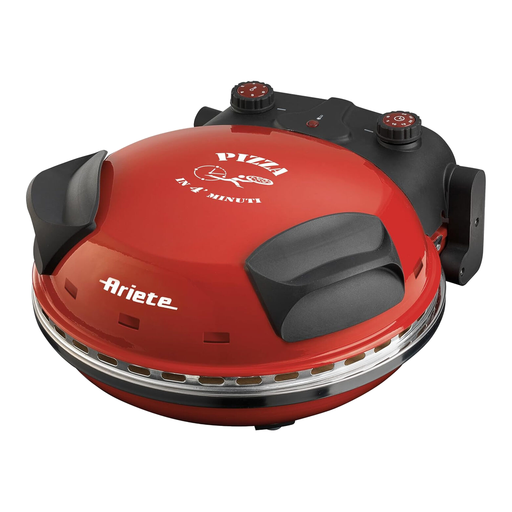 No image available
The product description mentions savoury pies and reheating food as well as pizza. Before choosing, check whether your baking dish is suitable for this appliance.
Features include 1,200 W, a thermostat with five cooking settings, a removable crumb tray and external dimensions of 34 × 30 × 19 cm.
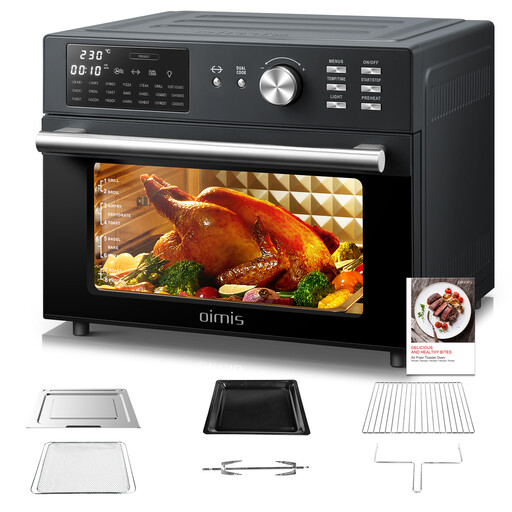 No image available
This 30 l oven is described as suitable for baking and family meals. Even so, compare your dish’s dimensions with the usable cooking space.
Features include 21 presets, an additional pizza function and 1,800 W. The external dimensions are 456 × 430 × 365 mm; the product name also lists a rotisserie and dehydrating function.
 No image available
Described as suitable for one or two people, this model is better suited to smaller portions. Its cooking space is limited if you want to bake several enchiladas in one dish.
Features include top and bottom heat, a temperature range of 100–230 °C, a 60-minute timer and external dimensions of 37 × 26.5 × 21 cm. Check your dish’s dimensions and the space available for the oven.
No. Measure the outside of your dish, including the handles, and compare its dimensions with the inside of the specific oven and its shelf positions. A manufacturer’s claim about round dishes doesn’t necessarily apply to rectangular ones.
Check the instructions for your chosen model, as well as the available worktop space, socket and required clearances. Severin specifies 12 cm at the sides and back, and 30 cm above, in its oven FAQs. These figures aren’t a general rule for other appliances.
The BfR recommends heating food to 70 °C throughout for at least two minutes. When keeping food hot, it should reach at least 60 °C throughout. If you’ll be storing extra portions for longer, plan how to chill and reheat them as well.
Compare actual consumption on a like-for-like basis. The wattage or oven capacity alone won’t tell you the cost per meal. If there’s a fault, remember that your statutory rights are different from a voluntary guarantee. The consumer advice centre explains that statutory rights are set out by law, while a guarantee is offered voluntarily.
Not in every case. The European Commission lists small and portable ovens as outside the scope of its energy labelling rules for household ovens. Whether a particular appliance is covered depends on its design; the absence of such a label is not, on its own, proof of a breach of the rules.