Start by considering your tray size, the number of portions and the space available. A built-in oven is a better fit if you have a suitable recess and want to use a larger tray or several trays. A countertop mini oven may suit you if smaller quantities are enough and you don’t have a suitable recess. Then compare the heating method and cleaning options, and, for appliances that require an energy label, the kWh per standard cycle, as explained by the German Environment Agency. No oven setting replaces the German Federal Institute for Risk Assessment’s recommendation to heat food to at least 70 °C throughout for two minutes, followed by safe cooling.
Who are the different types of oven suitable for?
Batch cooks preparing several portions
If you’re cooking chicken and sides for several working days, check that the tray and portions will fit in the oven. The German Federal Institute for Risk Assessment also recommends planning how to keep food cool where you’ll eat it and transporting containers in a cool bag.
Cooks without a built-in oven recess
A freestanding appliance may be an option for smaller traybakes. Check the usable tray dimensions and the space it will occupy. For the Rommelsbacher BG 1805/E, the manufacturer specifies a minimum width of 55 cm, including the feet.
Frequent tray roasters who want easier cleaning
If you regularly cook greasy or splattering dishes, the cleaning method may be one of your selection criteria. Compare the features of each model rather than treating extra equipment as essential for a traybake.
What should you look for when buying?
Built-in oven
A good fit if: you have a suitable recess and want to use a larger tray or several trays.
Check: the appliance and recess dimensions, the connection and what’s included; don’t confuse accessories that can be fitted later with equipment included as standard.
Freestanding mini oven
A good fit if: you don’t have a built-in recess and a smaller tray is sufficient for the number of portions you need.
Bear in mind: For the Rommelsbacher BG 1805/E, the manufacturer specifies a 42 l oven capacity and a minimum footprint width of 55 cm, including the feet. Capacity alone doesn’t confirm that a particular tray will fit.
When choosing an oven for chicken traybakes and make-ahead lunches, the most important criteria depend on how many portions you’re cooking and where the appliance can go.
| Consideration |
What should you look for when buying? |
Who is this particularly important to? |
| Tray space and number of portions |
Check the usable interior and tray dimensions, as well as what’s included; if you’re using several shelf levels, check the specified heating method. |
If I’m preparing several portions at once, I need enough usable tray space. That’s why it comes first for around 26 % of consumers. |
| Safe cooking and storage |
Plan to use a suitable food thermometer, and consider how to keep food cool where you’ll eat it, as well as using a cool bag for transport. The German Federal Institute for Risk Assessment recommends heating food to 70 °C throughout for at least two minutes. |
If I’m cooking chicken for lunches later in the week, I want to plan safe cooking, cooling and transport. Around 26 % of consumers put safe preparation and storage first. |
| Built-in or countertop space |
Check the recess or worktop dimensions against the appliance specifications, and check the connection and installation requirements. |
If there’s no suitable built-in recess, the appliance needs to fit the available space. For around 21 % of consumers, where the appliance will go is the main consideration. |
| Cleaning after roasting |
Compare the cleaning method and the accessories that need cleaning for the specific model; don’t treat extra features as essential. |
If I often cook greasy traybakes, I want to choose a cleaning method that suits how I use the oven. Around 16 % of consumers put cleaning first. |
| Energy use if you cook frequently |
For ovens that require an energy label, compare the kWh per standard cycle for each heating method. The German Environment Agency explains that the energy label also shows average consumption per cycle. |
If the oven is used often, I want to compare consumption figures without assuming they match the energy use of my recipe. Energy consumption is the main consideration for around 11 % of consumers. |
Which buying and usage mistakes should you avoid?
-
Assuming oven capacity in litres equals usable tray space
A capacity figure or stated tin size doesn’t automatically tell you whether your rectangular tray will fit in the oven.
Check the interior and tray dimensions of the specific appliance, along with the size of any accessories supplied.
If your existing tray doesn’t fit, you may need to buy a suitable one or cook in additional batches.
-
Relying on an oven setting or temperature to prove food is safe
The oven temperature you set doesn’t confirm that the poultry has been heated sufficiently throughout. Cooling is also important when you’re preparing meals for later.
Check the food’s temperature with a suitable food thermometer and follow the German Federal Institute for Risk Assessment’s hygiene advice on heating, cooling, storage and transport.
-
Comparing only appliance size when choosing between built-in and mini ovens
A built-in model needs to fit the recess and installation requirements; a countertop appliance needs a suitable space and a tray that fits.
Before deciding, check the dimensions, connection, installation or fitting instructions, and what’s included with the specific model.
Brands and model ranges to consider
The examples below refer to specific model ranges. The features mentioned are based on manufacturer information, not an independent performance comparison for chicken traybakes.
Bosch
The HBA514BS3 built-in oven is an example of an appliance for tray cooking, with a feature the manufacturer says can be used on up to three hot air levels.
- For this model, Bosch lists 3D Hotair and hydrolytic cleaning.
- A pull-out shelf can be fitted later; the specifications don’t confirm that a particular tray will fit or guarantee the cooking results for every dish.
Beko
The BBIM12300X is a built-in model for which the manufacturer lists a 72-l oven capacity and steam cleaning.
- AeroPerfect and even hot air distribution are features listed by the manufacturer for this model.
- These specifications aren’t an independent performance assessment for chicken traybakes; check the tray and recess dimensions separately.
Siemens
The HR776G1B1 is a built-in oven with a 71 l capacity, according to the manufacturer, as well as additional steam and cleaning functions.
- This model is listed with pyrolytic and hydrolytic cleaning, as well as a burst of steam.
- A pull-out shelf can be fitted later. The extra features aren’t proven to be essential for a simple traybake.
Rommelsbacher
The freestanding BG 1805/E is a mini oven option that doesn’t require a built-in recess.
- The manufacturer lists a 42 l capacity, fan-assisted cooking options and an included tray. The minimum footprint width is 55 cm, including the feet.
- The oven capacity doesn’t confirm that any large baking tray will fit.
Miele
The H 2465 B ACTIVE is another example of an oven with a different combination of features, including Fan Plus and PerfectClean.
- PerfectClean, Fan Plus and AirFry are features listed by the manufacturer for this model.
- These specifications aren’t an independent comparison of tray-roasting performance with other brands.
Joybuy products for traybakes
This selection includes built-in ovens and compact countertop appliances. Before buying, check that the tray, interior and footprint dimensions suit your needs.
 No image available
Bosch HBA571BB4 Series 2 built-in oven
A built-in option if you have a suitable recess; check the tray and oven dimensions first.
71 l oven capacity; 3D Hotair; pyrolytic and hydrolytic cleaning.
View at Joybuy
 No image available
Comfee built-in oven, 60 cm, 70 l
This model may suit you as a built-in appliance if you have a suitable recess; check the dimensions before buying.
3 kW; hot air; grill and pizza functions; AquaClean steam cleaning; LED display with timer; ECO mode; energy efficiency class A.
View at Joybuy
 No image available
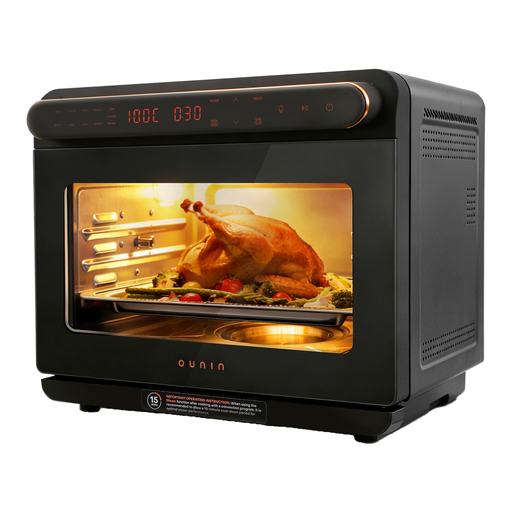
OUNIN 24L Steam Combi Oven, 10-in-1
A countertop alternative to a built-in oven if you’re looking for a compact appliance; check that the baking tray suits your dish and the number of portions you need.
24 l; Steam Bake and Steam Roast; rotisserie; 1-l water tank; 304 stainless steel interior.
View at Joybuy
 No image available
Woltu BF12sz mini oven, 32 l
A compact freestanding oven if you want to bake or grill without a built-in recess; check the available space and tray dimensions.
1.600 W; timer; crumb tray; temperature range 100 to 250 °C.
View at Joybuy
 No image available
Haier H6 ID23T3HTB built-in oven, 78 l
A built-in option for cooking several portions, provided the oven and recess dimensions suit your needs; check the measurements before buying.
Nine cooking functions; energy efficiency class A+.
View at Joybuy
Frequently asked questions
How can I tell if the chicken has been heated sufficiently?
The German Federal Institute for Risk Assessment recommends heating food to 70 °C throughout for at least two minutes. The oven temperature you set doesn’t confirm this, so check the food with a suitable food thermometer.
How should I store and transport make-ahead chicken lunches?
The German Federal Institute for Risk Assessment recommends quickly cooling hot food to below 7 °C for longer storage, and keeping perishable food at between 2 °C and 7 °C at most. Plan how to keep food cool where you’ll eat it and transport the containers in a cool bag. These are hygiene recommendations, not a guarantee of how long every portion will keep.
What should I check before fitting or positioning an oven?
For a built-in model, compare the appliance and recess dimensions, as well as the specified connection, with the fitting instructions. For a countertop appliance, check the available space and installation requirements. For the Rommelsbacher BG 1805/E, the manufacturer specifies a minimum footprint width of 55 cm, including the feet.
What does an oven’s energy label tell me?
For household ovens covered by EU energy labelling, the label includes information such as oven capacity and consumption per standard cycle for conventional and fan-assisted heating. The European Commission lists small ovens as exempt from the regulations referred to, so first check whether energy labelling applies to a mini oven. The absence of a comparable label alone isn’t enough to judge energy use.


