
Lieferung heute & morgen

Qualitätsgarantie

Willkommens-Angebote freischalten: KOSTENLOSE Lieferung | Bis zu 80 % RABATT | Kostenlose 30-Tage-JoyPlus-Testphase
App herunterladen
A child bed guard rail is designed to stop your little one from rolling out of bed while they sleep. In practice, though, not every bed guard suits every mattress or bed frame. That’s why colour and price aren’t the only things that matter – what’s crucial are the dimensions, the fixing method and the age recommendation.
A bed guard can be securely fitted and still be too low if the mattress sits significantly above the intended edge. Before you buy, measure the actual mattress height, including any toppers. With a wooden bed guard, there may also be a defined maximum height that must not be exceeded.
A bed guard without drilling is often attached using Velcro, straps or a clamp system. These methods can make assembly easier, but they need a suitable surface and correct installation. Compatibility needs particularly careful checking with slatted bases, divan beds or beds with drawers.
A foldable bed guard makes it easier for your child to get in and out, to make the bed and to reach your little one. However, every moving part brings extra hinges and locks. Before each use, check that the guard is fully locked into place and that there’s no gap between the mattress, the side guard and the bed frame.
Start by measuring:
A baby bed guard or a child bed guard shouldn’t be chosen purely by its external length. What also matters is how much protective surface actually sits alongside the mattress. For a 90x200 cm child’s bed, a fully integrated side guard can be more sensible than a short single guard, provided the bed suits your child’s age and how it will be used.
With a safety guard for a child’s bed, all the fixing elements must be compatible with the bed’s construction. After assembly, check the following:
You should repeat these checks regularly, especially after reassembling the bed or changing the mattress.
Wooden bed guards feel sturdy and often suit classic children’s beds. Fabric and mesh elements, on the other hand, are lightweight and give you a better view of your child. Rounded corners and adequate ventilation are practical design features, but they don’t replace checking the instruction manual.
The manufacturer’s age recommendation is also important. A guard rail for children from around 18 months isn’t automatically suitable for a baby. With a mid-height child’s bed, you also have a ladder and a raised sleeping surface. Such models should only be used according to the manufacturer’s instructions and with the recommended mattress.
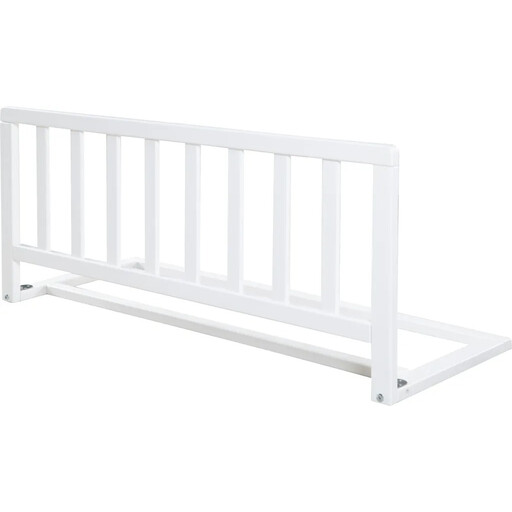
Why this product fits the profile: This 87.5 cm wide wooden guard is designed for children from around 18 months up to about 5 years and is fixed to the slatted base without drilling. It’s ideal for parents looking for a straightforward side guard for an existing bed.
The maximum mattress height of 18 cm and the fixing point on the slatted base are clearly stated. This means you can check whether the bed and mattress are compatible before you buy.
Solid wood, 38 cm height, 6 cm bar spacing and assembly with the supplied Velcro tape.

Why this product fits the profile: This mid-height children’s bed combines a continuous guard rail with a low ladder. It’s designed for children aged 3 years and over and fits a 90x200 cm mattress.
The required mattress size, the maximum user weight of 120 kg and the recommended age limit are all clearly stated. The ladder is low, but it does require instruction and supervision.
Solid pine wood, continuous side guard, 44 cm storage space under the bed and includes a slatted base.
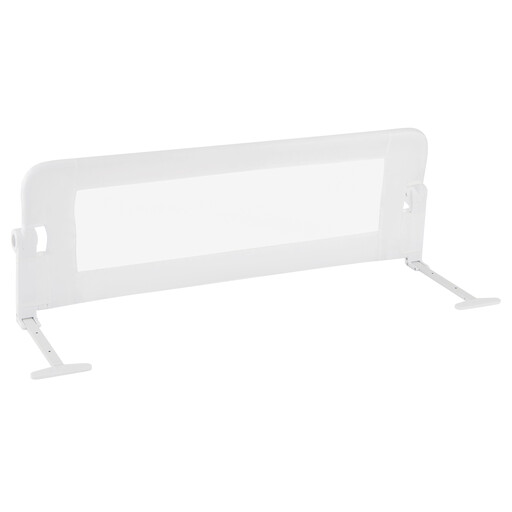
Why this product fits the profile: This foldable guard is designed for various bed types, including children’s, single and double beds. It suits households where you need frequent access to the bed or change the bedding regularly.
The adjustable straps and buckle allow flexible fixing. Before buying, you need to check the bed type, mattress size and the maximum load of 20 kg.
Folding mechanism, steel frame, breathable mesh fabric and a removable, washable cover.
We’ve put together a full, regularly updated list of products that fully meet these strict selection criteria and the safety regulations in force in the EU.
That depends on the individual model. According to the product information, the roba bed guard is designed for children from around 18 months up to about 5 years. The mid-height children’s bed is specified for children aged 3 years and over. What’s always decisive are the manufacturer’s instructions, the construction of the bed and your child’s development.
Depending on the model, it’s fixed using Velcro, straps or another holder provided by the manufacturer. A bed guard without drilling should only be used on beds for which the fixing system is suitable. After assembly, you must check that the guard is secure and that no dangerous gaps have appeared.
The length of use depends on the age rating, weight limit, mattress height and the condition of the product. A bed guard should be replaced if parts are damaged, connections are loose or fixings can no longer be reliably secured. You should also check the fit again when you move to a thicker mattress.