
Lieferung heute & morgen

Qualitätsgarantie

Willkommens-Angebote freischalten: KOSTENLOSE Lieferung | Bis zu 80 % RABATT | Kostenlose 30-Tage-JoyPlus-Testphase
App herunterladen
A child car seat needs to suit more than just your child’s age. Their height, your vehicle, the type of fitting and how you use the seat every day all affect whether it’s practical and correctly installed. Marketing terms such as ‘grows with your child’, ‘360-degree’ or ‘extra safe’ are no substitute for clear information about approval and installation.
A car seat for children aged 15 months and over won’t automatically suit every child of that age. For seats approved to ECE R129 or UN R129, height is the main factor. For example, a model for 76 to 150 cm may be intended for children from around 15 months, but it still needs to be adjusted correctly to suit your child’s height and build.
A child car seat with ISOFIX can usually be connected quickly and securely to your vehicle’s anchorage points. However, you’ll still need to check your vehicle handbook, the seating position and any additional fittings. Some models also require a Top Tether, support leg or vehicle seat belt. A green indicator on the seat confirms only that the relevant fitting is connected correctly – it doesn’t automatically confirm that every setting is right for your child.
A basic booster seat is designed for older children of the right height. It often has no integral harness and is used with the vehicle’s three-point seat belt. For smaller children, a seat with a backrest, headrest and a suitable seat-belt guide is usually the better option. A booster seat should also not be confused with an inflatable seat for ordinary chairs: the roba model in our selection is intended for chairs at home, in restaurants and when travelling, not for use in a car.
Look for a visible approval to ECE R129 or UN R129. This standard classifies child restraint systems according to factors including height, and includes requirements for side-impact testing. However, approval is no substitute for reading the instruction manual.
Before you buy, check:
A rear-facing child car seat is used facing away from the direction of travel. The cybex Sirona Gi i-Size can rotate through 360 degrees; depending on the settings, it can be used rear-facing or forward-facing. This makes it easier to get your child in and out, but doesn’t change the need to install the seat correctly.
ISOFIX can make installation easier, but it isn’t available in every vehicle or on every seat. Check whether your chosen position has ISOFIX and whether a Top Tether or support leg is permitted there. For older vehicles, a car seat fitted with the three-point seat belt may be a better option.
A 360-degree child car seat also needs enough space between the child seat, the door and the front seat. You should be able to use the rotation feature without it pressing against the car door or getting in the way of the driver’s seat.
An adjustable headrest, easy-to-reach harness and removable cover can all make a difference to everyday use. Look for:
Figures such as reductions in impact forces or injury risks should be treated as manufacturer claims only. They depend on the test conditions and can’t be applied to every accident.
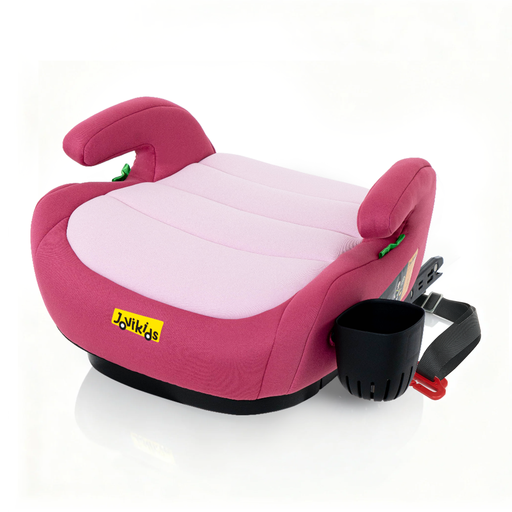
Why it suits this profile: According to the product details, this compact booster seat is designed for children measuring 125–150 cm. It weighs around 3 kg, has ISOFIX fittings and comes with a washable cover.
The specified height range makes it clear who the seat is intended for, helping to prevent it being used for smaller children.
ISOFIX fittings, a removable cover and compact dimensions of around 37 × 44 × 23 cm.

Why it suits this profile: This rear-facing child car seat is designed for children measuring 61–105 cm. It has an integrated base with ISOFIX, a support leg, 360-degree rotation and five recline positions.
The clearly defined height range helps prevent the seat being used beyond its intended limits. The ISOFIX indicators and integrated base also help make installation easy to check.
UN R129/03 approval, integrated side-impact protection, a headrest adjustable to 12 positions, and removable covers that can be washed at 30 °C.

Why it suits this profile: According to the product details, this child car seat grows with your child and is designed for children measuring 76–150 cm, or from around 15 months to 12 years. It’s a good option for families looking for a seat they can use over a longer period.
The change from the protective system to the vehicle seat belt is based on specific limits: according to the product details, the impact shield is used up to 105 cm or 21 kg.
UN R129/04 approval, ISOFIX and Top Tether in protective mode, 12 headrest positions, and a removable cover that can be washed at 30 °C.
We’ve put together a complete, regularly updated list of products that meet these strict selection criteria and the safety regulations in force across the EU.
How long you can use a seat depends on your child’s height and weight, the seat’s approval and its condition, not just their age. A seat with visible damage, missing parts or a history of involvement in an accident shouldn’t be used again. Follow the manufacturer’s guidance on the seat’s lifespan and storage.
Both fitting methods can be suitable when used correctly. ISOFIX often reduces installation errors and helps keep the seat stable. The three-point seat belt is more flexible and can also be used in vehicles without ISOFIX. What matters is the seat’s approval, compatibility with your car and following the installation instructions precisely.
A booster seat for 125–150 cm should only be used within the stated height range and with the three-point seat belt positioned correctly. The shoulder belt should sit across the shoulder, not the neck, while the lap belt should sit low across the pelvis. If the belt doesn’t fit properly, a suitable seat with a backrest is a better choice.