
Lieferung heute & morgen

Qualitätsgarantie

Willkommens-Angebote freischalten: KOSTENLOSE Lieferung | Bis zu 80 % RABATT | Kostenlose 30-Tage-JoyPlus-Testphase
App herunterladen
A children’s learning tower can make everyday life in the kitchen, bathroom or at the dining table more practical. With adult supervision, children can join in with certain activities, such as baking, washing their hands or helping with simple tasks. However, learning towers vary considerably in their construction, height adjustment and safety features.
Not every product marketed as a Montessori learning tower, children’s kitchen tower or children’s kitchen chair is suitable for standing children. Before you buy, check the technical details and safety information rather than relying solely on product photos or marketing claims.
The stated maximum load tells you only the permitted weight. It does not automatically mean that a children’s standing tower will be stable on every surface. You should also look for:
Never use a learning tower on tables, worktops or raised surfaces, or near stairs. A high weight limit does not replace the need for adult supervision.
A height-adjustable learning tower can be adapted more easily to your child’s height. However, check how many positions it actually offers and whether the platform locks securely into place. Three fixed platform heights may be enough for many families, but this does not mean the height can be adjusted continuously.
Also check whether adjustments must be made by an adult. If the platform is secured with screws, both sides must be fastened evenly and firmly before your child climbs in.
A wooden learning tower may be made from different types of wood or a combination of materials. The word “natural” alone tells you little about the wood’s origin, its finish or the product’s stability. Look for specific details such as:
The stated age is only a guide. A learning tower advertised for children aged 18 months and over should only be used if your child can stand independently and climb in and out safely. Even when a model carries this age recommendation, your child’s individual development is what matters.
Children must not use the tower unsupervised. Only one child should stand in it at a time. Before each use, check for loose screws, wobbly joints or damaged materials.
Compare the maximum load with your child’s current weight and how much they are likely to weigh in the future. Do not exceed the permitted total weight. Check the tower’s width, depth and height to make sure it will fit, particularly if your kitchen is small.
It’s a good idea to measure the space where you plan to put it before buying. Leave enough clearance between the tower and the cooker, open drawers or sharp edges. A children’s learning tower is no substitute for a safe working environment.
An adjustable platform makes it easier to adapt the tower to your child’s height. The entrance should also be designed so your child does not have to climb over an unnecessarily high edge. Check that the structure remains fully enclosed and stable during use.
Safety claims such as “TÜV-certified” or “TÜV-tested” should be verifiable in the product information. The product details for the Hauck model featured here mention a TÜV test. According to the supplier, the FSC label refers to the European beech wood used.
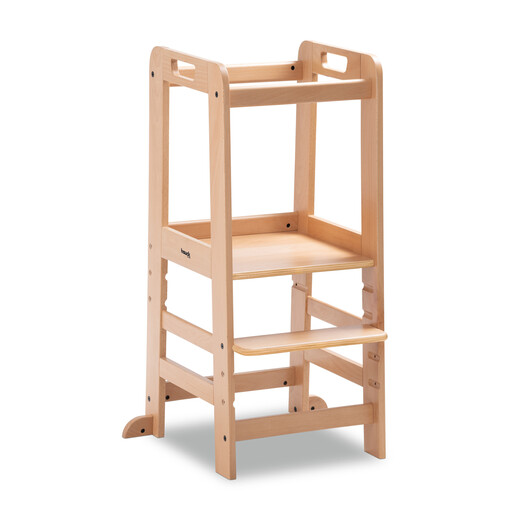
Why this product suits this profile: According to the product details, the tower is designed for children from around 18 months to 5 years old and has three platform heights. It gives families a clearly specified set of features for use in the kitchen, at the dining table or by the sink.
Rather than simply being described as a tower that grows with your child, its platform is specified as having three height settings. The maximum load of 40 kg and safety information are also stated.
Three platform heights, FSC-certified European beech wood according to the supplier, a maximum load of 40 kg and tools included.
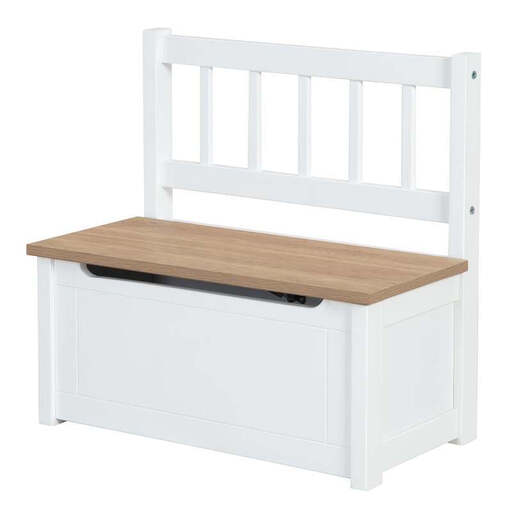
Why this product suits this profile: This children’s bench is not a learning tower and is not designed for standing. It’s a good fit for families looking for extra seating and storage for a child’s bedroom.
Its clearly stated purpose helps prevent it being misused as a children’s kitchen tower. The lid has an integrated brake to stop it closing accidentally.
A seat height of 25.5 cm, internal storage, a melamine-resin-coated surface and no assembly required according to the product details.
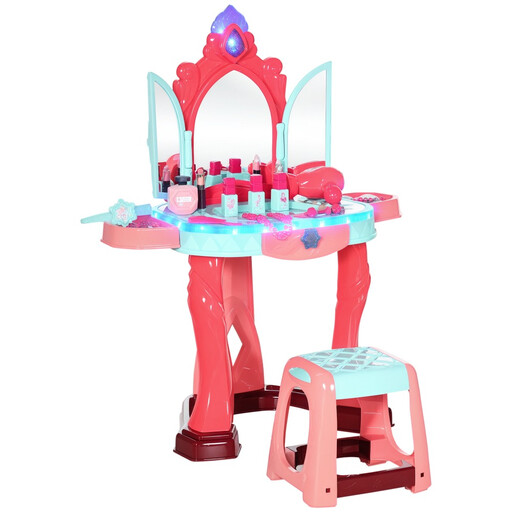
Why this product suits this profile: This table and stool offer a separate option for role play and seated activities in a child’s bedroom. It is not a substitute for a standing tower and, according to the product name, is designed for children aged 3 to 6.
The product is clearly described as a dressing table with a stool, making it easy to distinguish from a children’s learning tower designed for standing activities.
Table, stool, mirror, lighting and music features, plus accessories according to the product name; dimensions of approximately 57 × 34 × 76 cm.
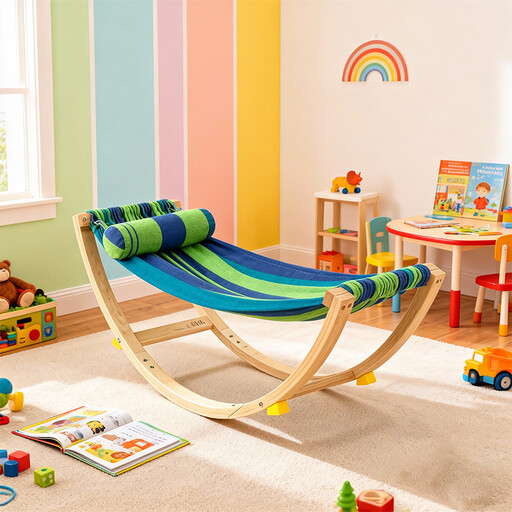
Why this product suits this profile: This product is a children’s hammock or hanging chair, not a learning tower. It’s for families looking for an extra place to sit or relax.
Its different product type and stated maximum load of 50 kg make clear that it is not designed for activities at worktop height.
Birch wood frame, polyester, safety stopper and stated dimensions of approximately 122 × 48 × 36 cm.
We’ve put together a complete, regularly updated list of products that meet these strict selection criteria and fully comply with the safety regulations in force in the EU.
Many models are listed as suitable for children from around 18 months. However, your child must be able to stand independently and climb in and out safely. An age recommendation does not replace adult supervision.
How long you can use a tower depends on its maximum load, construction and your child’s development. According to the product details, the Hauck Learn N Explore is suitable for children from around 18 months to 5 years and supports up to 40 kg. Stop using it if your child can no longer use it safely or reaches the weight limit.
Place the tower on a level, stable, non-slip floor. All four feet must be firmly on the ground. Check the platform, screws and joints before every use. Do not place the tower on tables or worktops, and only use it under direct adult supervision.