
Lieferung heute & morgen

Qualitätsgarantie

Willkommens-Angebote freischalten: KOSTENLOSE Lieferung | Bis zu 80 % RABATT | Kostenlose 30-Tage-JoyPlus-Testphase
App herunterladen
A children’s night light can make it easier to find your way around a child’s bedroom, nursery or hallway at night. However, models can vary considerably in their sensors, power supply, light colour and controls. That’s why an eye-catching product description is no substitute for checking the technical details.
Three common buying misconceptions come up particularly often:
A warm white night light is often in the region of 2,600 to 3,000 Kelvin. Product descriptions typically present this as a warmer, less neutral light than cool white. A low brightness setting may be enough for a baby night light or a night light for a child’s bedroom.
Look for specific details rather than vague claims such as ‘gentle’ or ‘promotes sleep’. Useful points to check include:
A dimmable night light can be adjusted to suit different situations: a low setting at night, a brighter one when tidying up or briefly checking the room.
A motion-sensor night light switches on when it detects movement. A dusk or light sensor can also prevent the light from coming on during the day. Check the range and detection angle: details such as up to 3 metres or 120° are more useful than vague promises of ‘reliable detection’.
The shut-off settings matter too. A model that switches off automatically after 60 seconds prevents the light from staying on unnecessarily. A timer night light, on the other hand, can stay on for a set period, for example as part of a bedtime routine.
Plug-in models are ready to use straight away and don’t need charging. They’re particularly suitable for hallways, stairways or fixed locations. Rechargeable models, by contrast, can be placed wherever you need them, whether on a bedside table, in your luggage or along a route you take at night.
Before buying, check:
A night light for a nursery should be placed out of a baby’s reach, unless the manufacturer specifically says otherwise. Electronic products should not be placed in a cot. If the product has touch controls or a battery, it’s also important to put it on a stable, dry surface.

Why this product suits this profile: This plug-in model combines warm white light with five brightness settings, making it suitable for a fixed spot in a child’s bedroom, hallway or stairway.
The product details specify 2,700 K, five settings, power consumption of 0.5 W and automatic shut-off after 60 seconds without movement.
Motion and dusk sensors, a detection range of up to 3 m and 120°, and no batteries required.
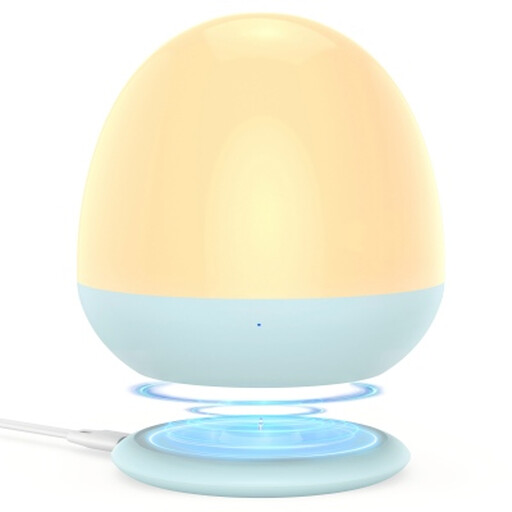
Why this product suits this profile: This portable light is a good option for families who want flexible placement and different charging options.
Instead of leaving the battery arrangement unclear, the product details specify USB charging and a stable charging station. The timer limits how long the light stays on.
ABS and PC casing, touch controls, a timer, and both wired and wireless charging. The product warning states that it is not suitable for children under three.
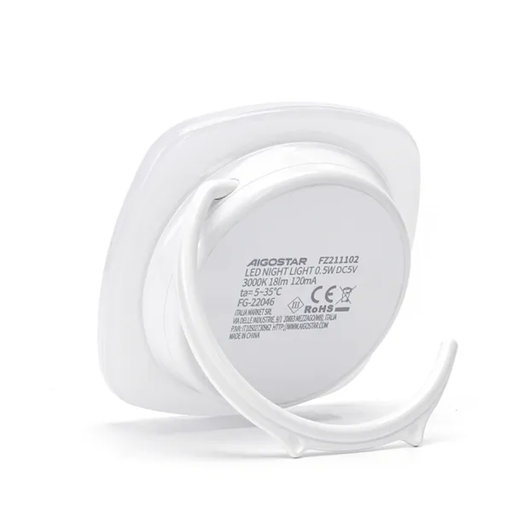
Why this product suits this profile: For a hallway, wardrobe area or route between the bedroom and bathroom, the rechargeable design offers a flexible alternative to a plug-in light.
The product details specify a battery, USB charging and motion detection. This means there’s no need to change batteries regularly, although you should still check the charge level.
500-mAh battery, 0.5 W LED, warm white light at 3,000 K and motion detection up to 3.5 m.
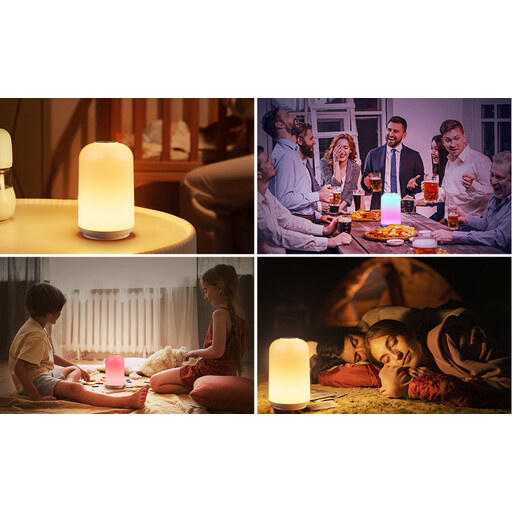
Why this product suits this profile: This model is designed for households that want to switch between practical lighting for finding their way around and colourful room lighting.
The product description clearly distinguishes between warm white and RGB modes. Warm white brightness can be adjusted steplessly, while RGB offers either a fixed colour or changing colours.
Built-in battery, USB charging at 5 V/1 A, 12 SMD LEDs, 40 lm and a light sensor for environments with no more than 40 Lux.
We’ve put together a complete, regularly updated list of products that meet these strict selection criteria and fully comply with the safety regulations in force in the EU.
There’s no single lumen figure that suits every room. A low setting is usually enough to find your way around. Choose a model with several brightness settings or a dimmer, and test its position to make sure the light doesn’t shine directly into anyone’s eyes or towards the bed.
A motion sensor can be handy in a hallway, on the stairs or on the way to the bathroom. In a child’s bedroom, check the detection range and shut-off time to make sure the light isn’t triggered continuously by every little movement. An additional light sensor is useful if you want the night light to stay off during the day.
Running costs depend on power consumption and how long the light is used each day. A 0.3 W or 0.5 W model will use less energy in theory than a light with a higher wattage. Rechargeable models also have charging losses. So compare the stated power consumption rather than relying on the label ‘energy-saving’.