
Lieferung heute & morgen

Qualitätsgarantie

Willkommens-Angebote freischalten: KOSTENLOSE Lieferung | Bis zu 80 % RABATT | Kostenlose 30-Tage-JoyPlus-Testphase
App herunterladen
A children’s night light should provide orientation at night without lighting up the room unnecessarily. When buying one, however, it is not just cute shapes or bright colours that matter. Practical shortcomings often only become apparent in everyday use: the battery runs out sooner than expected, the sensor responds unreliably or the lamp cannot be dimmed sufficiently.
This buying guide explains what families in Germany should look out for and which models are suitable for different situations.
An advertised battery life often only applies to the lowest brightness setting. For example, the VAVA VA-CL009 is advertised with up to 100 hours of battery life; according to the product description, this figure applies to the lowest setting and not to night-light mode. At maximum brightness, the stated operating time is around 7 hours.
Before buying, you should therefore check:
A colour-changing night light can be decorative. For night-time breastfeeding, changing nappies or finding your way to the toilet, however, warm white light with adjustable brightness is usually more practical. Many RGB models offer several colours, but provide no information about lumens, colour temperature or even illumination.
You should therefore look for a separate warm white setting and several brightness levels. A dimmable night light can be adapted more effectively to bedtime, care routines and orientation.
A decorative children’s lamp shaped like an animal or character can fit beautifully into a child’s bedroom. Nevertheless, it is not automatically suitable for playing with. Children should only use mains-powered lamps, ceramic models or products with small controls under supervision.
You should also pay attention to information about heat, moisture, cleaning and the power supply. A soft silicone casing may feel pleasant to the touch, but it does not replace safe positioning or following the manufacturer’s instructions.
A rechargeable night light is suitable for changing locations, such as moving it from the baby’s room to the hallway or taking it on holiday. Check the capacity in mAh, the charging time and the connection. The VIVREAL Football LED Night Light A032 has a 1200-mAh battery, a Type-C charging port and a stated operating time of up to 6 hours at maximum brightness.
A fixed plug-in model does not need recharging. It is suitable for hallways, stair areas or bathrooms, but must be compatible with the available socket and should not come into contact with water.
A night light with a dusk sensor switches on depending on the brightness of the surroundings. The Grifema models mentioned here activate automatically in the dark. A night light with a motion sensor also responds to movement and can switch off again after a set period.
A motion sensor can save energy in a hallway or on a staircase because the lamp does not stay on continuously. In a baby’s room, a constant low light may be more comfortable if frequent care is required. Check the range, detection angle and switch-off delay. The Grifema model with a motion sensor is specified as offering a range of up to 3 metres, a 120-degree detection angle and switch-off after 60 seconds without movement.
Warm white light in the region of around 2700 to 3000 Kelvin is often chosen for sleeping and night-time areas. It feels less harsh in a room than cool white light. Technical details such as lumens, wattage and dimming levels are more informative than general terms such as ‘soft’ or ‘easy on the eyes’.
Possible controls include switches, touch controls, remote controls or sensors. Simple touch controls can be helpful on a baby night light, while a plug-in model with a sensor in the hallway does not need to be switched on manually.
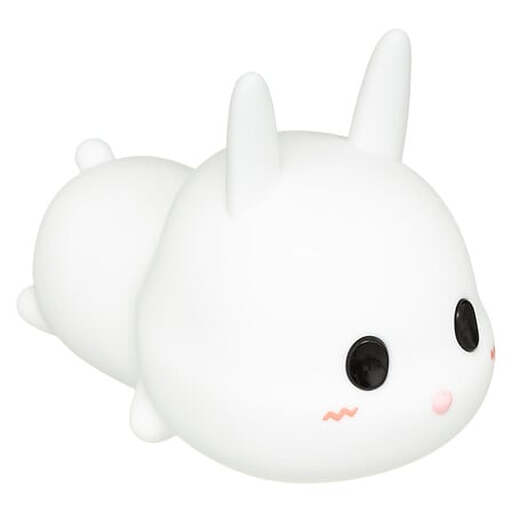
Why this product suits this profile: The compact rabbit model provides warm white LED light with three intensity levels and, thanks to its rechargeable battery, can be used flexibly beside the bed or when travelling.
The three brightness levels give you more control than a simple on/off light. The product data also clearly specifies the material, battery type and dimensions.
12 warm white LEDs, three intensity levels, a silicone and ABS casing, plus an integrated lithium-ion battery.
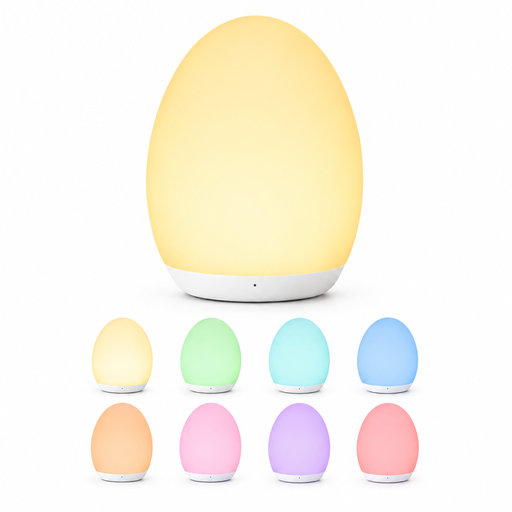
Why this product suits this profile: This portable baby night light combines dimmable warm white light, touch controls, a timer and eight colour modes for different routines in the baby’s room.
Battery life is specified according to brightness level. The 1-hour timer also prevents the lamp from being left on unnecessarily for too long.
2000-mAh battery, touch controls, memory function, eight colours and up to 7 hours at maximum brightness according to the product details.

Why this product suits this profile: This plug-in model is suitable for hallways, staircases, bathrooms or children’s bedrooms when light needs to be available automatically in the dark.
This model is not limited to decorative colour modes: it offers three brightness levels and an automatic dusk sensor. The stated usage instructions apply in damp areas.
Two-pack, 2700-Kelvin warm white light, three brightness levels and automatic activation in the dark according to the product description.
We have put together a complete, regularly updated list of products that fully meet these strict selection criteria and the safety regulations applicable in the EU.
With an LED night light, power consumption is a useful point of comparison. The sensor lights mentioned here, for example, operate at between 0.3 and 0.5 watts. This can be relevant if the light is to be left on continuously in a hallway. Actual electricity consumption, however, depends on operating time, sensor activation and the electricity tariff.
With rechargeable models, you should only use the supplied charger or the specified power source. Products bearing CE and RoHS markings should be checked against the relevant product description. Plug-in models should be kept out of the reach of small children and protected from moisture. A lamp is not a substitute for a toy; cables, mains plugs and small parts must be positioned safely.
That depends on its purpose. A low brightness setting is sufficient for subtle orientation. For changing nappies or feeding at night, a dimmable warm white setting may be more practical. Lumens information and several brightness levels make it easier to choose the right product.
Battery life varies depending on the model and brightness level. For the products mentioned here, the stated figures range from around 6 hours at maximum brightness to considerably longer operating times at reduced power. Always check which setting the manufacturer’s figure refers to.
A motion sensor can be useful in the hallway, on the stairs or on the way to the bathroom. In a baby’s room, a constant, dimmable low light is often easier to use when care is needed without additional activation. Positioning, range and a safe distance from the bed are the key considerations.