
Lieferung heute & morgen

Qualitätsgarantie

Willkommens-Angebote freischalten: KOSTENLOSE Lieferung | Bis zu 80 % RABATT | Kostenlose 30-Tage-JoyPlus-Testphase
App herunterladen
A children’s night light should help your child find their way without unnecessarily disturbing their sleep. In practice, though, decorative design or a long list of features alone won’t guarantee a good purchase. What matters is the brightness, power supply, ease of use and where you plan to put it.
A colourful casing tells you little about the light itself. A night light for a child’s bedroom shouldn’t brightly illuminate the whole room if its only purpose is to light the way to the bed or door. Details such as lumens, Kelvin and dimmable brightness settings are more useful than product photos.
Warm white light at around 2,700 to 3,000 Kelvin is often perceived as less harsh. For RGB models, check whether you can also select a permanent warm white setting.
A night light with a motion sensor can be useful if it only switches on in the dark. Without a dusk sensor, the lamp may also come on during the day, leading to unnecessary switching and making it less convenient to use.
Also check the detection angle, range and switch-off time. For example, a sensor with a three-metre range and a 120-degree detection angle is generally better suited to a hallway, stairs or doorway than to lighting a small area right beside the bed.
A rechargeable night light can be placed wherever you need it, but it will need charging regularly. When checking battery-powered models, factor in the cost of batteries and make sure the battery compartment closes securely. Plug-in models don’t need batteries, but shouldn’t be used near water or damaged sockets.
For products with electronic components, it’s important to check the stated age suitability. According to the product details, for example, the Jolywell model is not suitable for children under three. A night light is also not a toy unless the manufacturer explicitly says otherwise.
A low brightness setting is often enough to help your child find their way at night. A dimmable night light with several settings is easier to adapt to different situations: a low setting for settling down to sleep, and a brighter one for night-time feeds or tidying the bedroom.
These details can help you choose the right colour temperature:
A night light with a timer switches off after a set period. This can be useful if the light is only needed while your child is settling to sleep. If it switches on automatically when it detects movement, make sure the switch-off time suits the way you’ll use it. Switching off after 60 seconds is handy in hallways or on stairs, but may be too soon if you’re spending longer by the bed at night.
Plastics such as ABS or PC are lightweight and can be cleaned with a dry or slightly damp cloth. Ceramic and glass look decorative, but can break if dropped. A decorative children’s lamp should therefore be placed somewhere stable and out of reach of young children.
Before buying, also check:

Why it suits this type of buyer: According to the product details, this plug-in model doesn’t need batteries and offers five brightness settings. It’s suitable for a child’s bedroom, hallway or stairs if you want lighting to come on automatically in the dark.
According to the description, the built-in motion and dusk sensor stops the light from staying on in bright conditions. It switches off automatically after 60 seconds without movement.
Warm white light at 2700 Kelvin, five brightness settings, 0.5 watts of power and a range of up to three metres with a 120-degree detection angle.
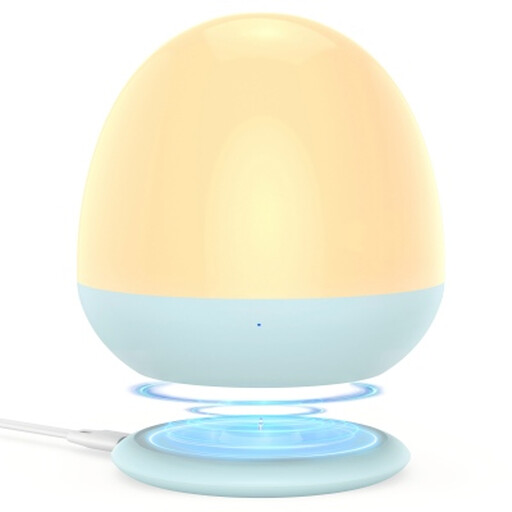
Why it suits this type of buyer: This egg-shaped model may appeal to parents looking for a portable baby night light with touch controls and several charging options.
The product description mentions a timer and a stable charging dock, so you don’t have to keep the light plugged in. Be sure to observe the age warning: it’s suitable for ages three and over.
ABS and PC casing, touch controls, and wired or wireless charging using the included charging dock.
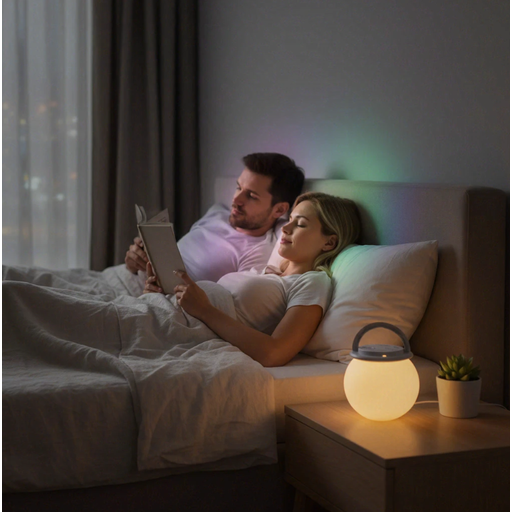
Why it suits this type of buyer: For families who want a battery-powered light they can use around the child’s bedroom, on the bedside table or while travelling, this model combines warm white light, RGB colours and dimming.
The timer limits how long the light stays on, while stepless dimming lets you choose a lower brightness. For bedtime, you can select warm white instead of a colour setting.
Built-in battery, USB charging, warm white light plus seven RGB colours, and stepless brightness adjustment according to the product details.
We’ve put together a complete, regularly updated list of products that meet these strict selection criteria and fully comply with the safety regulations in force in the EU.
A low brightness is usually enough to help your child find their way. A dimmable night light is more practical than a model with just one fixed setting, as you can adjust it for settling down to sleep, night-time feeds and short trips around the room.
Energy use depends on the wattage, how long the light is on and its power supply. The GRIFEMA model is rated at 0.5 watts. For battery-powered models, most of the electricity is used while charging. A timer or motion sensor can limit how long the light stays on.
Place the light somewhere stable, dry and out of reach of young children. Plug-in models shouldn’t be used in damp areas. A stable position is especially important for glass or ceramic lamps. Always check the manufacturer’s instructions and the product’s age suitability before use.