
Lieferung heute & morgen

Qualitätsgarantie

Willkommens-Angebote freischalten: KOSTENLOSE Lieferung | Bis zu 80 % RABATT | Kostenlose 30-Tage-JoyPlus-Testphase
App herunterladen
A children’s night light should help your child find their way at night without making the room unnecessarily bright. However, the options available vary considerably: some plug straight into a socket, while others charge via USB. You’ll also find motion sensors, timers, colour-changing lights and different dimming levels. So for families in the UK, design isn’t the only thing to consider.
Very bright or cool white light can be disruptive in a child’s bedroom. Claims such as “soft” or “easy on the eyes” are of limited value without specific technical details. Check whether the light has a dimming function, a low brightness setting or a warm white colour temperature.
A warm white night light with a colour temperature of around 2700 to 3000 Kelvin is often perceived as less harsh than cool white light. However, this says nothing about any medical effects or impact on sleep.
A plug-in night light is ready to use straight away, but it has to stay in one place. A rechargeable night light, on the other hand, can be used in the bedroom, hallway or when travelling. For models with a battery, parents should check the stated capacity, charging port and usage instructions.
Important: a battery-powered night light must not be immersed in water or placed near heat sources or open flames. When used by young children, follow the manufacturer’s instructions and supervise them.
A motion sensor is useful in a hallway or on the way to the bathroom, but in a bedroom it could switch on whenever there’s movement. A timer switches the light off after a set time, while a light sensor only responds when it’s dark. Before buying, consider whether you need a night light with a motion sensor, a timer or a low light that stays on.
Check the colour temperature in Kelvin, the brightness settings and, if stated, the light output in lumens. A dimmable night light with several settings is easier to adapt to different situations: use a low setting at bedtime and a brighter one for changing nappies or finding your way around.
Models with RGB colours offer more ways to customise the light. For finding your way around at night, however, a clearly described warm white setting is usually more useful than a wide range of colour effects.
For an LED night light, power consumption is an important point of comparison. A 0.3 or 0.5-watt model uses less energy in theory than a higher-powered device used for the same length of time. The actual cost depends on your electricity tariff and how long you use it.
A rechargeable night light should be fully charged before first use. Also check whether a USB cable, charging station or mains adapter is included. For a plug-in model, make sure the socket is accessible and in good working order.
A light sensor switches the light on or off depending on how bright the surroundings are. A motion sensor, by contrast, responds to movement within a certain detection range. The GRIFEMA model, for example, is listed as detecting movement up to 3 metres away within a 120-degree angle. According to the product description, it also switches off after 60 seconds without movement.
For a night light for a child’s bedroom, rounded shapes and a smooth surface are practical features. Soft silicone models can usually be cleaned easily with a slightly damp cloth. Electrical devices must not be immersed in water or opened by the user.
The models below suit a range of everyday situations. Product details such as battery capacity, power consumption, timer duration and materials are based on the relevant manufacturer or product descriptions.
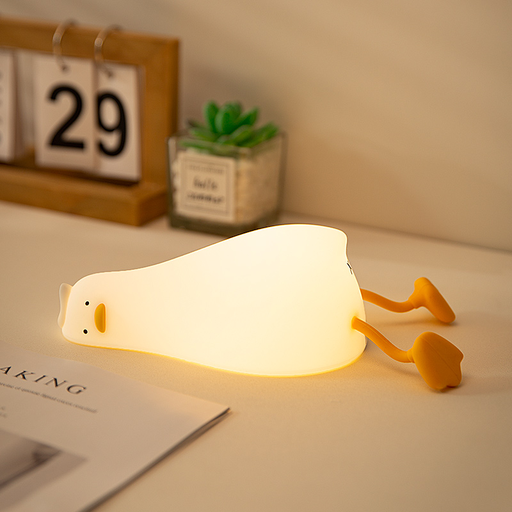
Why it suits this need: This compact duck-shaped light is a good choice for parents looking for a portable option that doesn’t need to be installed. According to the product details, it has a built-in 1200 mAh rechargeable battery.
USB charging means it doesn’t have to stay plugged into a socket. According to the description, clean it with a soft, slightly damp cloth and do not immerse it in water.
Soft silicone, a 1200 mAh battery and no installation required, according to the product description.
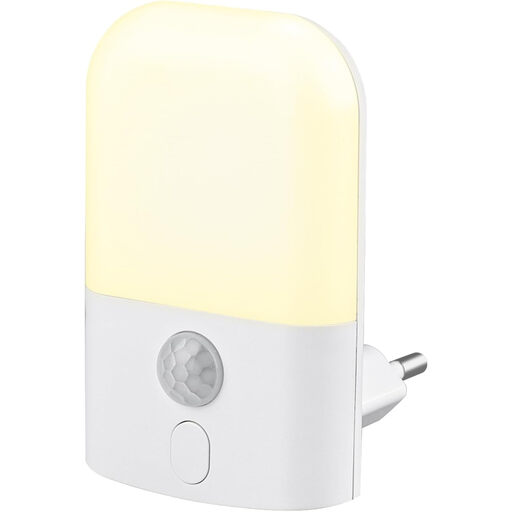
Why it suits this need: This plug-in model is a good choice for hallways, stairs or bathrooms. It offers five brightness settings, from 20 to 100 per cent, and warm white light at 2700 Kelvin.
You’re not limited to a single brightness setting. The motion and dusk sensors also help avoid unnecessary use; according to the description, the light switches off after 60 seconds without movement.
0.5 watts of power consumption, five brightness settings and a detection range of up to 3 metres within a 120-degree angle, according to the product details.
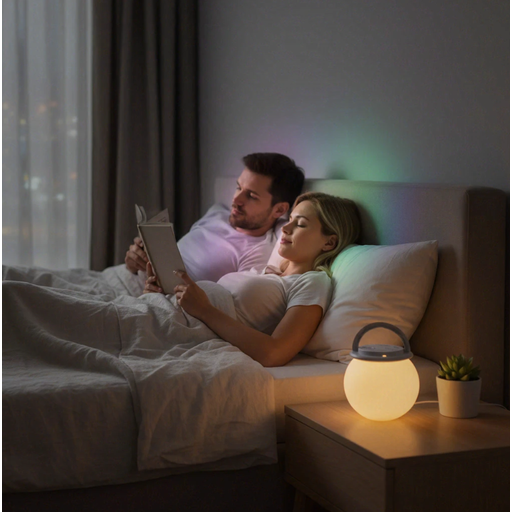
Why it suits this need: This model combines warm white light and RGB colours with stepless dimming. The timer is useful for establishing a regular routine in the bedroom or nursery.
Stepless dimming lets you fine-tune the brightness more precisely than fixed settings. Battery and USB power mean you’re not restricted to using the light near a socket.
0.9 watts of power consumption, according to the product details, plus warm white light, RGB mode, a timer and stepless dimming.
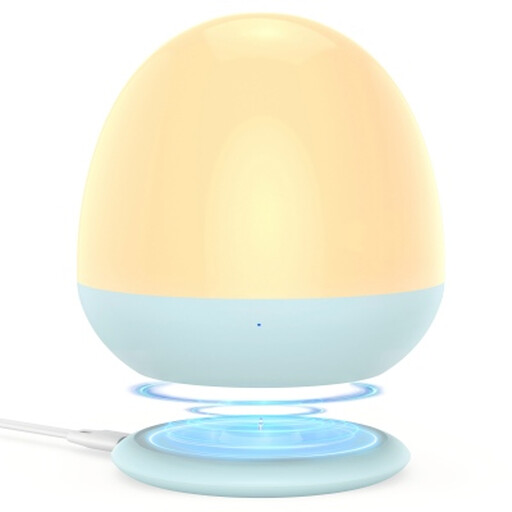
Why it suits this need: This egg-shaped lamp can be charged via USB or using the included charging station. That makes it suitable for a child’s bedroom, feeding or changing area, or for use on the go.
Having two charging options means you’re less reliant on a single cable. According to the description, the touch controls and timer can be operated directly on the lamp.
USB charging or wireless charging via the station, touch controls and a timer.
We’ve put together a complete, regularly updated list of products that meet these strict selection criteria and the safety regulations in force in the EU.
It depends on its power consumption and how long it’s used. A 0.5-watt model used for eight hours a day would use around 1.46 kilowatt hours a year. The cost in pounds depends on your electricity tariff. Sensors and timers can reduce the actual amount of time the light is on.
It depends on where you plan to put it. In hallways, on stairs and in bathrooms, a motion sensor can switch on the light only when it detects movement. In a sleeping area, a sensor that’s too sensitive may be disruptive. Check the detection angle, range and switch-off time.
There’s no single answer. It depends on factors such as battery capacity, brightness setting, charging cycles and how long the light is used. Only use the supplied charging cable or a compatible charging station, and follow the manufacturer’s instructions for cleaning and storage.