
Lieferung heute & morgen

Qualitätsgarantie

Willkommens-Angebote freischalten: KOSTENLOSE Lieferung | Bis zu 80 % RABATT | Kostenlose 30-Tage-JoyPlus-Testphase
App herunterladen
A children’s puzzle from age 3 should be neither too challenging nor left unused in the cupboard after just a few games. Packaging often focuses on colourful designs, age recommendations and quality claims. However, other details are more important when choosing a puzzle: number of pieces, puzzle format, material, storage and whether the child can already complete puzzles independently.
The following advice from the Joybuy Product Recommendation Officer helps parents, grandparents and childcare providers assess marketing claims objectively and choose a suitable puzzle for children.
“From age 3” is a guide, but it does not guarantee that every child will find the puzzle easy to complete. A 24-piece children’s puzzle may suit a child with some experience, while a beginner may find it easier to start with a children’s tray puzzle containing 12 or 15 pieces.
You should therefore also consider:
More pieces primarily mean a greater challenge. They are not automatically a sign of quality. For a child’s first puzzle, a clear design with 12 to 24 pieces may be more suitable than a larger set.
Puzzles can support the recognition of shapes and colours, the comparison of image details and hand-eye coordination. However, this should not be interpreted as a therapeutic or medical promise. The enjoyment and suitability of a puzzle depend greatly on the child’s age, interests and stage of development.
Glossy surfaces can reflect light in bright surroundings. For frequent use, precisely cut pieces and sturdy card are also important. Without a suitable place to store the puzzle, different designs can quickly get mixed together or individual pieces can go missing.
A set containing several separate pictures is therefore particularly practical if each design can be returned to the packaging complete.
For many children from age three, 12 to 24 pieces provide an accessible introduction. A 3x24-piece children’s puzzle consists of three individual designs, each with 24 pieces. This provides variety without unnecessarily increasing the difficulty through one large picture.
From around age four, puzzles with 24 to 48 pieces may also be suitable, depending on the child’s experience. A puzzle from age 4 with 37 or 40 pieces can still provide guidance when it includes a frame. The age recommendation on the packaging should always be considered together with the number of pieces.
A tray puzzle keeps the picture area in place and can make it easier to match pieces through pre-printed outlines. This is practical for younger children and beginners. With classic puzzles, the picture on the packaging or an included poster can provide guidance instead.
Check whether the base is sturdy enough, whether the pieces can be removed easily and whether the completed puzzle fits on a sufficiently large, level surface.
Children’s puzzles are usually made from printed card. Details such as “extra-thick card”, a matt surface or linen texture describe specific product features. However, they do not replace checking the safety information.
Important details include:
Puzzles with small pieces are generally unsuitable for children under 36 months unless the product information states otherwise. Even for children aged three and over, appropriate supervision is recommended, especially if they put pieces in their mouths.
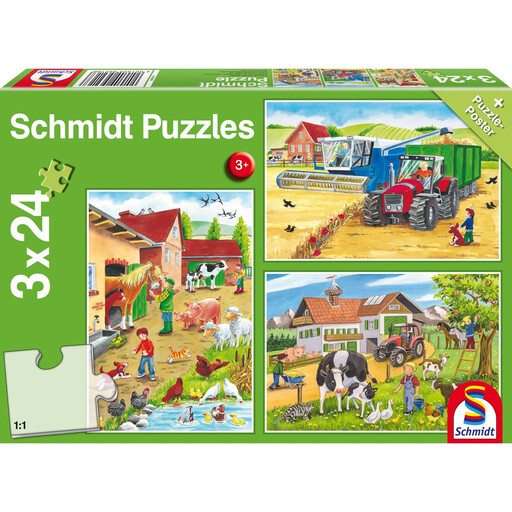
Why this product suits this profile: Three individual farm designs provide variety and are ideal for families looking for a manageable starter set.
Dividing the set into 3x24 pieces avoids one overly busy design. According to the product information, the matt surface and linen texture are designed to reduce glare during play.
Three farm scenes, 24 pieces per puzzle, precisely cut pieces and a stated age recommendation from 3 years.
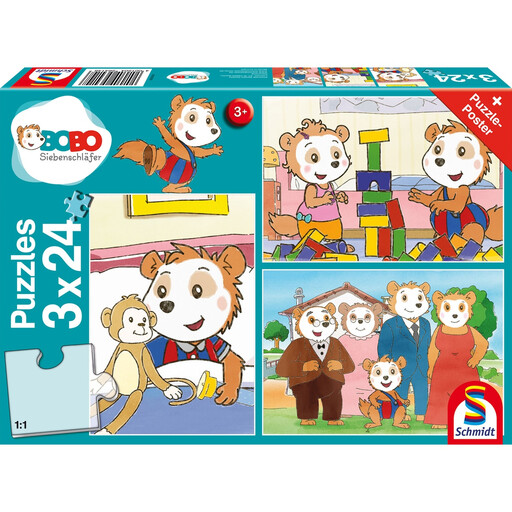
Why this product suits this profile: The set combines three designs with details about card quality, a matt surface and precisely cut pieces.
The specific material and surface details make it easier to assess the product beyond purely promotional quality claims.
3x24 pieces, family designs, matt surface with linen texture and stated suitability from age 3.
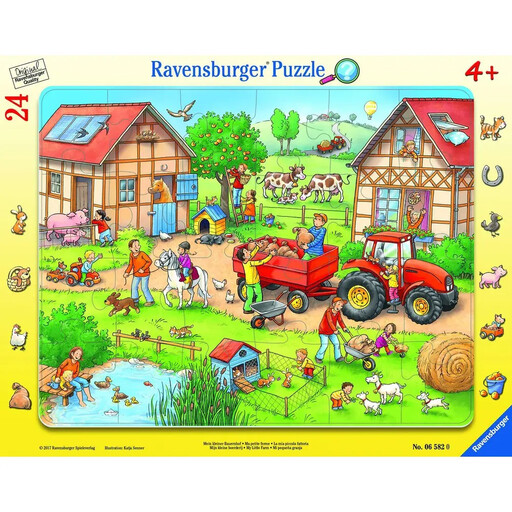
Why this product suits this profile: The farm design with a search game is suitable for children from age 4 who enjoy discovering picture details as well as putting the puzzle together.
The base with outlines provides guidance, while the additional search game offers another way to use the puzzle after it has been completed.
24 pieces, tray with guidance feature, farm design and ten picture elements to find.
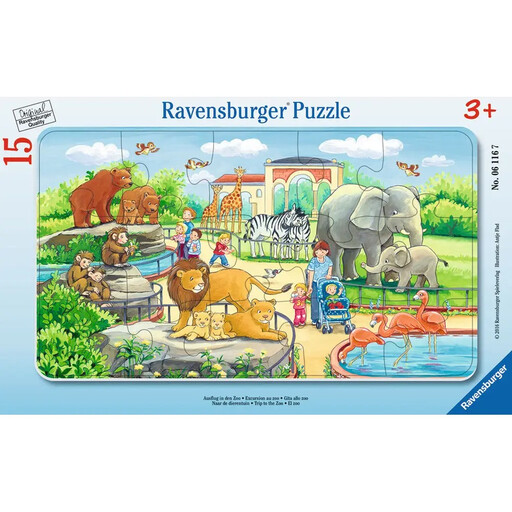
Why this product suits this profile: The animal design and frame are aimed at children from age 3 who need a manageable first puzzle.
With 15 pieces and a base featuring outlines, the challenge is kept manageable rather than relying solely on an eye-catching design.
15 pieces, frame with base, animal design and stated age recommendation from 3 years.
We have put together a complete, regularly updated list of products that fully meet these strict selection criteria and the safety regulations applicable in the EU.
12 to 24 pieces are often a useful starting point. A child with some experience may also manage a 24-piece puzzle well. However, the design, piece size, frame and the individual child’s experience are the key factors.
Neither format is fundamentally preferable. A children’s tray puzzle provides outlines and a fixed picture area. A classic 24-piece puzzle can be expanded more flexibly later on. For beginners, the frame is often a practical guide.
Its lifespan depends on the thickness of the card, the precision of the cut, storage conditions and how it is handled. Keep the pieces dry and store them separately by design. Damaged or badly creased pieces should be removed. This helps the puzzle remain usable for longer in a family home or childcare setting.