
Lieferung heute & morgen

Qualitätsgarantie

Willkommens-Angebote freischalten: KOSTENLOSE Lieferung | Bis zu 80 % RABATT | Kostenlose 30-Tage-JoyPlus-Testphase
App herunterladen
A rug in a child’s bedroom should create a cosy feel, add visual structure to the floor and withstand everyday play. However, product images and terms such as “extra soft”, “hard-wearing” or “non-slip” do not always provide enough information to assess how suitable a rug really is. When buying children’s rugs online, you should therefore look beyond colour and design.
1. A soft surface that requires a lot of care:
A soft shaggy rug with a long pile feels pleasant underfoot, but it can also hold on to crumbs, dust and small building pieces more easily. In a playroom, it is therefore important to check whether the rug can be cleaned with a vacuum cleaner without a rotating brush and whether stains can be treated locally.
2. Non-slip properties are simply assumed:
Not every rug for a child’s bedroom or playroom has a coated underside. Additional non-slip underlay may be needed on smooth floors. Even an integrated non-slip backing will not prevent movement on every type of surface. The manufacturer’s information and the condition of the floor should be considered together.
3. The size is not suitable for how the rug will be used:
A small rug can work well as a decorative accent beside the bed, but it only covers a limited play area. On the other hand, a rug that is too large can obstruct doors, wardrobe fronts or radiators. Before buying, measure the available floor space, the distance from furniture and the area where you want your child to move around.
A cotton rug is often a practical option for a child’s bedroom when you want a relatively lightweight, textile surface. With hand-tufted models, pay attention to the pile height and care instructions. Some products are intended for professional cleaning only.
A wool rug can offer a textured, natural surface. According to the product information, the Premier Kids lion and panda rugs are made from 100% wool. Both models are described as hand-woven or hand-tufted and have a stated height of around 1 cm. However, wool is not automatically stain-resistant. For these products, the recommended care includes spot cleaning with a damp cloth and gentle vacuuming.
The terms hand-woven rug and hand-tufted rug initially describe how the product was made. They are not blanket proof of a particular lifespan or freedom from harmful substances. For families, specific information about the material, pile height, backing, cleaning and manufacturer responsibility is therefore more relevant.
A deep pile can feel comfortable when sitting or playing, but it makes cleaning more difficult. According to the product details, My Flair’s round “My Shaggy” rug is made from polypropylene and has a stated depth of 4 cm. Different versions are available in sizes of 100 × 100 cm, 120 × 120 cm and 150 × 150 cm.
With a play rug featuring a design, you should also check whether the pattern is genuinely suitable for your child’s age. An animal-design rug, heart-shaped rug, football rug, rainbow rug or cloud rug can have a strong visual impact on the room. The more distinctive the shape, the more carefully you should plan around furniture and walking routes.
The term non-slip rug should only be used when the supplier specifies a suitable backing or coating. According to the product description, the large flower-shaped rug made from synthetic faux wool has a natural rubber or PVC backing with anti-slip properties. The pink round rug is also described as having an integrated rubber underside and REACH compliance. REACH concerns the handling of chemical substances; it does not automatically indicate a particular level of slip resistance or durability.
You should also check:
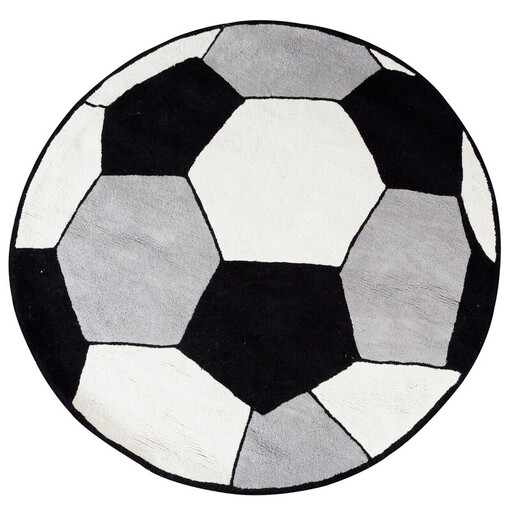
Why this product suits the profile: The round, ball-shaped cotton rug adds a clear design feature without requiring a large floor area, measuring 100 × 100 cm.
The material, dimensions and cleaning recommendation are clearly specified. However, the product data does not mention an anti-slip backing, so this should be checked separately on smooth floors.
100% cotton, hand-tufted construction, square dimensions and a football design for sports-themed rooms.
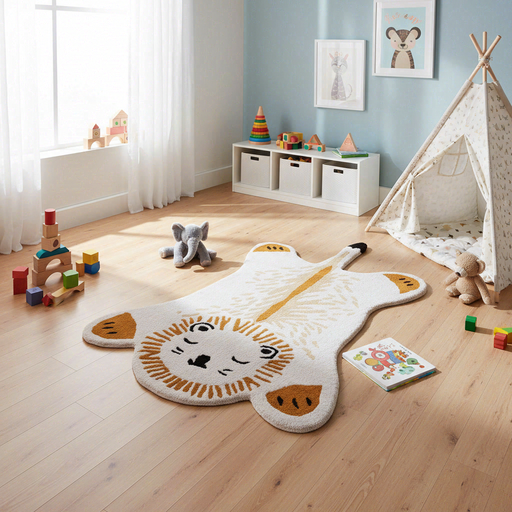
Why this product suits the profile: The combination of a natural material, hand-woven and hand-tufted construction and a low height of around 1 cm works well in decorative children’s bedrooms.
The product details specify the material, origin, dimensions and care instructions. No non-slip coating is mentioned, so a suitable underlay should be planned if required.
100% wool, 150 × 90 cm, multicoloured lion design and hand-woven construction.
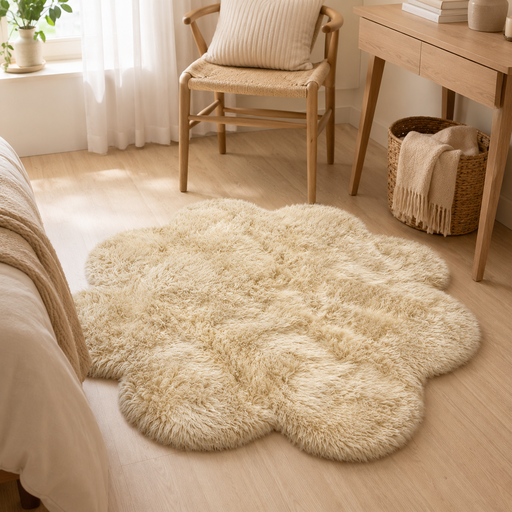
Why this product suits the profile: Its large surface is suitable for defining a play zone or creating a striking focal point in a living room or bedroom.
The product description specifies an anti-slip backing and provides clear guidance on unrolling, vacuuming and treating stains. Suitability for underfloor heating should be checked separately.
180 × 180 cm, deep pile made from synthetic faux wool, flower shape and integrated anti-slip backing.
We have put together a complete, regularly updated list of products that fully meet these strict selection criteria and the safety regulations applicable in the EU.
Only place the rug on a clean, dry and level surface. On smooth floors, check before use whether the rug moves out of place. Furniture can help secure the edges, but must not create a trip hazard.
For regular care, gentle vacuuming is sufficient for many models. Deep-pile versions should be cleaned without a rotating brush, in line with the manufacturer’s instructions. Dab up spilled liquids wherever possible rather than rubbing vigorously. For cotton models where professional cleaning is recommended, avoid home remedies and machine washing.
When choosing a rug for a baby’s room, also bear in mind that rugs must not be used as bedding or toys. Loose fibres, raised edges and small detachable parts should be checked regularly.
It depends on how you plan to use it. A rug measuring around 80 to 100 cm in length or diameter works well as an accent beside a bed or seating area. Larger formats are more suitable for creating a continuous play zone. Before buying, measure the available space and the distance from doors and drawers.
Both materials may be suitable. The key factors are not just the fibre, but also the pile height, construction, backing and care instructions. Wool can provide a textured surface, while cotton is available in some models with hand-tufted or hand-woven construction. The material alone does not automatically determine whether a rug is suitable for every child’s bedroom.
Their lifespan depends on the level of use, material, construction, surface underneath and care. A flat rug with protected edges may be suitable for heavily used areas, while a delicate deep pile requires more maintenance. Check the rug regularly and follow the manufacturer’s specific instructions on cleaning and use.