
Lieferung heute & morgen

Qualitätsgarantie

Willkommens-Angebote freischalten: KOSTENLOSE Lieferung | Bis zu 80 % RABATT | Kostenlose 30-Tage-JoyPlus-Testphase
App herunterladen
A children's shelf with book and toy storage should help keep things tidy, be easy for children to reach and stand safely in the nursery. In practice, however, it is often only after assembly that you find out whether the dimensions, shelf layout and stability really suit everyday life. An eye-catching design alone says little about whether a children's bookcase is genuinely suitable for picture books, building blocks and cuddly toys.
As a Joybuy Product Recommendation Officer, I filter the relevant product data according to practical criteria. This is not about sweeping promises, but about clear, verifiable details such as dimensions, materials, load capacity and safety features.
A shelf may look spacious in product photos but take up a great deal of floor space in the nursery. Before buying, check the width, height and depth, as well as the distance from doors, radiators and play areas. Lower models are often easier for toddlers to access. A tall nursery shelf, on the other hand, requires suitable wall fixing.
Maximum load capacity is not stated in the same way for every model. Some manufacturers specify the total load, while others give a value per compartment or level. Heavy children's books should ideally be placed on the lower shelves. The stated load capacity must not be exceeded; the shelf is not designed for sitting, climbing or standing on.
A large open compartment can hold plenty of toys, but it can quickly become untidy. A children's shelf with compartments, separate levels or a removable toy chest makes it easier to keep everything organised. Open sections are ideal for books, while small items and building blocks can be stored in a box or closed compartment.
A Montessori bookcase generally refers to a low shelf with open access. However, the term is not a consistent quality standard. The actual product dimensions are what matter. Models with a height of around 70 to 104 cm may be easy for children to reach, depending on their height. Parents should nevertheless make sure that frequently used items are not placed in high or difficult-to-reach areas.
The models featured here use materials including MDF, chipboard or PB (E1) and solid pinewood elements. A painted or melamine-resin-coated surface can make cleaning with a slightly damp cloth easier. Look for neatly rounded edges and clear assembly instructions. Decorative descriptions do not replace checking the specific material and safety information.
A children's bookcase must be stable once assembled. Many models include or explicitly require wall fixing with anti-tip protection. The fixing materials must be suitable for the type of wall in question. Assembly should be carried out by adults only. Small screws and connecting parts must be kept out of children's reach during assembly.
For smaller rooms, compact dimensions may be more important than a large number of compartments. Wipe coated surfaces with a soft, slightly damp cloth and dry them afterwards. With shelves on castors or with a removable box, keep the surrounding path clear. Check screws and connections regularly, particularly after frequent use.
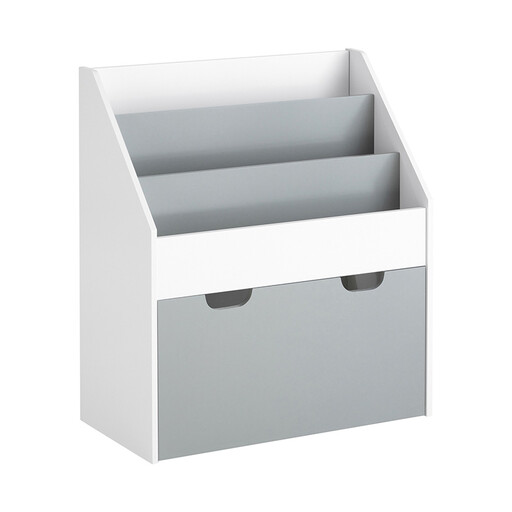
Why this product suits this profile: The compact combination of three compartments and a removable toy chest is ideal for smaller nurseries and manageable toy collections.
The layout prevents books and larger toys from ending up together in a single deep storage compartment. The product details also state that it has rounded edges and anti-tip protection.
Dimensions of approximately 63 × 70 × 30 cm, MDF (E1), removable box and a stated total load capacity of up to 25 kg.
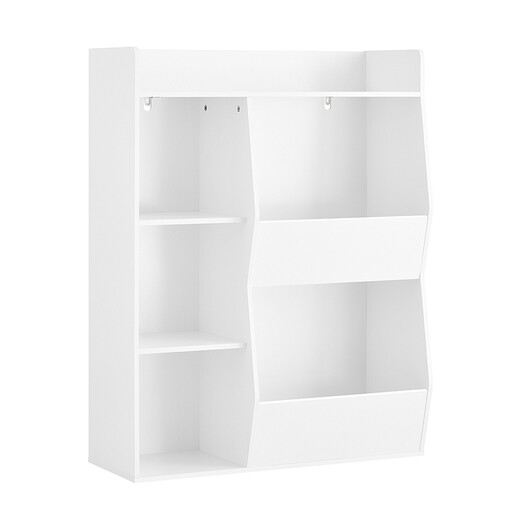
Why this product suits this profile: Five open shelves provide a clear way to organise books, cuddly toys, photographs and smaller toys. At 104 cm high, it is easy for many children to reach, although it should be suitable for the individual child's height.
The open levels make the actual layout easy to see. Rounded edges and a stated anti-tip system address common safety requirements, but do not replace correct wall fixing.
80 × 104 × 34 cm, PB (E1), five open compartments, product weight of approximately 16.9 kg and a stated load capacity of up to 53 kg.
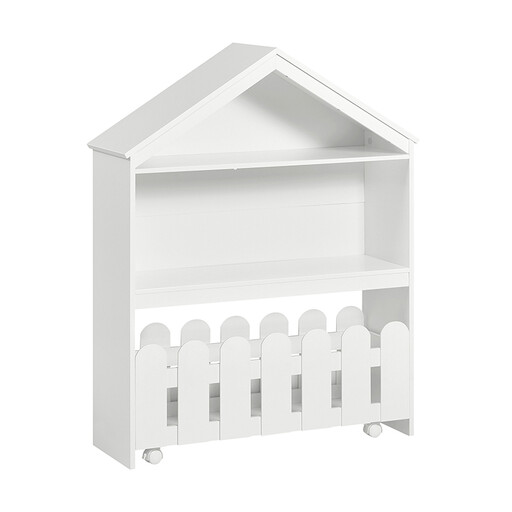
Why this product suits this profile: The two-piece design is an interesting option for families or nurseries that want to organise books and toys separately or use the units flexibly.
Separate storage reduces the mixing of different items. Before buying, carefully check the floor space of approximately 114 × 30 cm and the requirements for anti-tip protection and assembly.
Two-piece set, castors according to the product description and dimensions of approximately 91 × 114 × 30 cm.
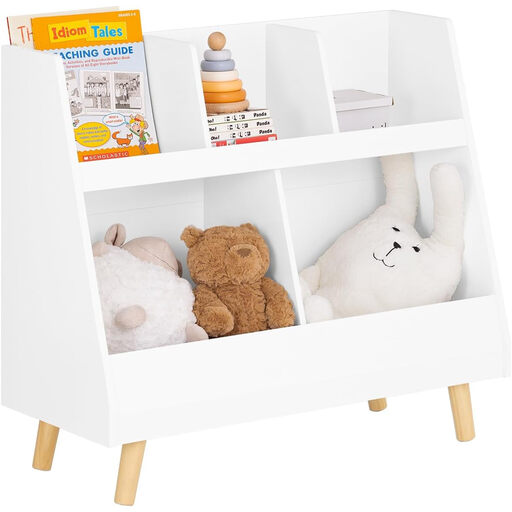
Why this product suits this profile: The five compartments combine book storage with space for smaller toys. The compact white design can be incorporated into sleeping or play areas.
The stepped layout creates clearly visible areas for different items. Before buying, compare the rounded edges, MDF (E1) construction and stated maximum load of 25 kg with your individual requirements.
Five compartments, MDF (E1) with solid pinewood legs, white finish and dimensions of approximately 86 × 78 × 36 cm.
We have compiled a complete, regularly updated list of products that fully meet these strict selection criteria and the safety regulations applicable in the EU.
The right height depends on the child's age, height and how the shelf will be used. Low models with easily accessible compartments are practical for toddlers. With taller shelves, frequently used books should be placed at the bottom. Regardless of the height, safe assembly according to the instructions is essential.
If the manufacturer provides anti-tip protection or requires wall fixing, it should always be used. Children must not climb onto the shelves or pull themselves up on them. The choice of suitable wall plugs and screws depends on the type of wall.
Keep books in open compartments and place building blocks, dolls or larger toys in a separate toy chest. Limiting the number of items in each compartment makes tidying up easier. Toys that are not currently needed can be stored elsewhere temporarily and swapped back in later.