
Lieferung heute & morgen

Qualitätsgarantie

Willkommens-Angebote freischalten: KOSTENLOSE Lieferung | Bis zu 80 % RABATT | Kostenlose 30-Tage-JoyPlus-Testphase
App herunterladen
Choosing the right children's swimming aid is a key decision for parents and grandparents. With a wide variety of models available—from armbands and swim vests to specialised swim trainers—it can be challenging to get a clear overview. This guide is designed to provide direction by introducing different types of swimming aids and highlighting the crucial criteria for selecting one for babies and toddlers. Our goal is to empower you to make an informed decision based on your child's individual needs and developmental stage.
An important note upfront: A swimming aid is a tool for water familiarisation and for toddlers learning to swim. It never replaces constant supervision by an adult.
To find the most suitable support for your child, several fundamental aspects should be considered.
The market offers various systems, each designed for different stages of a child's development and the learn-to-swim process.
Manufacturers provide specific age and weight recommendations for every swimming aid. These specifications are crucial for the product's functionality and safety. An aid that is too large can slip off, while one that is too small won't provide sufficient buoyancy. The fit is an essential criterion for a safe swimming aid.
A high-quality swimming aid is distinguished by its well-designed safety features. These include:
Here, we present a selection of models that stand out for their specific features, making them suitable for various uses.
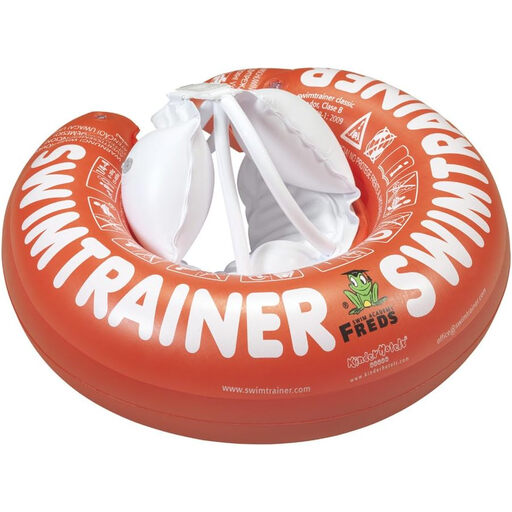
Why this model stands out
The SWIMTRAINER Classic from FREDS SWIM ACADEMY is designed as a swimming aid for babies and toddlers. Its construction, featuring five separate air chambers and a safety harness, aims to keep the child in a horizontal swimming position. This is intended to encourage the natural leg movements used in breaststroke.
Advantages
Who is it for?
This model is designed for babies and toddlers from 3 months to 4 years old with a body weight of 6 to 18 kg. It is primarily suitable for initial water familiarisation and preparing a child to learn to swim.
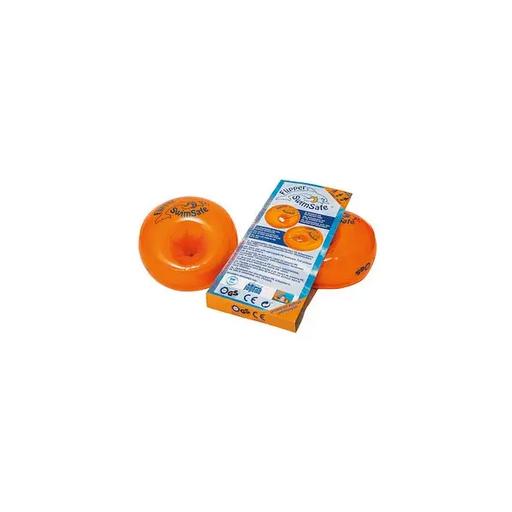
Why this model stands out
The Flipper Swimsafe Armbands combine an unbreakable PE foam core with an inflatable air chamber. This hybrid design provides a base level of buoyancy that can be individually adjusted by inflating the chamber. A non-slip surface in the armpit area is designed to improve grip.
Advantages
Who is it for?
These armbands are designed for children aged 1 to 6 years (11 to 30 kg). They are suitable for children who already have some water confidence and want to move their arms and legs freely to practise their first swimming strokes.
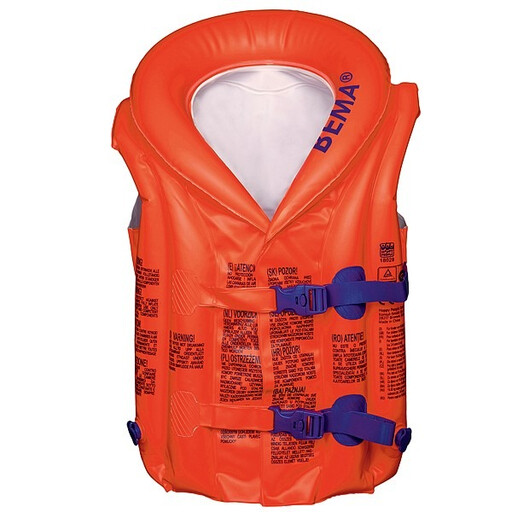
Why this model stands out
The Bema Children's Swim Vest provides buoyancy across the entire torso. Made from polyester and equipped with a safety clasp, it is a durable alternative to inflatable models. The buoyancy is integrated directly into the material and does not need to be adjusted by inflation.
Advantages
Who is it for?
According to the manufacturer, this vest is suitable for children from 2 years of age. It is an option for use in shallow water during recreational activities where a constant and secure posture in the water is desired.
The selection presented covers a range of needs, but the market offers many other variations. If you haven't found the right model for your child yet or wish to get a broader overview, you can find more products in our category.
Discover Our Full Range of Swimming Aids
1. When is a swimming aid suitable for a baby? Some models, such as certain swim trainers, are suitable for babies as young as 3 months for water familiarisation under constant supervision, according to manufacturers. The specific age and weight specifications of the product are always the deciding factor.
2. What is the difference between a swimming aid and a life vest? A swimming aid (buoyancy aid) is designed to support a conscious person while they are learning to swim. It is not a life-saving device. A life vest, on the other hand, is a piece of personal protective equipment (PPE) engineered to keep a person, even if unconscious, in a safe position with their head above water. For toddlers learning to swim in a supervised environment, a swimming aid is the appropriate tool.
3. How do I find the safest swimming aid for my child? You can identify a safe swimming aid by its correct fit according to the manufacturer's age and weight guidelines, multiple separate air chambers, safety valves, and robust, non-toxic materials. However, the most important safety measure at all times remains uninterrupted, within-reach supervision by an adult.