
Lieferung heute & morgen

Qualitätsgarantie

Willkommens-Angebote freischalten: KOSTENLOSE Lieferung | Bis zu 80 % RABATT | Kostenlose 30-Tage-JoyPlus-Testphase
App herunterladen
A children’s table should do more than look good in a child’s bedroom. It needs to suit your child’s height, stand securely and be suitable for the activities it’s intended for. Depending on the model, it can be used as a craft table, play table, dining spot or garden sand and water table.
However, it’s easy to make the wrong choice. Some product descriptions focus on versatile features, while important details such as seat height, cleaning requirements or safety warnings may be less prominent. The points below will help you assess marketing claims objectively.
The age recommendation alone isn’t enough. For example, a model might be advertised as suitable from 18 months, while also carrying a warning that it’s not suitable for children under 36 months. In these cases, parents should pay attention to the specific safety warning, the assembly instructions and the need for supervised use.
This is particularly important with a children’s activity table that includes water, sand, small accessories or detachable parts. Younger children must be directly supervised by an adult.
A reversible tabletop, built-in compartments or removable tubs can be useful. But it’s worth considering whether you’ll use these features regularly and how easy they are to clean. A table with lots of accessories often takes up more space and requires more assembly time than a simple model.
For a mud and sand table, parents should also check whether the tub can be removed, whether all the water can be drained after play and whether the table is suitable for the intended outdoor space.
A table may seem like the right height, while its matching chair is too low or too high. When choosing a children’s table and chairs, compare at least the table height, seat height, legroom and whether the chairs can be tucked away.
The size of the room matters too: a round table with a diameter of 60 cm needs enough room to move around it. In a small child’s bedroom, a square set with chairs that slide underneath may be more practical.
For a children’s table for ages 3 and up, specific measurements are more helpful than general claims such as “ergonomic”. A low table makes sitting and doing crafts easier, as long as the chair is the right height. The WOLTU set has a table height of 49 cm and a seat height of 23,1 cm. According to the product details, it’s designed for children aged 3 to 7.
If the table doesn’t come with chairs, parents should measure the seats they already have. Ideally, your child’s feet should rest steadily on the floor when seated. The tabletop should also offer enough room for colouring supplies, books or plates.
Wood, MDF and plastic all have different care requirements. MDF can usually be wiped clean, while solid wood may be more sensitive to moisture, depending on its finish. For sand and water play, a surface specifically described as weather-resistant is important.
Rounded corners, wide legs and reinforced crossbars are practical design features that can help make a children’s play table stable. They don’t, however, replace correct assembly. Check all the screws after putting the table together, and don’t continue using any damaged or loose parts.
A wipe-clean surface is useful for a children’s craft table. With a sand and water table, the tubs and accessories should be cleaned and dried after every use. Any leftover water can also make surfaces slippery.
Storage beneath the tabletop or a shelf keeps pens, toys and craft materials close to hand. Take care not to mistake the stated weight capacity for a climbing or seating function. A children’s table is not designed to be climbed on.
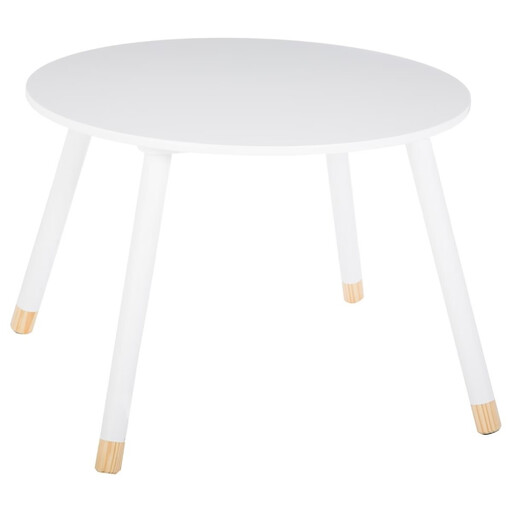
Why this product suits this profile: This round table focuses on the essentials and works well in a child’s bedroom or play area. With a diameter of 60 cm and a height of 43 cm, it’s listed as suitable for children aged 3 to 10.
The product details give fixed measurements, weight and material, rather than adjustable features you may not need. The table doesn’t fold and has no adjustable parts.
Wooden construction, a product weight of 4,3 kg and a surface that can be wiped with a damp cloth.
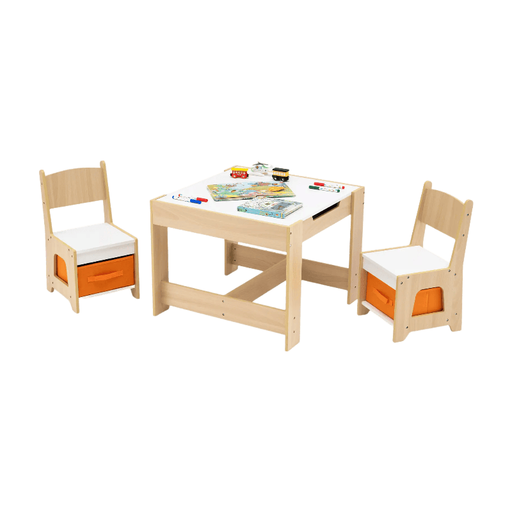
Why this product suits this profile: This set combines a table, two chairs and storage. It’s a good fit for households where one spot is used for reading, drawing, playing and eating.
The double-sided tabletop is detachable, with a whiteboard side and a chalkboard side. Hidden storage and two fabric drawers help keep materials tidy.
Table dimensions of 61,5 × 61,5 × 48,5 cm, two chairs that slide underneath and a stated table weight capacity of 50 kg.

Why this product suits this profile: This table is designed for outdoor sand, water and mud play. In winter, it can also be used as a children’s craft table.
The built-in plastic tub can be removed, and the shelf underneath provides space for accessories. This makes it easy to keep play and cleaning separate.
Dimensions of 50 × 38,5 × 32 cm, solid wood, a weather-resistant finish and a removable tub measuring 9 cm high.
We’ve put together a complete, regularly updated list of products that meet these strict selection criteria and comply fully with the safety regulations applicable in the EU.
Before using the children’s table for the first time, assemble it fully according to the instructions. All screws and connections must be secure. Keep small assembly parts out of reach of young children while putting the table together.
For everyday care, a lightly damp cloth is enough for many wood and MDF models. Empty sand and water tables after every play session. For outdoor models, it’s best to store them somewhere dry and sheltered from rain and direct sunlight, unless the manufacturer states that they can be left outside permanently.
The right height depends on your child’s height and the chair they’ll be using. As a guide, parents should consider the table and seat heights together. Specific measurements from the manufacturer are more useful than general age recommendations.
It depends on the model. Some activity tables and sand tables are listed as suitable from 18 months, but may carry additional warnings for children under 36 months. Traditional children’s tables with chairs are often recommended from age 3. Always follow the product details and safety warnings.
How long it remains suitable depends on its size, weight capacity, care requirements and your child’s growth. An adjustable-height model may last longer. With fixed dimensions, parents should check whether the table and seat heights will remain suitable throughout the intended period of use.