
Lieferung heute & morgen

Qualitätsgarantie

Willkommens-Angebote freischalten: KOSTENLOSE Lieferung | Bis zu 80 % RABATT | Kostenlose 30-Tage-JoyPlus-Testphase
App herunterladen
Children’s and baby toys should be entertaining, age-appropriate and reliable in everyday use. At the same time, there is a huge range to choose from: interactive lights and sound effects, Montessori toys, construction toys and board games for children all suit different stages of development and situations. For parents, grandparents and relatives, it is therefore not just about the design, but also about asking: is the toy really right for the child and the intended environment?
‘From 6 months’ or ‘for 1 to 3 years’ is not a general mark of quality, but an important guide to how the toy should be used. A baby toy for children from 6 months should be designed differently from a toy with small components for older children. Also check whether the child can already sit, grasp objects or press buttons deliberately. Their actual developmental stage affects whether they can use a product meaningfully.
An activity cube for children or an activity table for toddlers can combine several play areas. However, what matters is whether the controls are easy to reach and whether the product stands securely. Musical toys for babies should also have a volume control. A large number of melodies cannot replace thoughtful, user-friendly design.
Statements such as ‘non-toxic’, ‘safe’ or ‘educationally valuable’ should not be accepted without checking them. Look at the specific material details, warnings, age limits and information about the responsible person in the EU. CE marking and EN71 information can provide useful guidance; however, the details on the product page, packaging and instructions remain decisive.
With baby toys, rounded edges, securely attached parts and an appropriate size are particularly important. Products containing small parts or small balls are generally unsuitable for children under three if there is a risk of swallowing. This applies, for example, to collectible figures and construction toys with many individual parts.
Even a toy without small parts should initially be used under supervision. Regularly check moving components, battery compartments, arrows, cords and plug-in connections for damage.
ABS plastic is used in many interactive toys. Buyers should look for smooth surfaces, rounded edges and a stable base. Claims such as BPA-free should come directly from the product description and should not be applied indiscriminately to an entire product category.
For battery-operated toys, a securely closable battery compartment and clearly recognisable polarity markings are practical points to check. Batteries are not included with several of the products mentioned here.
Musical toys for babies, a children’s drum or an activity table can quickly become a constant source of noise indoors. A volume control or quiet mode makes them easier to use in homes and during rest periods. Also measure the available space. A compact toy with a carry handle may be more suitable for travelling than a large table.
For care and maintenance, wipe-clean surfaces and clear cleaning instructions are useful. Electronic parts should not be cleaned with water.

Why this product suits this profile: This compact cube combines eight play areas, taking up less floor space than several separate activity toys.
The 1–3 years age recommendation, approximate dimensions of 23 × 23 × 24 cm and carry handle make the possible uses clear.
ABS plastic according to the product details, rounded edges, plus piano, telephone, gear and musical elements.
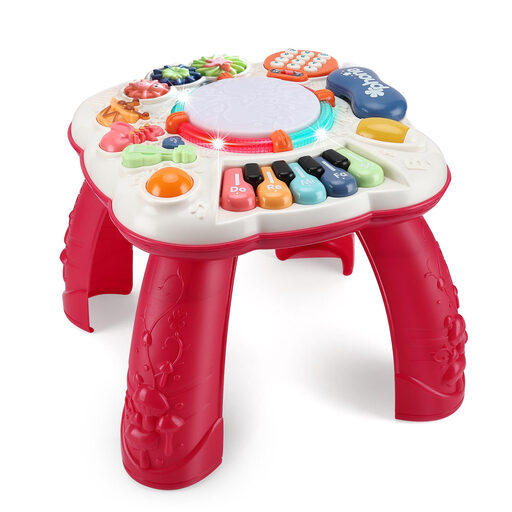
Why this product suits this profile: The detachable legs allow it to be used as a floor play panel for younger babies and later as an activity table.
The product details list six play areas, a volume control and a quiet mode. This makes it possible to assess both the features and its suitability for everyday use.
Age range of 6–36 months according to the product details, piano keys, drum, telephone element and rotating gears.
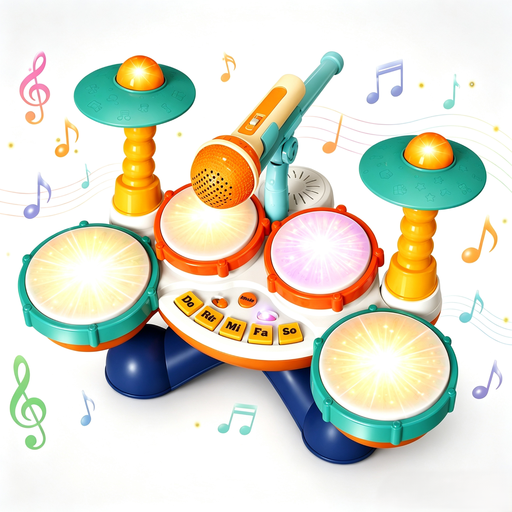
Why this product suits this profile: For families looking for musical toys and shared activities, this set combines drum surfaces, cymbals and a microphone.
An adjustable volume helps you adapt it to your home environment. According to the description, the product is intended for ages 1–4; batteries are not included.
Four illuminated drum surfaces, two cymbals, ten melodies and three play modes according to the product details.
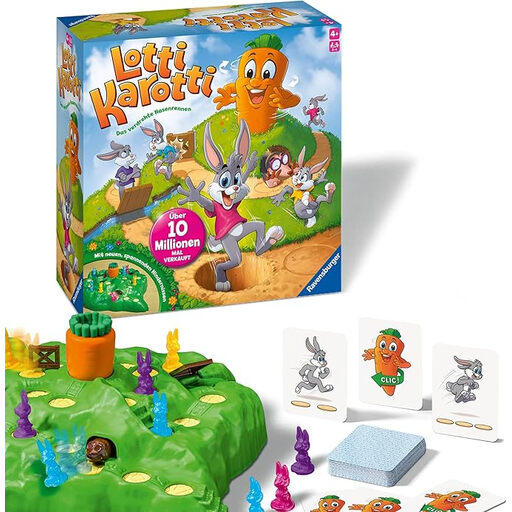
Why this product suits this profile: This children’s board game is aimed at families with children aged four and over, and is ideal for shared games that do not take too long.
The recommended age, number of players from 2 to 4 and playing time of around 20 minutes are all clearly stated.
No batteries required; game materials made from cardboard and plastic according to the product description.
For children aged four and over, a bow-and-arrow game with plastic arrows and suction-cup tips may be an option for supervised outdoor play. According to the product details, the set is intended for ages 4–8 and requires AA batteries for its light and sound effects. Before use, check the arrow tips, bowstring and battery compartment.
For older children and adults, a construction toy such as the Louvre Museum model with 803 pieces is a suitable choice. It contains small components and, according to the warning, is not suitable for children under three; assembly under full supervision is recommended for children aged six and over. As a party game for adults, ‘HITSTER Summer Party’ can be played by 2–10 people aged 16 and over. The HITSTER app with Spotify is required for music playback.
We have put together a complete, regularly updated list of products that fully meet these strict selection criteria and the safety regulations applicable in the EU.
Suitable products encourage grasping, pressing, rolling or observation and do not contain small parts that can easily come loose. An activity panel, a simple rattle or an age-appropriate musical drum may be suitable. The manufacturer’s information and the child’s abilities are the key factors.
Lifespan depends on the materials, how the toy is used and how well it is cared for. With electronic toys, batteries should be removed before prolonged storage. Regularly check edges, buttons, moving parts and battery compartments. It is not possible to give a general estimate of how long a toy will last.
First check the age recommendation, number of players, space required and any small parts. A children’s board game is ideal for playing together, while a construction toy may require more assembly time and supervision. For birthdays, it is also important to check whether batteries, app access or additional accessories are required.