
Lieferung heute & morgen

Qualitätsgarantie

Willkommens-Angebote freischalten: KOSTENLOSE Lieferung | Bis zu 80 % RABATT | Kostenlose 30-Tage-JoyPlus-Testphase
App herunterladen
Choosing a new children's bed is a major decision. It's not just a place to sleep, but a space for safety, growth, and comfort. The market offers a wealth of options, but not all deliver on their promises. As your Joybuy Product Recommendation Officer, I'm here to help you identify common purchasing pitfalls and make an informed decision that meets the needs of your child and your family.
Many parents invest in a bed that shows flaws after just a few months. The most common problems include:
To make a durable and safe choice, you should carefully examine three core areas. These criteria will help you objectively assess the quality of a bed.
Safety is the top priority. A children's bed with a guard rail is essential for younger kids. Don't just check for its presence, but also for the height and stability of the barrier. It should be high enough to prevent rolling out during sleep, but low enough to allow an awake child to get out independently.
Also, check the material thickness and the joints of the bed frame. A solid wood bed for children generally offers greater stability and longevity than beds made from particle board. Rounded edges and corners minimise the risk of injury during play. Look for information on certified safety standards that manufacturers provide for their products.
The choice of material affects not only stability but also the room's atmosphere and the bed's durability.
A modern children's bed is more than just a place to sleep. A multipurpose bed for children can be a smart solution for small rooms. Models with integrated drawers, shelves, or even a pull-out desk make optimal use of the available space.
For families looking for a long-term solution, a convertible bed or a youth bed 90x200 is an option worth considering. These beds are designed to be used from the toddler years well into the teens, making them a sustainable investment.
To make your decision easier, we have compiled a few models based on different requirements and use cases.
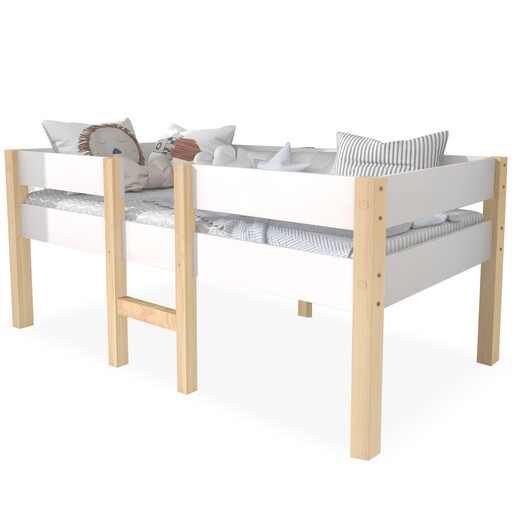
Why This Fits Their Persona: Ideal for the transition from a crib to a first "big kid" bed. The continuous guard rail and low ladder offer maximum safety for children aged 3 and up, while the sturdy solid wood construction gives parents peace of mind.
The construction of solid pine wood and stable corner posts prevents wobbling and ensures long-lasting stability, unlike many visually similar but unstable models.
The wrap-around guard rail with a narrow entrance provides a high level of security. The 44 cm of clearance under the bed creates additional storage space for toy boxes.
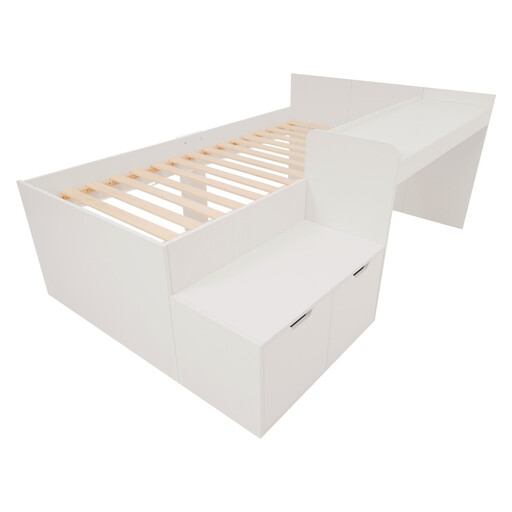
Why This Fits Their Persona: Perfect for parents who want to create order and functionality in smaller children's rooms. This bed combines sleeping, studying, and storage in one piece of furniture, maximising the available space.
This bed solves the problem of impractical storage. The two large drawers and additional storage space under the bed offer genuinely usable room for toys and clothes.
The combination of a bed, desk, and storage is extremely space-saving. The solid wood and MDF construction promises a high load capacity (bed frame up to 120 kg).
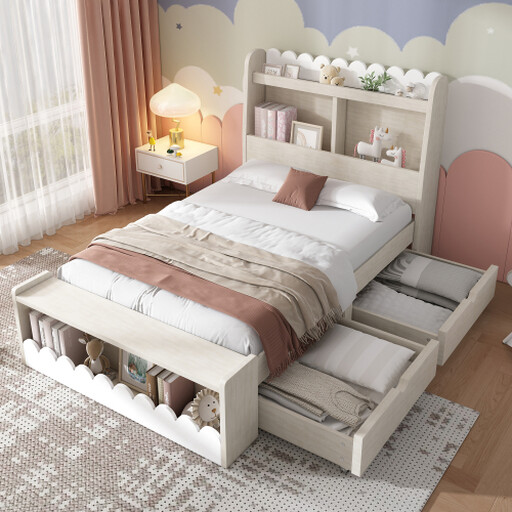
Why This Fits Their Persona: For families looking for a multifunctional solution that will remain useful for years. The combination of a sleeping area, deep drawers, shelves, and a bench offers features that are also relevant for an older child or in a teenager's room.
This bed bypasses the trap of lacking adaptability. The flexibly mountable drawers and the additional shelves at the head and foot are permanently useful features that are not tied to a specific age.
The 50 cm deep drawers offer an exceptional amount of storage space. The shelves with anti-fall stoppers are a thoughtful detail for books or an alarm clock.
We have compiled a complete, up-to-date list of products that fully meet these strict selection criteria and rigorous safety requirements.
1. From what age is a 90x200 cm children's bed suitable? A single bed for children measuring 90x200 cm is generally suitable for children from around 3 to 4 years old. The decisive factor is when your child can safely transition from a crib to an open bed. Models with a good guard rail make this transition much easier and can often be used even earlier. The 90x200 cm size has the advantage of being sufficient well into the teenage years.
2. How high should a guard rail on a children's bed be? A general recommendation is that the guard rail should extend at least 16 cm above the top of the mattress. However, more important than an exact number is the combination of the barrier's height, the mattress thickness, and the stability of its attachment. Check the manufacturer's specifications and ensure the structure is mounted firmly to the bed frame without any play.
3. What is the difference between solid wood and MDF for children's beds? The main difference lies in the material composition and properties.