
Lieferung heute & morgen

Qualitätsgarantie

Willkommens-Angebote freischalten: KOSTENLOSE Lieferung | Bis zu 80 % RABATT | Kostenlose 30-Tage-JoyPlus-Testphase
App herunterladen
A children’s bed needs to do more than provide a suitable sleeping surface. Families also need to consider a practical layout, easy care, a safe design and a lifespan that suits their child’s age. But there are clear differences between a wooden cot, a 90x190 cm children’s bed and a 90x200 cm children’s bed.
As a Joybuy Product Recommendation Officer, I’ve sifted through the key product details to show you what to check before you buy.
A bed with a sleeping area of 90 x 190 cm isn’t necessarily 190 cm long. Extra shelving, drawers or a built-in desk can make the overall dimensions considerably larger. Before you buy, compare both measurements with the space available.
A children’s bed with storage may have drawers, open compartments or space beneath the sleeping area. What matters is the actual internal dimensions and weight limits. If you’re considering a children’s bed with drawers, check:
A convertible children’s bed can be used through several stages of your child’s development. However, conversion parts aren’t always included. For example, the roba 70x140 cm house bed can be converted into a junior bed or sofa using conversion sides sold separately. Factor in these extra costs and whether the parts will still be available later.
The right size depends on your child’s age and height, the room and how long you plan to use the bed:
The mattress should fit the frame without wide gaps. You should also check the mattress thickness recommended by the manufacturer. The first product is designed for a 90 x 190 cm mattress around 15 cm thick. The bed with a desk takes a 90 x 200 cm mattress with a recommended thickness of 13 cm.
A solid wood children’s bed is often associated with sturdiness and a natural look. Even so, it’s worth checking the full materials list: some models combine solid wood with MDF. MDF may be used for side panels, fronts or decorative details.
Look for details such as:
For a wooden cot, parents should also check whether the manufacturer provides information about the coatings used, harmful substance testing and the relevant safety requirements. A general claim about safety is no substitute for specific product documentation.
A children’s bed with a slatted bed base should either come with a well-fitting base or clearly state which type can be used. For cots, it’s also important to check whether the base height can be adjusted and when to switch to a junior bed. Once your child can climb out independently, you should reconsider whether it’s still suitable to use the bed as a cot.
Don’t confuse maximum weight capacity with recommended use. For example, the bed with a desk has separate weight limits for the bed, desk and top of the drawers. Children shouldn’t climb or jump on the bed, desk, shelves or bench.
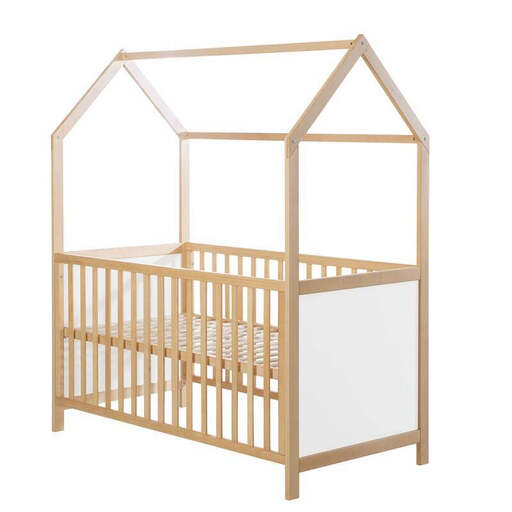
Why this product suits this type of buyer: Its compact sleeping area, three adjustable base heights and included slatted bed base make it a good fit for families looking for a cot or toddler bed that doesn’t take up too much room.
The three base heights make it easier to adapt the bed as your child grows. The conversion option is clearly outlined, but you’ll need to budget separately for the conversion sides.
70 x 140 cm sleeping area, natural wood, included slatted bed base and the option to convert it into a junior bed or sofa.

Why this product suits this type of buyer: This model combines a wooden frame with two deep drawers, open shelves and a storage bench at the foot of the bed. Check the bench’s weight limit separately before using it.
The drawers can be fitted on either the left or right. The overall dimensions of 230 x 98 x 100 cm make it easy to see how much floor space you’ll need.
Two drawers, 13 cm-deep shelves, included slatted bed base and a recessed mattress platform for a 90 x 190 cm mattress.

Why this product suits this type of buyer: This bed is a good choice for children’s bedrooms where you want to combine a bed, workspace and storage in a compact footprint.
Separate weight limits for the bed, desk and drawers help you use each part appropriately. The overall dimensions are 137 x 205 x 82,5 cm.
90 x 200 cm sleeping area, integrated desk, two drawers, extra storage under the bed and rounded edges.
All three models need to be assembled. Before using the bed, parents should:
Surfaces can usually be cleaned with a slightly damp cloth. Check the screw joints regularly, especially after moving the bed or assembling it again.
We’ve put together a complete, regularly updated list of products that meet these strict selection criteria and fully comply with the safety regulations in force in the EU.
It depends on the sleeping area, construction and weight limit. A 70 x 140 cm bed is more compact and is often designed for early childhood. A 90 x 190 cm or 90 x 200 cm model may last longer, provided its weight limit is suitable. Always follow the manufacturer’s guidance and take your child’s height into account.
As well as the bed size, check the overall dimensions and desk surface. It’s also important to check the desk’s separate weight limit, allow enough room to move around and make sure the bed is placed on a stable, level surface. The desk shouldn’t be used for climbing.
Not necessarily. Drawers need enough clearance at the side or at the foot of the bed to slide out. Before buying, measure doorways, radiators, gaps from the walls and the actual depth of the room. In a small room, a model with open shelves or storage under the bed may be more practical.