
Lieferung heute & morgen

Qualitätsgarantie

Willkommens-Angebote freischalten: KOSTENLOSE Lieferung | Bis zu 80 % RABATT | Kostenlose 30-Tage-JoyPlus-Testphase
App herunterladen
A children’s bed needs to offer more than just a sleeping surface. For expectant parents and families with young children, the right mattress, sturdy components, safe use and the longest possible service life all matter. At the same time, many models advertise numerous features that are not always practical in everyday use.
Before placing your order, check these three typical purchasing and marketing pitfalls:
For a baby bed or bedside crib, the mattress should fit the intended sleeping surface exactly. This applies, for example, to a 60 x 120 cm baby bed or a bedside crib with mattress measuring 45 x 90 cm. Only use the mattress size specified by the manufacturer and follow the guidance on the maximum mattress height.
For older children, a 90 x 200 cm children’s bed provides more space and can be used for several years. However, it also requires more room in the children’s bedroom. Before buying, check not only the sleeping surface but also the external dimensions, the position of the ladder and the distance from wardrobes or radiators.
A children’s bed with fall protection should have a securely attached, continuous or sufficiently long safety rail. With a junior bed, the entrance must still remain accessible. A ladder is practical when it has wide, firmly attached steps. However, it is not a toy and should initially be introduced to younger children under supervision.
With a cot, check the bars, locks and removable elements regularly. Only remove as many bars as are necessary for safe access in and out of the bed.
A wooden children’s bed may be made from solid wood, plywood, MDF or chipboard. These terms describe different materials and should not automatically be considered equivalent. The product details, workmanship, stability of the joints and proper assembly are what matter.
Also look out for any stated standards. According to the product details, the first bedside crib presented here is manufactured to EN 1130:2019. According to its product description, the multifunctional model is designed to comply with EN 716–1:2017 + AC:2019 and is eph-certified. Such information does not replace the assembly instructions: safety straps, castor brakes, screws and connecting elements must be used exactly as described.
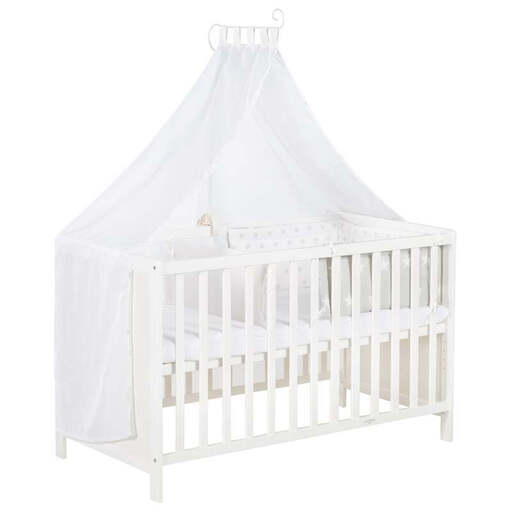
Why this product suits the profile: This model comes with a slatted base, mattress, bed guard, canopy and canopy frame. This means several components do not need to be sourced separately.
The sleeping surface is clearly specified as 60 x 120 cm. Six height settings between 22 and 42 cm, along with five removable bars, are also documented.
Can be used as a bedside crib, cot and toddler bed; stated maximum weight of 50 kg and age range from 0 to 5 years.
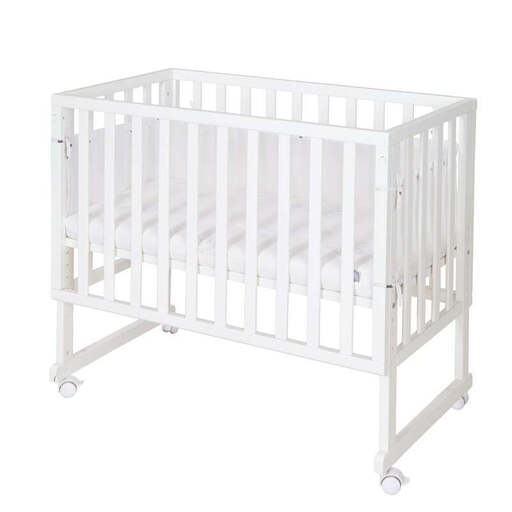
Why this product suits the profile: This bedside crib is designed for the first stage of a baby’s life and combines a mattress, fabric fall protection and a height-adjustable frame.
The recommended mattress measures 45 x 90 cm. The model also has seven height settings from 22.4 to 44.6 cm, four castors and locking brakes.
Mattress included; designed according to EN 1130:2019 according to the product details; can later be used as a sofa with a stated load capacity of 65 kg.

Why this product suits the profile: According to the product details, this mid-height children’s bed is intended for children aged three and over. It offers a 90 x 200 cm sleeping surface and storage space beneath the bed.
The mattress is expressly not included. This allows you to choose a suitable 90 x 200 cm mattress specifically, rather than relying on an unclear standard size.
Solid pine wood, continuous fall protection, low ladder and 44 cm of clearance beneath the sleeping surface; stated maximum load of 120 kg.
We have put together a complete, regularly updated list of products that fully meet these strict selection criteria and the safety regulations applicable in the EU.
A children’s bed should be assembled by adults in accordance with the instructions. Check and retighten the screws and connecting elements after the initial period of use. With a baby bedside crib, the supplied straps must be attached to the parents’ bed. Observe the stated maximum side thickness and only use the castors with the brake engaged when the bed is stationary.
With a height-adjustable baby bed, check that every setting is correctly secured. Once a baby can pull themselves up, sit or kneel independently, a bedside crib may no longer be suitable, depending on the manufacturer’s guidance. A children’s bed with a ladder should be positioned securely and kept at a sufficient distance from windows, radiators and other furniture.
This depends on the design, entrance height and the manufacturer’s guidance. According to the product description, the mid-height model presented here is intended for children aged three and over. For babies and younger toddlers, a cot or suitable bedside crib is usually the more appropriate design. Supervise children when they use a ladder for the first time.
The usable life depends on the sleeping surface, weight limit, the child’s development and the conversion functions. According to the product details, a model measuring 60 x 120 cm may be designed for use from birth until around the age of five. A 90 x 200 cm children’s bed offers more sleeping space, but is not automatically suitable for babies. The manufacturer’s guidance remains decisive.
No. Even if the mattress and slatted base are included, the bed must be fully assembled and securely attached to the parents’ bed. Before use, check all components, the height, that the straps are firmly secured and that the castors are locked. A damaged or unsuitable mattress must not be used.